
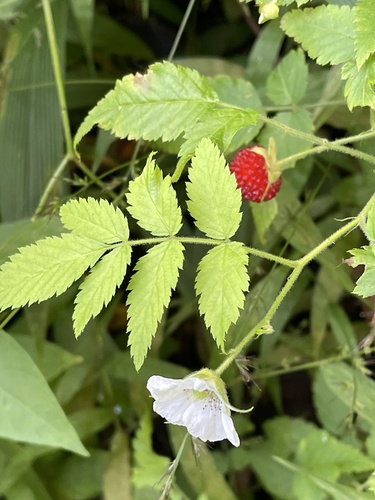


Roseleaf Bramble
rubus rosifolius
The Roseleaf Bramble (Rubus rosifolius) is a sprawling, prickly shrub belonging to the rose family. Native to the rainforest margins and wet forests of eastern Australia and parts of Asia, this resilient plant is celebrated for its delicate white flowers and bright, edible red berries. As a pioneer species, it quickly colonizes disturbed grounds, creating dense thickets that provide shelter and food for local wildlife. While its sweet but mildly flavored fruits are a foraging treat, its extensive root system and rapid growth have also allowed it to become an aggressive, invasive weed in several tropical and subtropical regions around the world.
Habitat: Found predominantly in tropical and subtropical rainforest margins, wet sclerophyll forests, and heavily disturbed soils such as roadsides and landslips.
This sprawling perennial shrub typically grows up to 2 to 3 meters in height, featuring reddish, prickly stems covered in fine hairs. Its bright green compound leaves are deeply veined, serrated along the edges, and closely resemble the leaves of true roses. It blooms with attractive, five-petaled white flowers that give way to somewhat elongated aggregate fruits. These thimble-shaped berries turn from green to a vivid, glossy ruby-red when fully ripe and detach easily from their central receptacle.
Category
PlantsRarity
Common
Danger
1/5 · Very low
Snaps
Be the first to snap!
Because it thrives in disturbed soils, it is often one of the very first plants to appear after a forest fire or logging operation.
Despite its sweet and juicy appearance, the fruit of the Roseleaf Bramble is often described by foragers as milder and less flavorful than commercial raspberries, sometimes leaving a slightly dry aftertaste.
In places like Hawaii and Puerto Rico, this plant thrives a little too well, often forming dense mats that choke out fragile native understory vegetation.
The species name 'rosifolius' translates directly to 'rose-leaved', a nod to the fact that both its leaves and its prickly stems heavily resemble those of traditional garden roses.
Rapidly establishes itself in disturbed, burned, or cleared soils, helping to prevent erosion but often outcompeting slower-growing plants.
Stems and leaves are armed with sharp prickles that effectively deter many large herbivores from consuming its foliage.
Capable of aggressive vegetative reproduction, it sends up new shoots from a sprawling underground root system to form dense, impenetrable thickets.
As a photosynthetic plant, it produces its own energy by converting sunlight, water, and atmospheric carbon dioxide.
Zosterops lateralis
Disperses seeds over wide areas after consuming the ripe, red fruit.
Apis mellifera
Pollinates the plant's white flowers while collecting nectar.

Epiphyas postvittana
Foliage acts as a food source and host for developing caterpillars.
No trait badges are assigned for this object yet.
No aliases listed yet.
Collections for this object will appear here as more themes are added.
Danger
1/5 · Very low
No special safety notes yet.
Start with the whole plant, then compare leaf arrangement, leaf edges, stems and any flowers or fruit. Opposite leaves grow in pairs; alternate leaves come one at a time along the stem. These details tell you far more together than a single green leaf does. Plant Identifier: upload a photo and compare the visible details.
100-300 cm
3-15 years
As a photosynthetic plant, it produces its own energy by converting sunlight, water, and atmospheric carbon dioxide.
Found predominantly in tropical and subtropical rainforest margins, wet sclerophyll forests, and heavily disturbed soils such as roadsides and landslips.
Zoom in to split clusters and explore where this object has been snapped.
Recent snaps will appear here as new observations are added.
Take the discovery with you
Snap it with Snappit to identify it, learn what makes it special, and add the discovery to your collection.



















