

Rust Weed
polypremum procumbens
Rust Weed (Polypremum procumbens) is a subtle yet fascinating ground-hugging herb native to the sandy, open spaces of the Americas. Often overlooked due to its low profile and delicate, wire-like stems, this resilient little plant is a master of adaptation, thriving where other plants struggle. It forms intricate, moss-like mats in nutrient-poor soils, from pine flatwoods to gravelly roadsides, playing a quiet but crucial role in stabilizing loose sands. What makes Rust Weed truly special is its dramatic seasonal transformation. While it spends the spring and summer clothed in deep green foliage, the onset of autumn or dry spells triggers a brilliant shift, turning the entire plant a warm, rusty-orange or coppery hue. This striking color change makes it look as though a metallic dust has been sprinkled across the ground, offering a beautiful visual cue to observant hikers and nature lovers.
Habitat: Found in open, sandy environments such as pine flatwoods, coastal dunes, roadsides, and disturbed fields.
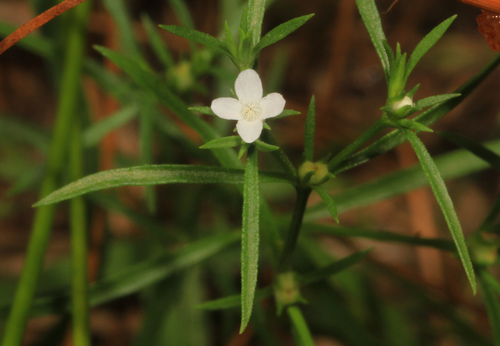
Rust Weed is characterized by its prostrate, highly branched, wire-like stems that form low, tufted mats typically reaching only 10 to 30 centimeters in length. Its leaves are small, linear, and grass-like, measuring about 1 to 2 centimeters long, arranged in opposite pairs along the stems and often joined at the base by a tiny membrane. Throughout the warmer months, the plant bears incredibly small, solitary white flowers nestled directly in the leaf joints. Each star-shaped flower has a four-lobed corolla with a yellow-haired throat, which eventually matures into a small, dry, two-valved seed capsule containing many tiny seeds.
Category
PlantsRarity
Common
Danger
1/5 · Very low
Snaps
Be the first to snap!
Despite its common name, Rust Weed is actually bright green for most of the year, only turning its signature rust-orange color during periods of cold or drought stress.
It is the only species in the genus Polypremum, making it a monotypic genus within the Tetrachondraceae family.
Its species name 'procumbens' refers to its prostrate growth habit, meaning the stems trail along the ground without rooting at the nodes.
Under drought stress or cooler autumn temperatures, the plant synthesizes protective pigments that turn its leaves a vibrant rust-orange, shielding its tissues from intense light.
Its prostrate, wiry structure hugs the ground closely, protecting it from heavy winds, grazing animals, and physical disturbance like foot traffic.
An efficient root system allows it to extract moisture and scarce minerals from highly acidic, sandy, or gravelly soils where other plants cannot survive.
As a photoautotroph, Rust Weed produces its own organic nutrients using sunlight, water, and carbon dioxide through the process of photosynthesis.

Lasioglossum species
Visits the tiny white flowers for nectar and aids in the pollination of Rust Weed.

Odocoileus virginianus
May occasionally graze on the foliage in sandy pine flatwoods and disturbed margins.
Cuscuta compacta
A parasitic vine that can wrap around Rust Weed stems to draw nutrients directly from its tissues.
No trait badges are assigned for this object yet.
No aliases listed yet.
Collections for this object will appear here as more themes are added.
Danger
1/5 · Very low
No special safety notes yet.
Start with the whole plant, then compare leaf arrangement, leaf edges, stems and any flowers or fruit. Opposite leaves grow in pairs; alternate leaves come one at a time along the stem. These details tell you far more together than a single green leaf does. Plant Identifier: upload a photo and compare the visible details.
10-30 cm
0.01-0.05 kg
1-3 years
As a photoautotroph, Rust Weed produces its own organic nutrients using sunlight, water, and carbon dioxide through the process of photosynthesis.
Found in open, sandy environments such as pine flatwoods, coastal dunes, roadsides, and disturbed fields.
Zoom in to split clusters and explore where this object has been snapped.
Recent snaps will appear here as new observations are added.
Take the discovery with you
Snap it with Snappit to identify it, learn what makes it special, and add the discovery to your collection.