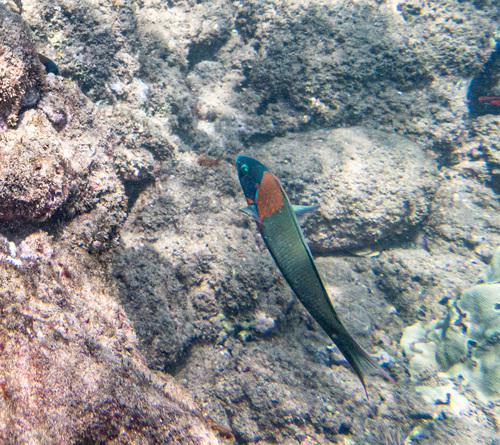


Saddle Wrasse
thalassoma duperrey
The Saddle Wrasse (Thalassoma duperrey), known locally in Hawaii as hinalealauwili, is one of the most common and curious reef fish found in the Hawaiian archipelago. Extremely abundant in shallow coastal waters, these active, diurnal swimmers are famous for their bold, inquisitive nature. They often follow divers and snorkelers, hoping the disturbance will kick up tasty invertebrates from the sandy bottom or reef crevices. As protogynous hermaphrodites, their life history is a fascinating journey of transformation, transitioning from female to male when social structures demand. Their ubiquitous presence and playful behavior make them an absolute favorite for marine life observers in Hawaiian waters.
Habitat: Found in shallow coral reefs, rocky shorelines, and sandy-bottomed lagoons throughout the Hawaiian Islands.
Easily recognized by their vibrant, multicolored bodies, adult Saddle Wrasses feature a deep blue-green head, a prominent bright orange-red vertical band (or 'saddle') just behind the gill covers, and a greenish-blue body. Their tail fin is lyre-shaped, particularly in terminal phase males. Juveniles look strikingly different, displaying a horizontal dark stripe along a pale body, which helps them blend in. They grow to a maximum length of about 25 centimeters.
Category
FishRarity
Common
Danger
1/5 · Very low
Snaps
2
If the dominant male in a social group dies, the largest female will begin changing color and behavior to take his place within hours, fully transitioning into a fertile male in a matter of weeks.
The Hawaiian name for this fish is hinalealauwili, which refers to its erratic, twisting swimming pattern around the reef.
They are so bold and inquisitive that snorkelers often find themselves surrounded by them just by gently kicking sand with their fins.
They begin life as females and can transition into colorful terminal males when the dominant male of a harem dies.
They actively follow larger marine animals or human divers to feed on small organisms exposed by disturbed substrate.
They use their pectoral fins in a wing-like flapping motion to maneuver agilely around complex coral structures.
They are opportunistic carnivores that feed primarily on a wide variety of small benthic invertebrates found on the reef and in the sand.
Age differences: Juveniles often act as cleaner fish, picking parasites off larger fish, whereas adults feed strictly on benthic invertebrates.
Triaenodon obesus
Preys upon this small wrasse as a regular part of its reef diet.
Paracirrhites arcatus
Competes directly for food resources, hunting for small invertebrates in the same reef crevices.
Gymnothorax javanicus
Juvenile wrasses clean parasites off the body and gills of this large eel.
No trait badges are assigned for this object yet.
No aliases listed yet.
Collections for this object will appear here as more themes are added.
Danger
1/5 · Very low
No special safety notes yet.
Look at body shape, where the fins sit and their outline, mouth position, stripes and spots. Young fish and breeding adults can wear different patterns, and aquarium color varieties can look nothing like wild fish. Fish Identifier: upload a photo and compare the visible details.
10-25 cm
0.1-0.3 kg
3-7 years
15 km/h
They are opportunistic carnivores that feed primarily on a wide variety of small benthic invertebrates found on the reef and in the sand.
Found in shallow coral reefs, rocky shorelines, and sandy-bottomed lagoons throughout the Hawaiian Islands.
Foraging
Zoom in to split clusters and explore where this object has been snapped.

Hawaii, US
You might spot Gold Dust Day Gecko, Yellow Tang, and Black Triggerfish.
View guide →

Hawaii, US
You might spot ʻōhiʻa Lehua and Stinking Passionflower.
View guide →
Take the discovery with you
Snap it with Snappit to identify it, learn what makes it special, and add the discovery to your collection.