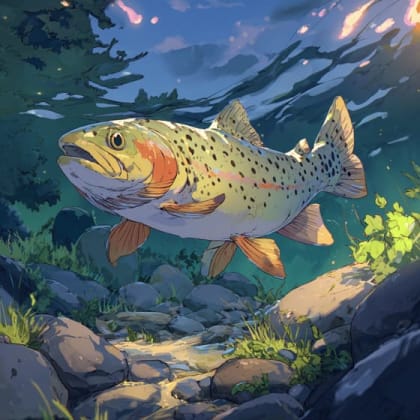
Wolf eel
Anarrhichthys ocellatus
The wolf eel is a long, snake-like fish that lives in the ocean. It has a big mouth and sharp teeth, but it’s not really a wolf! These eels like to hide in rocky places.
Habitat: Coastal areas
The Wolf eel has an elongated, muscular body with a large head and powerful jaws. It is typically gray or brown, covered in distinctive dark spots, called ocelli, that give it a mottled appearance. Its large, soulful eyes sit atop a prominent snout.
Category
FishRarity
Common
Danger
3/5 · Moderate
Snaps
Be the first to snap!
A wolf eel pair often mates for life and cares for their eggs together!
Despite its name, the wolf eel is actually a type of fish, not a true eel!
Their powerful bite is strong enough to crack open a diver's protective fin!
Wolf eel babies are bright orange, looking totally different from their parents!
Wolf eel has incredibly strong jaws and specialized teeth that help them crush tough shells of prey.
Wolf eel can blend into its rocky den and surrounding reefs that helps them hide from bigger predators.
Wolf eel can dig and maintain a safe den in rocky crevices that helps them raise their young securely.
These ocean bottom dwellers use their strong jaws to crush and eat hard-shelled seafood like crabs and clams!
Age differences: Young wolf eels eat smaller crustaceans before developing strong enough jaws for larger prey.
Strongylocentrotus purpuratus
A favorite meal, crushed with powerful jaws.

Metacarcinus magister
Its hard shell is no match for the eel's strong bite.
Enteroctopus dofleini
Young wolf eels can be prey for this clever hunter.

Carcharodon carcharias
Larger sharks may prey on adult wolf eels.
Social animals live in organized groups, cooperating for survival benefits such as foraging, defense, and raising offspring.
Solitary animals live alone for most of their lives, only interacting with others for mating or parental care.
Camouflaged describes organisms that possess coloring or patterns that allow them to blend into their environment.
Piscivorous organisms are animals that primarily subsist on a diet of fish.

Coastal habitats are dynamic environments located along the interface between land and sea, influenced by tides, waves, and saltwater.

This trait identifies organisms whose diet consists entirely or primarily of animal tissue.

Marine habitats encompass all saltwater environments of the Earth's oceans, supporting an immense diversity of aquatic life.
No aliases listed yet.
Danger
3/5 · Moderate
Always stay at a safe distance from ocean animals and never touch them without permission.
The easiest way to identify Wolf eel is to use the Snappit nature identifier app.
150-240 cm
10-19 kg
20-25 years
These ocean bottom dwellers use their strong jaws to crush and eat hard-shelled seafood like crabs and clams!
1 km/h
Coastal areas
Foraging
Zoom in to split clusters and explore where this object has been snapped.
Recent snaps will appear here as new observations are added.
Oregon, US
You might spot Sea Otter, Harbor Seal, and Sea Lion.
View guide →

Washington, US
You might spot Sea Otter, Harbor Seal, and Northern Fur Seal.
View guide →
Utah, US
You might spot Great White Shark and Gentoo Penguin.
View guide →

California, US
You might spot Sea Otter, Octopus, and Northern Sea Nettle.
View guide →

Alaska, US
You might spot Steller Sea Lion, Harbor Seal, and Tufted Puffin.
View guide →

California, US
You might spot Pacific Hairy Hermit Crab, Sea Urchin, and Sea Cucumber.
View guide →
Take the discovery with you
Snap it with Snappit to identify it, learn what makes it special, and add the discovery to your collection.