

South American Tapir
tapirus terrestris
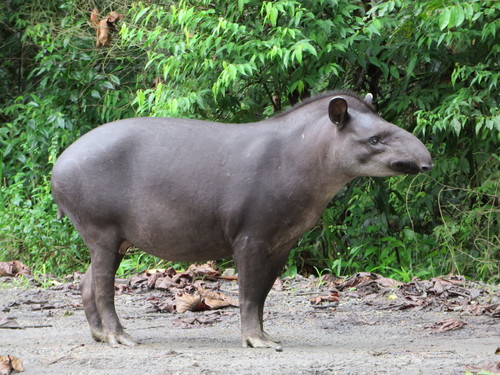
The South American Tapir, also known as the lowland tapir, is the largest native terrestrial mammal in the Amazon. Looking like a blend of a wild boar and an elephant, this gentle giant is a vital cornerstone of its ecosystem. Tapirs are exceptional swimmers, often retreating to rivers and lakes to escape predators, cool off, or forage for aquatic vegetation. Known affectionately as the 'gardeners of the forest,' they play a critical ecological role by eating vast quantities of fruit and dispersing seeds across large distances, which helps maintain the health and diversity of their tropical habitats.
Habitat: Found in tropical rainforests, grasslands, and wetlands of South America, always near water sources like rivers and swamps.
This heavy-bodied mammal features a dark brown to reddish-brown coat, a short, bristly crest running from the crown of its head down its neck, and a highly distinctive prehensile snout. Adults stand about 77 to 108 centimeters tall at the shoulder, with compact tails and large, rounded ears rimmed with white fur. While adults are solid-colored, their calves are born with a striking pattern of white spots and stripes that provides excellent camouflage against the dappled forest floor.
Category
MammalsRarity
Common
Danger
1/5 · Very low
Snaps
Be the first to snap!
Baby tapirs look like fuzzy watermelons, covered in stripes and spots that fade entirely by the time they reach six months of age.
Lowland tapirs are known to jump into deep water to seek relief from irritating skin parasites, allowing small fish to pick them clean.
Their closest living relatives are not pigs or elephants, but rather horses, zebras, and rhinoceroses, which share their odd-toed ungulate lineage.
Its flexible, elongated nose and upper lip function like a mini-trunk to grab leaves, pull down branches, and pluck fruits.
An excellent swimmer, the tapir can walk along riverbeds and submerge itself entirely, using its snout as a snorkel to breathe.
Possesses incredibly thick skin around its neck and shoulders, helping to shield it from thorny underbrush and predator attacks.
The tapir is a browser that feeds on leaves, shoots, buds, twigs, and fruits, actively foraging throughout the understory and in water bodies.
Age differences: Calves nurse on milk for the first few months, gradually introducing soft forest leaves and fruits into their diet.

Panthera onca
Jaguars are the apex predators of South American forests and are one of the few natural predators strong enough to hunt adult tapirs.
Mauritia flexuosa
Tapirs feed extensively on the nutrient-rich fruits of the Moriche Palm and disperse the seeds intact across the landscape.

Hydrochoerus hydrochaeris
In shared wetland habitats, capybaras and tapirs occasionally compete for access to succulent semi-aquatic grasses.
No trait badges are assigned for this object yet.
No aliases listed yet.
Collections for this object will appear here as more themes are added.
Danger
1/5 · Very low
No special safety notes yet.
Compare ears, muzzle, tail, feet and coat markings. Size is hard to judge without something nearby for scale, and young mammals may not have adult coloring yet. Mammal Identifier: upload a photo and compare the visible details.
180+ cm
150+ kg
25+ years
40 km/h
The tapir is a browser that feeds on leaves, shoots, buds, twigs, and fruits, actively foraging throughout the understory and in water bodies.
Found in tropical rainforests, grasslands, and wetlands of South America, always near water sources like rivers and swamps.
Foraging
Zoom in to split clusters and explore where this object has been snapped.
Recent snaps will appear here as new observations are added.
Take the discovery with you
Snap it with Snappit to identify it, learn what makes it special, and add the discovery to your collection.