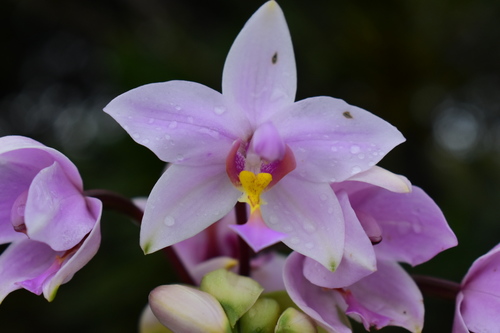


Spathoglottis Plicata
spathoglottis plicata
Spathoglottis Plicata, commonly known as the Philippine ground orchid or large purple orchid, is a resilient and stunning terrestrial orchid native to the warm, tropical landscapes of Asia, northern Australia, and the Pacific. Unlike many of its tree-dwelling orchid relatives that rely on forest canopies, this hardy species plants its roots firmly in the soil, allowing it to colonize sunny grasslands, forest edges, and even disturbed roadsides with remarkable ease. This adaptability, combined with its long-lasting and vibrant flower clusters, has earned it a beloved place in tropical gardens worldwide. Whether growing wild in its native habitats or thriving in urban landscapes, this orchid is a testament to nature's capacity for vibrant beauty and tough resilience.
Habitat: Found in open, sun-drenched grasslands, forest margins, and disturbed roadsides across tropical and subtropical regions.
This terrestrial orchid features distinct, pleated (plicate) green leaves that grow up to 80 centimeters long, closely resembling young palm fronds. From the center of its bulbous base rise tall, erect flower spikes that can reach up to a meter in height. These spikes bear clusters of vibrant purple to pink flowers, each about 3 to 5 centimeters wide. The blossoms are characterized by three sepals, two petals, and a prominent T-shaped lip, which is often accented with yellow markings at the center to guide pollinators.
Category
PlantsRarity
Common
Danger
1/5 · Very low
Snaps
1
Because it produces thousands of tiny, wind-dispersed seeds, it has successfully naturalized and is sometimes considered a weed in Florida and Hawaii.
Its species name, 'plicata', literally means 'pleated' or 'folded', describing the characteristic accordion-like texture of its long leaves.
Unlike typical epiphytic orchids that grow suspended on tree branches, this species is strictly terrestrial and grows directly in the dirt.
The deeply pleated, fan-like structure of its leaves channels heavy tropical rainfall away from the crown of the plant, preventing rot.
It possesses a rapid growth cycle and high seed viability, allowing it to quickly establish and stabilize itself in newly disturbed soils.
It utilizes a beneficial relationship with soil fungi to extract carbon and vital nutrients during its early, non-photosynthetic germination stages.
As a photoautotroph, this orchid synthesizes its own sugars from carbon dioxide and water using sunlight absorbed by its green chlorophyll.
Age differences: Relies entirely on symbiotic mycorrhizal fungi for organic carbon during seed germination before developing leaves and starting photosynthesis.
Apis cerana
Acts as a primary pollinator, visiting flowers for nectar and transferring pollen.
Tulasnella calospora
Forms vital mycorrhizal associations with the orchid's roots to assist in nutrient absorption.
No trait badges are assigned for this object yet.
Collections for this object will appear here as more themes are added.
Danger
1/5 · Very low
No special safety notes yet.
The easiest way to identify Spathoglottis Plicata is to use the Snappit nature identifier app.
30-100 cm
0.2-1 kg
5-15 years
As a photoautotroph, this orchid synthesizes its own sugars from carbon dioxide and water using sunlight absorbed by its green chlorophyll.
Found in open, sun-drenched grasslands, forest margins, and disturbed roadsides across tropical and subtropical regions.
Zoom in to split clusters and explore where this object has been snapped.

Hawaii, US
You might spot Gold Dust Day Gecko, Star Of Bethlehem, and Spanish Shawl.
View guide →

Hawaii, US
You might spot Spathoglottis Plicata, Thatch Screwpine, and Brown Anole.
View guide →
Take the discovery with you
Snap it with Snappit to identify it, learn what makes it special, and add the discovery to your collection.











.jpg&width=800)



_001.jpg&width=800)




