

Spotted Dove
spilopelia chinensis
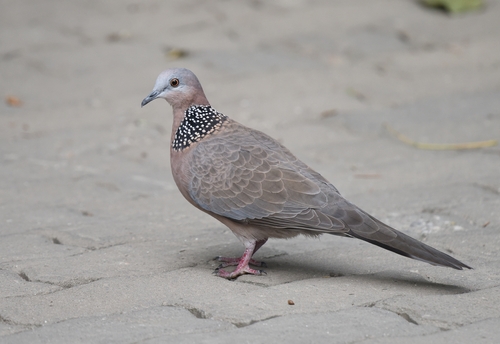
The Spotted Dove is a charming and familiar sight across its wide native range in Southern Asia, as well as in many global urban areas where it has been introduced. Characterized by its gentle demeanor and soft, rhythmic cooing, this medium-sized dove is easily recognized by its distinctive black-and-white checkered collar. It is a highly adaptable bird that has successfully integrated into human-modified landscapes, thriving in parks, gardens, and agricultural fields. Often seen foraging on the ground in pairs or small groups, the Spotted Dove plays an important role in its ecosystem as a seed disperser. Its placid nature and tolerance of human activity make it a beloved backyard visitor, bringing a touch of peaceful wildlife to bustling cities.
Habitat: Commonly found in open woodlands, agricultural lands, suburban gardens, and urban parks where there is ground access for foraging.
This elegant dove features a rosy-grey breast that fades to a light greyish belly, with warm brown upperparts and wings. Its most defining characteristic is the collar of white spots over a black patch on the back and sides of its neck. It has a notably long, dark tail tipped with white, which is particularly visible in flight, and reddish-pink legs and feet.
Category
BirdsRarity
Common
Danger
1/5 · Very low
Snaps
3
During courtship, the male flies up vertically with a loud clapping of wings, then glides downward in a wide, sweeping arc to impress the female.
Juvenile Spotted Doves do not have the signature checkered collar; they only develop this distinctive pattern as they mature into adulthood.
They are remarkably comfortable nesting near humans, often building their flimsy twig nests on window ledges, hanging flower baskets, or air conditioners.
Unlike most birds that must scoop water and tilt their heads back to swallow, the Spotted Dove can submerge its bill and drink continuously by suction.
Both parents produce a highly nutritious, protein-rich milk-like substance in their crops to feed their newly hatched chicks.
When startled on the ground, they can perform a rapid, near-vertical takeoff accompanied by a loud clapping sound made by their wings to evade predators.
Primarily feeds on seeds, grains, and fallen fruits gleaned from the ground, occasionally consuming small insects.
Age differences: Chicks are fed crop milk for the first few days before transitioning to regurgitated seeds.

Felis catus
Preys on the eggs, fledglings, and adult doves, particularly in suburban and urban environments.
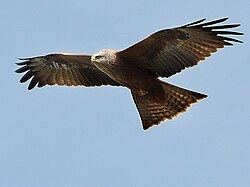
Milvus migrans
Preys on adult doves in their native Asian range.
Columba livia
Competes for foraging space, fallen grain, and nesting sites in urban environments.
No trait badges are assigned for this object yet.
No aliases listed yet.
Collections for this object will appear here as more themes are added.
Danger
1/5 · Very low
No special safety notes yet.
Compare the silhouette, bill shape, tail length, wing bars and markings around the eyes. The same small brown bird at your feeder can look quite different in breeding plumage, winter plumage or its first year. Bird Identifier: upload a photo and compare the visible details.
28-32 cm
38-44 cm
0.11-0.16 kg
3-10 years
60 km/h
Primarily feeds on seeds, grains, and fallen fruits gleaned from the ground, occasionally consuming small insects.
Commonly found in open woodlands, agricultural lands, suburban gardens, and urban parks where there is ground access for foraging.
Zoom in to split clusters and explore where this object has been snapped.

Hawaii, US
You might spot Hawaiian Garden Spider, Beach Naupaka, and Black Noddy.
View guide →

US
You might spot Brown Anole, Zebra Dove, and Red-Crested Cardinal.
View guide →

Hawaii, US
You might spot Spotted Dove, Zebra Dove, and Java Sparrow.
View guide →
Take the discovery with you
Snap it with Snappit to identify it, learn what makes it special, and add the discovery to your collection.