





stag's-horn clubmoss
Lycopodium clavatum
Stag's-horn clubmoss is a green plant that looks like tiny trees with soft, forked branches. It grows in shady places and is very special because it has been around for millions of years!
Habitat: Forests
The stag's-horn clubmoss is a low-growing plant with creeping stems that send up erect, branched stems covered in tiny, scale-like, bright green leaves. Its yellow-brown, club-shaped spore cones resemble miniature antlers, making it visually distinct from true mosses.
Category
PlantsRarity
Common
Danger
1/5 · Very low
Snaps
1
Despite its name, it's not a true moss; it's an ancient plant related to ferns!
Its powdery spores are so flammable, they were once used in fireworks and flash photos!
This plant is a living fossil, growing on Earth when dinosaurs roamed!
Unlike flowering plants, it reproduces with tiny spores, not seeds, like ancient ferns!
The stag's-horn clubmoss has tiny, wind-dispersed spores that help it spread far and reproduce without seeds, an ancient adaptation.
This clubmoss stays green all year round, even in winter, helping it absorb sunlight when other plants are dormant.
It has a creeping stem system that helps it form dense mats, anchoring it firmly and protecting the forest floor.
Rhizophagus intraradices
helps clubmoss acquire nutrients from soil
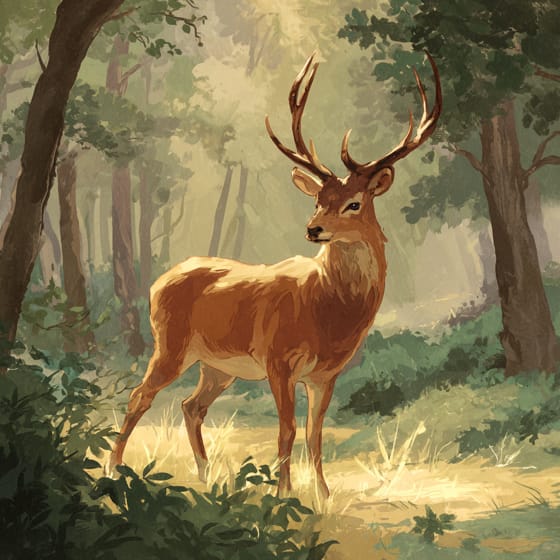
Cervus elaphus
may browse on its evergreen foliage in winter
Apodemus sylvaticus
provides cover and microhabitat on the forest floor
Grass-like plants are herbaceous plants that visually resemble true grasses, typically having long, narrow leaves.
Shade tolerant plants are adapted to grow and thrive in areas with low light levels, requiring less direct sunlight.
Evergreen plants retain their foliage throughout the year, never shedding all their leaves at once.
Spore-producing organisms reproduce by releasing small, often single-celled, reproductive units called spores.

This trait signifies organisms belonging to a very old evolutionary group with ancestors dating back millions of years.

Describes organisms that break down dead organic material, recycling nutrients back into the ecosystem.

Forest habitats are terrestrial environments dominated by dense tree cover, supporting a high diversity of plant and animal life.

This trait characterizes organisms with an exceptionally long lifespan compared to others of their kind.
No aliases listed yet.
Danger
1/5 · Very low
Always look but don't touch plants unless you know they're safe.
The easiest way to identify stag's-horn clubmoss is to use the Snappit nature identifier app.
5-15 cm
30-100 cm
No
Mild
Perennial
Wind
Forests
Zoom in to split clusters and explore where this object has been snapped.

West Virginia, US
You might spot Eastern Red-Backed Salamander and Wehrle's Salamander.
View guide →
Ontario, CA
You might spot Cardinal Flower, Canadian Bunchberry, and Twinflower.
View guide →

British Columbia, CA
You might spot Western Toad, Nettles, and Lady Fern.
View guide →
Take the discovery with you
Snap it with Snappit to identify it, learn what makes it special, and add the discovery to your collection.








.jpg&width=800)



_001.jpg&width=800)

