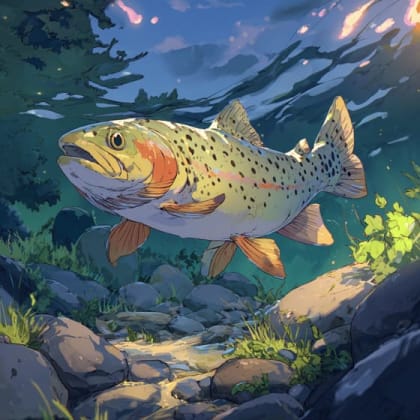
Stargazer Fish
Uranoscopus
The Stargazer Fish is a unique underwater creature known for its ability to bury itself in the sand and ambush prey. It has eyes on top of its head to spot food and predators easily.
Habitat: Coastal areas
The Stargazer Fish has a flattened, cylindrical body, often sandy-colored or mottled brown, with large, upward-facing eyes on the top of its head. Its wide, upward-pointing mouth and rough skin allow it to perfectly blend into sandy or muddy seabeds, making it visually distinct.
Category
FishRarity
Common
Danger
3/5 · Moderate
Snaps
Be the first to snap!
Some species can breathe air by gulping it, allowing them to survive out of water!
Stargazer Fish can change their skin patterns to perfectly match their sandy surroundings.
Their eyes are always on top of their head, just like they are stargazing!
They have an enormous mouth that can expand wide to swallow surprisingly large prey.
Stargazer Fish can deliver an electric shock because of special organs that help them stun prey and deter predators.
Stargazer Fish has venomous spines behind its gill covers and dorsal fins that help them protect against threats.
Stargazer Fish can bury itself rapidly in sand or mud that helps them hide and surprise unsuspecting prey.
Stargazer Fish has a worm-like appendage on its tongue that helps them wiggle it to attract curious small fish.
These patient predators wait buried in the sand to ambush smaller fish and crustaceans.
Epinephelus coioides
Larger groupers occasionally prey on them.
Carcharhinus amblyrhynchos
Sharks may consume them if they are spotted.
Sardinella aurita
Ambushes and eats these smaller schooling fish.
Metapenaeus monoceros
Pounces on slow-moving crustaceans from below.
Wildlife encompasses all undomesticated animal and plant life existing in their natural habitats.
Camouflaged describes organisms that possess coloring or patterns that allow them to blend into their environment.
Piscivorous organisms are animals that primarily subsist on a diet of fish.
An ambush predator hunts by patiently waiting and concealing itself, then launching a sudden attack when unsuspecting prey comes within range.

Coastal habitats are dynamic environments located along the interface between land and sea, influenced by tides, waves, and saltwater.

This trait describes organisms capable of generating electric fields or electric shocks.

Aquatic habitats encompass environments where organisms live predominantly in water, including oceans, rivers, lakes, and wetlands.

Venomous organisms produce toxins that are injected into another animal, typically through a bite or sting.
Danger
3/5 · Moderate
If you see a Stargazer Fish while swimming, admire it from a safe distance and avoid touching it.
The easiest way to identify Stargazer Fish is to use the Snappit nature identifier app.
18-90 cm
0.1-3.5 kg
5-15 years
These patient predators wait buried in the sand to ambush smaller fish and crustaceans.
5 km/h
Coastal areas
Ambush
Zoom in to split clusters and explore where this object has been snapped.
Recent snaps will appear here as new observations are added.
Take the discovery with you
Snap it with Snappit to identify it, learn what makes it special, and add the discovery to your collection.