

Tachytes
tachytes
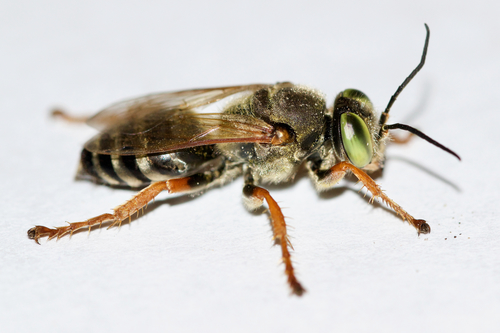
Tachytes is a genus of stout-bodied, solitary predatory wasps belonging to the family Crabronidae, commonly known as square-headed wasps or sand wasps. These industrious insects are renowned for their highly specialized hunting skills and nesting behavior, where females excavate deep burrows in sandy soil to raise their offspring. Fast and incredibly agile fliers, Tachytes are highly beneficial predators in many ecosystems, helping to naturally control populations of herbivorous pests like grasshoppers and katydids. Unlike social wasps, each female works entirely alone to establish her nest and secure food for her future brood. Their industrious digging habits, darting flight patterns, and striking facial features make them a fascinating subject for wildlife observers and insect enthusiasts alike.
Habitat: Typically found in open, sunny environments with loose, sandy soils, such as coastal dunes, riverbanks, and sandy fields.
Tachytes wasps typically measure between 1 and 2 centimeters in length, with robust bodies covered in fine, shimmering golden or silvery hairs that give them a slightly dusty or metallic appearance. Their most defining and striking feature is their large, compound eyes, which are often a brilliant, vivid green or golden-green when alive. They possess short, broad heads and clear or slightly smoky wings with a wingspan of about 1.5 to 3 centimeters. Their legs are heavily armed with spine-like bristles, particularly on the front legs, which form a comb-like structure adapted for shifting sand.
Category
InsectsRarity
Common
Danger
1/5 · Very low
Snaps
Be the first to snap!
Some species are affectionately called 'locust blowers' because of the rapid buzzing sound and high speed with which they carry heavy prey through the air.
Their glowing green eyes lose their brilliant color and turn dark shortly after the wasp dies, making living specimens especially striking.
To prevent other predators or parasites from finding their nests, female Tachytes carefully cover their burrow entrances with sand whenever they leave to hunt.
Possesses specialized tarsal combs on the front legs that allow the wasp to rapidly excavate loose sand from its nesting burrow like a miniature backhoe.
Delivers a precise sting to the motor centers of orthopteran prey, completely paralyzing them while keeping them alive to ensure fresh food for the larvae.
Capable of rapid, darting flight and precise hovering, allowing them to spot camouflaged prey on the ground and navigate complex terrain.
Adults feed primarily on sugary nectar from flowers, while their predatory larvae feed exclusively on paralyzed orthopterans provided by the mother.
Melanoplus femurrubrum
Females hunt and paralyze this species to stock their underground larval chambers.
Daucus carota
Adult wasps feed on nectar from these flowers, assisting with pollination in the process.

Sphex ichneumoneus
Competes for suitable sandy nesting sites and overlapping orthopteran prey species.
No trait badges are assigned for this object yet.
No aliases listed yet.
Collections for this object will appear here as more themes are added.
Danger
1/5 · Very low
No special safety notes yet.
Look for six legs, antennae, three body sections and the shape of the wings. Beetles have hardened front wings; flies have just one working pair. Tiny insects may need a close view before their group is clear. Insect Identifier: upload a photo and compare the visible details.
1+ cm
1+ cm
0.0001+ kg
1+ years
15 km/h
Adults feed primarily on sugary nectar from flowers, while their predatory larvae feed exclusively on paralyzed orthopterans provided by the mother.
Typically found in open, sunny environments with loose, sandy soils, such as coastal dunes, riverbanks, and sandy fields.
Zoom in to split clusters and explore where this object has been snapped.
Recent snaps will appear here as new observations are added.
Take the discovery with you
Snap it with Snappit to identify it, learn what makes it special, and add the discovery to your collection.