

Tanoak
notholithocarpus densiflorus
The Tanoak is a majestic evergreen tree native to the coastal regions of California and southwestern Oregon. Despite its common name, it is not a true oak, but rather an evolutionary link between oaks and chestnuts, classified in its own unique genus Notholithocarpus. Historically prized for its tannin-rich bark which was once heavily harvested for leather tanning, this tree plays a foundational role in its native forest ecosystems by providing abundant food and shelter for a variety of wildlife. Tanoaks are incredibly resilient, capable of vigorous resprouting from their root crowns after wildfires, making them a cornerstone species of the Pacific Northwest and Californian chaparral.
Habitat: Found in moist coastal forests, mixed evergreen woodlands, and redwood ecosystems of California and Oregon.
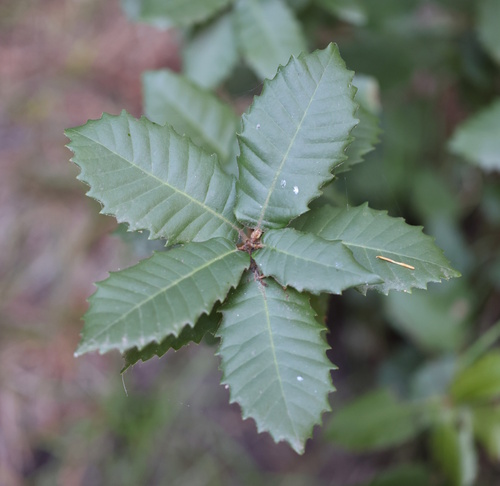
Tanoaks typically grow as medium to large trees reaching heights of 15 to 45 meters, though they can also form dense, multi-stemmed shrubs in drier habitats. They are easily recognized by their thick, leathery, evergreen leaves that feature prominent parallel veins and sharply toothed margins. The leaves have a distinctive pale, fuzzy underside covered in fine, woolly golden-white hairs. Perhaps their most identifying feature is the acorn-like fruit, which sits inside a unique cup densely covered in long, spreading, bur-like scales, giving them a whiskery or spiny appearance reminiscent of a chestnut bur.
Category
PlantsRarity
Common
Danger
1/5 · Very low
Snaps
4
Despite its common name, the tanoak is not a true oak, but rather an evolutionary bridge between chestnuts and oaks.
Its acorns are cradled in unique, brush-like cups covered in long, hairy fibers that look like tiny sea urchins.
The common name tanoak refers to the historical use of its bark by early settlers for tanning leather due to its extremely high tannin content.
Capable of rapidly growing back from underground root crowns after intense wildfires.
Establishes deep mycorrhizal networks with underground fungi to maximize nutrient and water uptake.
Accumulates high concentrations of bitter tannins in its bark and leaves to deter herbivores and insect pests.
As a photoautotrophic plant, the tanoak produces its own energy through photosynthesis, utilizing sunlight, carbon dioxide, and water.
Phytophthora ramorum
Tanoak serves as a critical food source and host to this destructive water mold pathogen.

Aphelocoma californica
The scrub-jay feeds on and caches tanoak acorns, aiding in the tree's seed dispersal and propagation.

Odocoileus hemionus
Mule deer browse the leaves and twigs of tanoak seedlings and consume its highly nutritious acorns.
No trait badges are assigned for this object yet.
No aliases listed yet.
Collections for this object will appear here as more themes are added.
Danger
1/5 · Very low
No special safety notes yet.
The easiest way to identify Tanoak is to use the Snappit nature identifier app.
1000-4500 cm
150-300 years
As a photoautotrophic plant, the tanoak produces its own energy through photosynthesis, utilizing sunlight, carbon dioxide, and water.
Found in moist coastal forests, mixed evergreen woodlands, and redwood ecosystems of California and Oregon.
Zoom in to split clusters and explore where this object has been snapped.

California, US
You might spot Redwood Sorrel, Redwood, and Button's Banana Slug.
View guide →

California, US
You might spot Redwood, Pacific Trillium, and Evergreen Huckleberry.
View guide →
Take the discovery with you
Snap it with Snappit to identify it, learn what makes it special, and add the discovery to your collection.











.jpg&width=800)



_001.jpg&width=800)




