
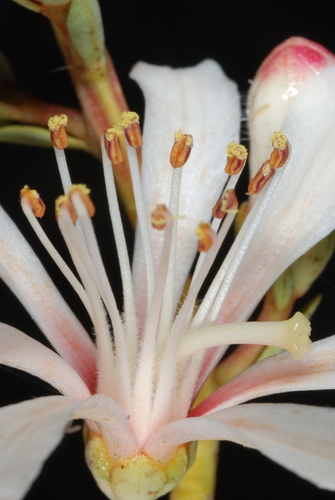


Tarflower
bejaria racemosa
Tarflower (Bejaria racemosa) is a striking evergreen shrub native to the pine flatwoods and scrublands of the southeastern United States, primarily Florida. Renowned for its beautiful, sweet-smelling summer blooms, the plant gets its common name from a fascinating, albeit slightly macabre, characteristic. Its elegant white or pale pink blossoms exude a highly sticky, resinous substance that acts like natural flypaper, often trapping unsuspecting gnats, flies, and ants. Though it captures these insects, the Tarflower is not carnivorous and does not digest them; the sticky sap is believed to deter nectar-thieving ants so that flying pollinators can do their job. Adaptable and resilient, this sun-loving member of the heath family thrives in nutrient-poor, sandy soils and is well-adapted to the frequent natural fires of its native ecosystems.
Habitat: Found primarily in the sandy soils of pine flatwoods, dry prairies, and oak scrublands of the southeastern United States.
The Tarflower is a loosely branched, woody shrub that typically reaches 1 to 2.5 meters in height. It features alternate, oval-shaped leaves that are a pale, greyish-green color with smooth margins. The true spectacle of the plant is its terminal clusters of striking, star-shaped flowers. Each blossom boasts seven distinct, elongated petals—an unusual number for flowers—that are white with occasional pink blushing. The petals, sepals, and flower stalks are heavily coated in a remarkably sticky, dark resin that often has small trapped insects adhered to it.
Category
PlantsRarity
Common
Danger
1/5 · Very low
Snaps
Be the first to snap!
Despite catching numerous small insects in its sticky sap, the Tarflower is not carnivorous; it does not digest its victims or absorb their nutrients.
In historical times, early pioneers of Florida would deliberately hang cut branches of Tarflower in their homes to act as natural flypaper.
Its common name 'Tarflower' originates from the dark, sticky, tar-like residue that the flowers leave behind on grazing animals and human clothing.
The blossoms of the Tarflower typically have seven petals, which is an extremely unusual number in the plant kingdom, where petals usually appear in multiples of three, four, or five.
The plant exudes a sticky, tar-like substance on its flowers and stems that physically traps ants and small crawling insects, preventing them from stealing nectar.
Adapted to the fire-prone ecosystems of pine flatwoods, the shrub is capable of rapidly resprouting from its woody base after a wildfire sweeps through the area.
Its slightly waxy, leathery leaves and deep root system allow it to survive long periods of dry weather in rapidly draining, sandy soils.
Like most plants, the Tarflower produces its own energy through photosynthesis by utilizing sunlight, carbon dioxide, and water.

Bombus impatiens
Bumblebees are one of the primary pollinators capable of safely navigating the sticky petals to gather nectar.

Papilio palamedes
Swallowtail butterflies frequently visit the fragrant blooms during the summer to drink nectar and assist in pollination.

Camponotus floridanus
Crawling insects, like ants, attempt to steal nectar but often become hopelessly stuck in the plant's protective resin.
No trait badges are assigned for this object yet.
No aliases listed yet.
Collections for this object will appear here as more themes are added.
Danger
1/5 · Very low
No special safety notes yet.
Start with the whole plant, then compare leaf arrangement, leaf edges, stems and any flowers or fruit. Opposite leaves grow in pairs; alternate leaves come one at a time along the stem. These details tell you far more together than a single green leaf does. Plant Identifier: upload a photo and compare the visible details.
100-250 cm
10-50 years
Like most plants, the Tarflower produces its own energy through photosynthesis by utilizing sunlight, carbon dioxide, and water.
Found primarily in the sandy soils of pine flatwoods, dry prairies, and oak scrublands of the southeastern United States.
Photosynthesis
Zoom in to split clusters and explore where this object has been snapped.
Recent snaps will appear here as new observations are added.
Take the discovery with you
Snap it with Snappit to identify it, learn what makes it special, and add the discovery to your collection.



















