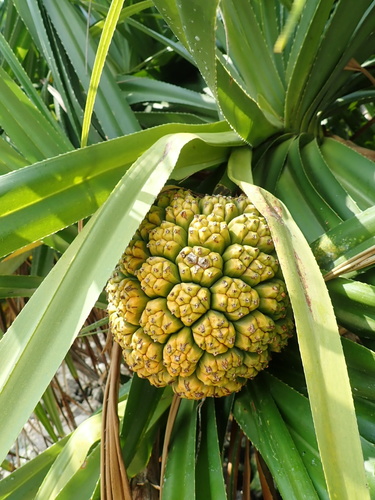


Thatch Screwpine
pandanus tectorius
The Thatch Screwpine, Pandanus tectorius, is a culturally and ecologically significant tree native to coastal regions of the tropical Pacific and Indian Oceans. Known for its distinctive stilt roots that resemble miniature wooden teepees and its dramatic spiraling leaf arrangement, this resilient plant thrives in sandy shores and harsh marine winds. Its large, pineapple-like segmented fruits, called keys or drupes, are a vital food source in many Pacific island communities, while its durable, fibrous leaves are traditionally harvested for weaving mats, sails, and thatch roofs. Beyond its human utility, the Thatch Screwpine plays a crucial role in coastal ecosystems, securing loose shorelines against erosion and providing habitat for nesting seabirds and land crabs. Its ability to thrive in poor, saline soils makes it a true survivor of the tropical coastline.
Habitat: Found on sandy beaches, coastal dunes, rocky shores, and the edges of mangrove swamps throughout the tropical Pacific and Indian Ocean regions.
This small, branching tree typically reaches heights of 4 to 14 meters. It is easily recognized by its thick, sprawling stilt roots (prop roots) emerging from the lower trunk to anchor it in unstable sand. The long, sword-like leaves are arranged in a tight spiral at the ends of the branches, measuring 1 to 2 meters in length, with sharp, prickly margins. The tree produces large, spherical, or ovoid compound fruits that turn from light green to a vibrant orange or yellow when ripe, resembling woody pineapples. Female trees bear these heavy fruits, while male trees produce large, fragrant, white to yellow clusters of flowers surrounded by pale bracts.
Category
PlantsRarity
Common
Danger
1/5 · Very low
Snaps
1
Despite its name and the appearance of its fruit, the Thatch Screwpine is not related to pineapples; it gets its name from the spiral arrangement of its leaves.
In traditional Pacific cultures, the fragrant male flowers, known as hinano, are used to scent coconut oil and create elaborate festive leis.
Individual fruit segments, called drupes or keys, can float in seawater for up to several months while remaining viable for germination.
The tough leaves are soaked, beaten, and scraped to remove spines before being woven into sails that historically powered Polynesian voyaging canoes.
The plant develops extensive stilt roots that anchor the trunk securely into unstable sandy soils, allowing it to withstand high winds and coastal storms.
It possesses thick, waxy, fibrous leaves that minimize water loss and protect the plant from harsh salt spray and intense tropical sunlight.
It produces woody, fibrous fruit segments containing air cavities that allow them to float across ocean currents for months to colonize new shores.
As a photoautotrophic plant, the Thatch Screwpine produces its own organic nutrients through photosynthesis using sunlight, carbon dioxide, and water absorbed from the soil.
Coenobita perlatus
Hermit crabs seek shelter under the fallen leaves and feed on the decomposing fruit keys of the tree.
Pteropus samoensis
Pacific flying foxes feed on the ripe, sweet orange pulp of the fruit, acting as seed dispersers.
Erionota thrax
The caterpillars of this butterfly feed extensively on the tough, spiny leaves of the screwpine.
No trait badges are assigned for this object yet.
No aliases listed yet.
Collections for this object will appear here as more themes are added.
Danger
1/5 · Very low
No special safety notes yet.
The easiest way to identify Thatch Screwpine is to use the Snappit nature identifier app.
400-1400 cm
50-80 years
As a photoautotrophic plant, the Thatch Screwpine produces its own organic nutrients through photosynthesis using sunlight, carbon dioxide, and water absorbed from the soil.
Found on sandy beaches, coastal dunes, rocky shores, and the edges of mangrove swamps throughout the tropical Pacific and Indian Ocean regions.
Zoom in to split clusters and explore where this object has been snapped.

Hawaii, US
You might spot Hawaiian Garden Spider, Beach Naupaka, and Black Noddy.
View guide →

Hawaii, US
You might spot Torch Ginger, Red-Crested Cardinal, and African Tulip Tree.
View guide →

Hawaii, US
You might spot Spathoglottis Plicata, Thatch Screwpine, and Brown Anole.
View guide →
Take the discovery with you
Snap it with Snappit to identify it, learn what makes it special, and add the discovery to your collection.












.jpg&width=800)



_001.jpg&width=800)




