





smooth Solomon's seal
Polygonatum biflorum
Smooth Solomon's seal is a lovely plant with smooth, green leaves and small, bell-shaped flowers. It grows in shady places and is a favorite among woodland creatures.
Habitat: Forests
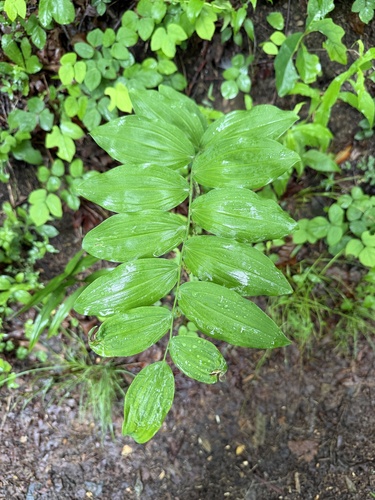
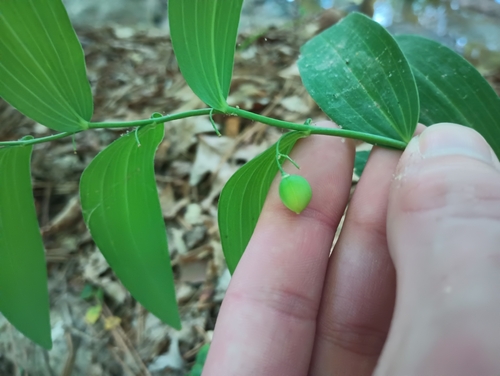
The smooth Solomon's seal has gracefully arching stems with smooth, oval leaves arranged alternately. Small, greenish-white, bell-shaped flowers hang in pairs beneath the stem. Later, dark blue-black berries develop, contrasting with its vibrant green foliage.
Category
PlantsRarity
Common
Danger
1/5 · Very low
Snaps
8
Each year, a new 'seal' scar forms on its underground stem, marking its age like a tree's rings!
Its berries might look tasty, but only birds should eat them – they're not for human tummies!
Look closely at its root scars! They resemble ancient wax seals, giving the plant its unique name.
Native Americans once used its roots to soothe minor aches and skin irritations!
Smooth Solomon's seal can spread widely using thick underground stems, called rhizomes, helping it form new plant colonies.
Its bell-shaped flowers hang beneath the stem, which helps protect nectar from rain and offers a sheltered landing spot.
The smooth Solomon's seal produces dark blue-black berries, which attract birds to eat them and scatter its seeds far and wide.

Odocoileus virginianus
Deer browse on its tender young shoots and leaves.
Bombus impatiens
Bumblebees visit the bell-shaped flowers for nectar and pollen.
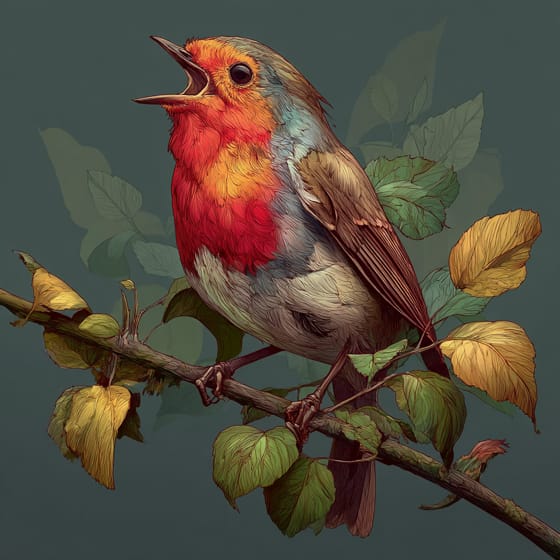
Turdus migratorius
Robins and other birds consume its ripe blue-black berries.
Bell-shaped flowers possess petals fused or arranged to form a cup-like or campanulate structure resembling a bell.
Deciduous plants periodically shed all their leaves, typically during autumn or dry seasons.
Flowering plants are any plants that produce flowers as part of their reproductive cycle.
Shade tolerant plants are adapted to grow and thrive in areas with low light levels, requiring less direct sunlight.

Edible plants are those parts of a plant that are considered safe for human consumption.

Forest habitats are terrestrial environments dominated by dense tree cover, supporting a high diversity of plant and animal life.
No aliases listed yet.
Danger
1/5 · Very low
Always look but don't touch plants unless you know they are safe!
The easiest way to identify smooth Solomon's seal is to use the Snappit nature identifier app.
30-90 cm
30-60 cm
1-2 cm
Late Spring to Early Summer
No
Mild
Perennial
Zoom in to split clusters and explore where this object has been snapped.
May 24, 2026
Andrews GeyserPhoto attribution
(c) Terry Loeb, some rights reserved (CC BY)
License: CC BY 4.0 ↗
Image may be shown cropped inside the card frame.
May 17, 2026
Caldwell Street Historic DistrictPhoto attribution
(c) Raven Dandridge, some rights reserved (CC BY)
License: CC BY 4.0 ↗
Image may be shown cropped inside the card frame.

Wisconsin, US
You might spot Eastern Redcedar, Rock Polypody, and Vulture.
View guide →

Illinois, US
You might spot Osage-Orange, Cutleaf Teasel, and Red Clover.
View guide →

Wisconsin, US
You might spot Common Eastern Bumble Bee, Red-Belted Bumble Bee, and Duck.
View guide →

South Dakota, US
You might spot Brittle Pricklypear and Eastern Redcedar.
View guide →

North Carolina, US
You might spot Galax, Mountain Laurel, and Downy Rattlesnake Plantain.
View guide →

South Carolina, US
You might spot Butterfly Pea, Red-Tailed Hawk, and Northern Cardinal.
View guide →
Take the discovery with you
Snap it with Snappit to identify it, learn what makes it special, and add the discovery to your collection.






.jpg&width=800)



_001.jpg&width=800)


