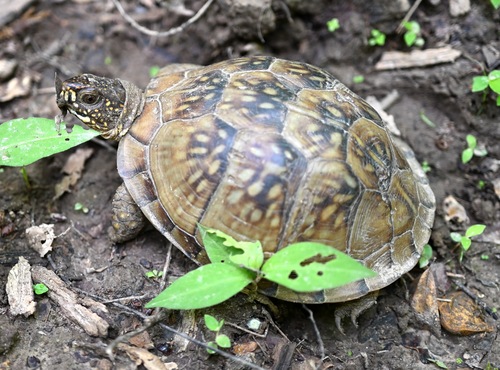
Three-toed Box Turtle
Terrapene triunguis
The Three-toed Box Turtle is a small turtle with a special shell that can close up tight! They are friendly and love to explore their surroundings slowly.
Habitat: Forests
The Three-toed Box Turtle has a high-domed, reddish-brown shell, often with faint yellow or olive markings. Its head and limbs are typically yellowish-orange, sometimes adorned with red spots. A key feature is the three distinct toes on each hind foot, making it unique.
Category
ReptilesRarity
Common
Danger
1/5 · Very low
Snaps
18
A box turtle can sometimes survive for over a year without food!
Each growth ring on their shell can tell you how old they are.
Temperature decides if a hatchling will be male or female!
They often have favorite spots and rarely roam far from home.
Three-toed Box Turtle has drab brown and olive colors that help them blend perfectly into the forest floor, hiding from hungry eyes.
Three-toed Box Turtle can find hidden food like mushrooms and grubs because of its excellent sense of smell, even after rain.
Three-toed Box Turtle can survive cold winters by digging into the soil and entering a deep sleep, conserving energy until spring.
They are omnivores, munching on a variety of plants, fruits, fungi, and small critters!
Age differences: Younger turtles eat more insects and protein, while adults consume a broader omnivorous diet.

Procyon lotor
Raccoons often prey on their eggs and hatchlings when found.
Mephitis mephitis
Skunks can dig up and eat box turtle eggs or small young.
Limax maximus
The turtles will forage for and eat slow-moving slugs.
Morchella esculenta
A favorite food source, they seek out various fungi like morels.
Solitary animals live alone for most of their lives, only interacting with others for mating or parental care.
This trait identifies organisms whose diet includes both plant and animal matter.
This trait characterizes organisms whose diet consists entirely or primarily of plant material.
This trait signifies organisms belonging to a very old evolutionary group with ancestors dating back millions of years.

Forest habitats are terrestrial environments dominated by dense tree cover, supporting a high diversity of plant and animal life.

This trait characterizes organisms with an exceptionally long lifespan compared to others of their kind.

Armored describes animals protected by a hard, external covering or shell for defense.

Diurnal animals are primarily active during daylight hours, typically resting or sleeping at night.
No aliases listed yet.
Danger
1/5 · Very low
If you see a turtle, watch it from a distance and don't touch it without asking an adult.
The easiest way to identify Three-toed Box Turtle is to use the Snappit nature identifier app.
10-14 cm
0.3-0.6 kg
30-50 years
0.5 km/h
They are omnivores, munching on a variety of plants, fruits, fungi, and small critters!
Forests
Foraging
Zoom in to split clusters and explore where this object has been snapped.
Apr 24, 2026
Locust Grove State Historic SitePhoto attribution
(c) Amber M. King, some rights reserved (CC BY)
License: CC BY 4.0 ↗
Image may be shown cropped inside the card frame.

Louisiana, US
You might spot Mississippi River Wakerobin and Lyreleaf Sage.
View guide →
Missouri, US
You might spot Giraffes, African Lion, and Tiger.
View guide →

Texas, US
You might spot Reticulated Giraffe, Grant's Zebra, and Ostrich.
View guide →

Oklahoma, US
You might spot Bull Shark and Loggerhead Sea Turtle.
View guide →

Arkansas, US
You might spot Rainbow Trout and Spicebush Swallowtail.
View guide →

Arkansas, US
You might spot Prairie Lizard, Anole, and Canada Goose.
View guide →
Take the discovery with you
Snap it with Snappit to identify it, learn what makes it special, and add the discovery to your collection.