





Ugandan grey-cheeked mangabey
Lophocebus ugandae
The Ugandan grey-cheeked mangabey is a playful monkey with grey cheeks and a long tail. They live in groups and love to swing through the trees in their forest homes.
Habitat: Forests
The Ugandan grey-cheeked mangabey has a distinctive crest of dark hair on its head and very prominent grey cheeks that contrast sharply with its darker face. Its body is covered in dark brown to black fur, and it possesses a long tail, often longer than its body.
Category
MammalsRarity
Common
Danger
2/5 · Low
Snaps
Be the first to snap!
Their tail is often longer than their whole body, like a super-long balancing pole!
These mangabeys have special cheek pouches to store yummy snacks for later.
These monkeys are expert at cracking open tough nuts and seeds with their strong jaws.
They use loud 'whoop-gobble' calls that can be heard far through the forest!
Ugandan grey-cheeked mangabeys can swiftly leap and climb through dense trees because of their strong limbs and long tails that help them balance.
Ugandan grey-cheeked mangabeys have a loud 'whoop-gobble' call that helps them communicate territory and warn others of danger.
Ugandan grey-cheeked mangabeys are important seed dispersers that help grow new trees in the forest by spreading seeds after eating fruits.
These monkeys are omnivores, enjoying a mix of fruits, seeds, leaves, and insects!
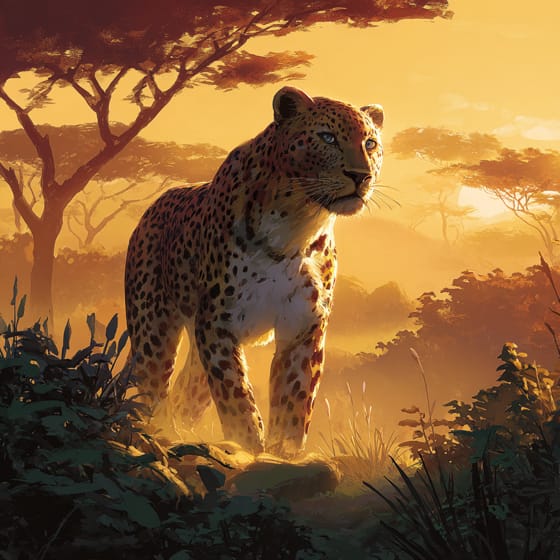
Panthera pardus
Main predator in their forest habitat.
%2C_at_Ndumo_Nature_Reserve%2C_KwaZulu-Natal%2C_South_Africa_(28947411865).jpg&width=800)
Stephanoaetus coronatus
A significant aerial predator of mangabeys.
Ficus natalensis
Feeds on the fruits, dispersing their seeds.
Cola nitida
Consumes the nutritious nuts from this tree.
Furry describes animals possessing a dense covering of soft hair or fur.
Social animals live in organized groups, cooperating for survival benefits such as foraging, defense, and raising offspring.
This trait identifies organisms whose diet includes both plant and animal matter.
Arboreal animals live primarily in trees, utilizing them for shelter, food, and protection from predators.

Forest habitats are terrestrial environments dominated by dense tree cover, supporting a high diversity of plant and animal life.

Diurnal animals are primarily active during daylight hours, typically resting or sleeping at night.

Endangered status indicates a species is at a very high risk of extinction in the wild in the near future.
No aliases listed yet.
Danger
2/5 · Low
Always watch from a distance and never try to touch wild animals.
The easiest way to identify Ugandan grey-cheeked mangabey is to use the Snappit nature identifier app.
40-55 cm
4-9 kg
15-20 years
25 km/h
These monkeys are omnivores, enjoying a mix of fruits, seeds, leaves, and insects!
Forests
Foraging
Zoom in to split clusters and explore where this object has been snapped.
Recent snaps will appear here as new observations are added.
Take the discovery with you
Snap it with Snappit to identify it, learn what makes it special, and add the discovery to your collection.




.jpg&width=800)

.JPG&width=800)



.jpg&width=800)
