
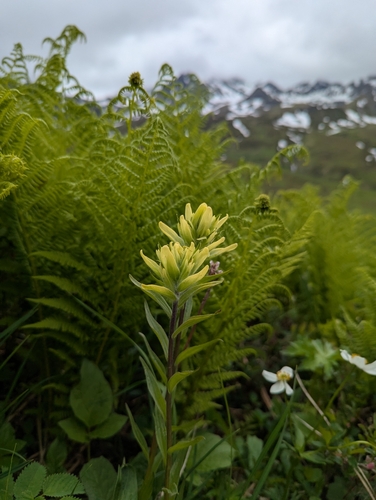


Unalaska Paintbrush
castilleja unalaschcensis
The Unalaska Paintbrush (Castilleja unalaschcensis) is a striking perennial wildflower native to the harsh, wind-swept coastal meadows and alpine tundras of Alaska, particularly the Aleutian Islands. Characterized by its clusters of bright, greenish-yellow bracts, this resilient plant stands out amidst the rugged subarctic landscapes, bringing vibrant color to barren shorelines and grassy slopes during the brief northern summer. Beyond its visual charm, this species is a fascinating survivor. As a hemiparasite, it possesses specialized roots that can tap into neighboring grasses and sedges to absorb water and essential nutrients. This clever adaptation allows it to thrive in nutrient-poor arctic soils where other plants struggle, making it an ecological cornerstone of its native coastal communities.
Habitat: Found in coastal meadows, gravelly riverbanks, alpine tundra, and grassy cliffsides of southern and western Alaska.
This perennial herb typically grows between 15 to 50 centimeters in height, featuring erect, unbranched stems covered in fine, soft hairs. The most prominent identifier is the dense, spike-like cluster of yellow to greenish-yellow bracts at the top of the stem, which easily overshadow the inconspicuous, small greenish flowers nestled inside them. The leaves are lance-shaped, alternate, and have smooth margins, clasping directly to the stem. The plant lacks the brilliant red tones of its close relatives, making its soft yellow palette a key identifying marker in its subarctic habitat.
Category
PlantsRarity
Common
Danger
1/5 · Very low
Snaps
Be the first to snap!
Their seeds are extremely tiny and dust-like, allowing them to be carried long distances by strong subarctic winds.
They are hemiparasites, meaning they can photosynthesize independently but grow much larger and healthier when stealing nutrients from neighbors.
Unlike most members of the paintbrush family which are famously red, the Unalaska Paintbrush glows with a distinct yellow-green color.
Uses specialized structures called haustoria to penetrate the roots of host plants, siphoning off water and nutrients to thrive in nutrient-poor soils.
Features dense, fine hairs on its stems and leaves that trap heat and protect the plant from freezing northern winds.
Utilizes brightly colored, leaf-like yellow bracts rather than petals to attract pollinators, saving energy on flower production.
Primarily produces its own food through photosynthesis while supplementing its water and mineral intake by parasitizing the roots of nearby plants.
Carex lyngbyei
The paintbrush taps into the root system of this sedge to siphon water and nutrients.
Bombus polaris
The bumblebee pollinates the flowers while feeding on its nectar.
Microtus oeconomus
Tundra voles occasionally feed on the foliage and seed pods of the plant.
No trait badges are assigned for this object yet.
No aliases listed yet.
Collections for this object will appear here as more themes are added.
Danger
1/5 · Very low
No special safety notes yet.
Start with the whole plant, then compare leaf arrangement, leaf edges, stems and any flowers or fruit. Opposite leaves grow in pairs; alternate leaves come one at a time along the stem. These details tell you far more together than a single green leaf does. Plant Identifier: upload a photo and compare the visible details.
15-50 cm
0.05-0.2 kg
3-10 years
Primarily produces its own food through photosynthesis while supplementing its water and mineral intake by parasitizing the roots of nearby plants.
Found in coastal meadows, gravelly riverbanks, alpine tundra, and grassy cliffsides of southern and western Alaska.
Zoom in to split clusters and explore where this object has been snapped.
Recent snaps will appear here as new observations are added.
Take the discovery with you
Snap it with Snappit to identify it, learn what makes it special, and add the discovery to your collection.


















