





mile-a-minute weed
Persicaria perfoliata
Mile-a-minute weed is a fast-growing plant that can climb over other plants and fences. It has bright green leaves and tiny, blue flowers that attract butterflies and bees!
Habitat: Urban areas
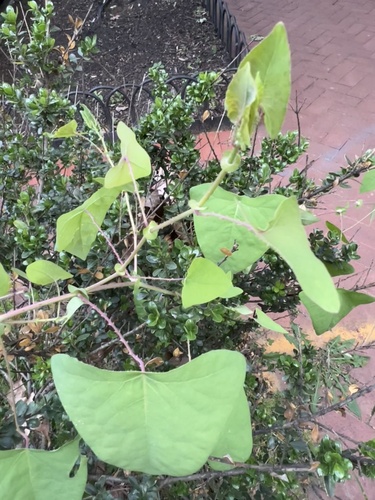
The mile-a-minute weed has distinctive light green, triangular (arrowhead-shaped) leaves, often with a dark blotch in the center. Its slender, reddish stems are covered in tiny, backward-pointing barbs, making it feel rough to the touch. Tiny, white, or pale pink flowers appear in clusters at the leaf nodes.
Category
PlantsRarity
Common
Danger
2/5 · Low
Snaps
13
Its unique seeds wear a tiny blue "hat" that helps them float on water!
The plant's stems have tiny, backward-pointing hooks, making it clingy like Velcro!
This plant can grow almost a foot (30 cm) in just ONE day!
Young leaves taste like spinach with a tangy kick and are safe to eat raw!
Mile-a-minute weed can grow up to 15 cm daily, quickly climbing over and smothering other plants for sunlight.
It has sharp, hooked barbs on its stems that help it grip and climb aggressively over any support.
Its blue-black seeds are buoyant, allowing water to carry them far from the parent plant for dispersal.
Rhinoncomimus latipes
Its leaves are eaten by this specialized biocontrol weevil.
Apis mellifera
Its small flowers attract various generalist insect pollinators.

Cardinalis cardinalis
Many bird species eat its distinctive blue-black seeds.
Flowering plants are any plants that produce flowers as part of their reproductive cycle.
Describes plants that are particularly attractive and beneficial to a wide range of pollinating organisms.
Rapid growing plants exhibit accelerated growth rates, quickly increasing in size and biomass within a short period.
This habitat trait indicates species that can coexist with humans in urban and suburban environments, utilizing man-made structures and green spaces.

Invasive species are non-native organisms that cause harm to the environment, economy, or human health.

Describes organisms that transfer pollen, enabling the fertilization and reproduction of plants.
Danger
2/5 · Low
Be careful not to touch the plant too much, as it can be prickly.
The easiest way to identify mile-a-minute weed is to use the Snappit nature identifier app.
30-600 cm
0.2-0.4 cm
Summer-fall
Yes
None
Annual
Self
Zoom in to split clusters and explore where this object has been snapped.
Jun 1, 2026
Oxon Run ParkwayPhoto attribution
(c) Frederick Nunley, some rights reserved (CC BY)
License: CC BY 4.0 ↗
Image may be shown cropped inside the card frame.

Maryland, US
You might spot American Cancer-Root and Rue Anemone.
View guide →

Maryland, US
You might spot Common Pawpaw, Zebra Swallowtail, and Bald Eagle.
View guide →

Pennsylvania, US
You might spot Harlequin Bug, White-Tailed Deer, and Bee.
View guide →

Connecticut, US
You might spot Spongy Moth, Eastern Tent Caterpillar Moth, and Monarch.
View guide →

New Jersey, US
You might spot Chinese Sumac, Porcelain Berry, and White-Tailed Deer.
View guide →

Maryland, US
You might spot American Cancer-Root and Rue Anemone.
View guide →
Take the discovery with you
Snap it with Snappit to identify it, learn what makes it special, and add the discovery to your collection.








.jpg&width=800)


_001.jpg&width=800)




