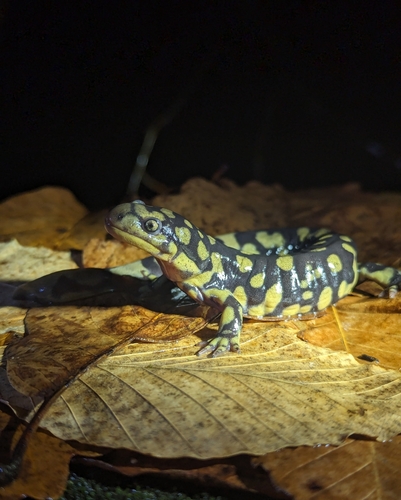


Unisexual Mole Salamander Complex
ambystoma unisexual
The Unisexual Mole Salamander Complex represents one of the most fascinating reproductive mysteries in the amphibian world. Comprising entirely female lineages, these amphibians are not a single traditional species but rather a complex genetic mix resulting from ancient hybridizations of up to five different Ambystoma species, including the Blue-spotted and Jefferson salamanders. What makes them truly extraordinary is their unique reproductive strategy known as kleptogenesis. They 'steal' sperm from sympatric male salamanders to stimulate their eggs to divide, sometimes discarding the male's genetic material and sometimes incorporating it, leading to complex polyploid genomes. Found primarily in northeastern North America, these secretive creatures spend most of the year hidden underground, emerging only during early spring rains to migrate to vernal pools.
Habitat: Found in mature deciduous and mixed forests of northeastern North America, typically living underground or beneath decaying logs near fishless vernal pools used for breeding.
Due to their complex genetic heritage, individuals can vary significantly in appearance, generally looking like slightly larger or differently patterned versions of their host species. Most commonly, they feature dark brown, black, or dark gray stout bodies adorned with varying degrees of pale blue, silvery, or grayish-white flecks along their sides, limbs, and tails. They possess broad heads, prominent costal grooves along their sides, and a laterally compressed tail. Their overall size often correlates with their ploidy level, with triploid and tetraploid individuals typically growing larger and more robust than standard diploid salamanders.
Category
AmphibiansRarity
Common
Danger
1/5 · Very low
Snaps
Be the first to snap!
Depending on which male species they borrow sperm from, an individual salamander might contain genetic material from up to five different salamander species.
Despite 'stealing' sperm from males of other species to trigger reproduction, the resulting offspring are almost always completely female.
Scientists often use letters like 'J' and 'L' to denote their genomic makeup, representing the Jefferson and laterale (Blue-spotted) salamander genomes they possess.
The lineage of the unisexual Ambystoma is ancient, having reproduced this way for over 5 million years, making them the oldest known lineage of unisexual vertebrates.
They reproduce by 'stealing' sperm from males of closely related species to trigger egg development, often incorporating the male's genome into their own.
Because of their unusual reproductive strategy, they can possess multiple sets of chromosomes, allowing for remarkably high genetic diversity and adaptability to different environments.
Like other mole salamanders, they possess the remarkable ability to regenerate lost tissues, including limbs and parts of their tail, if injured by a predator.
Adults feed opportunistically on a wide variety of forest-floor invertebrates, while aquatic larvae consume small aquatic organisms.
Age differences: Larvae are fully aquatic and eat zooplankton and small aquatic invertebrates, while terrestrial adults transition to larger forest-floor invertebrates.
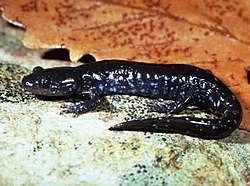
Ambystoma laterale
Unisexual females require sperm from sympatric males to trigger reproduction.
Procyon lotor
Raccoons frequently prey on migrating salamanders during heavy spring rains.
Dytiscidae
Aquatic predators that consume salamander larvae in vernal pools.
No trait badges are assigned for this object yet.
Collections for this object will appear here as more themes are added.
Danger
1/5 · Very low
No special safety notes yet.
Compare body shape, toes, markings, tail and skin texture. Tadpoles and larvae can look nothing like the adults they turn into. Amphibian Identifier: upload a photo and compare the visible details.
10-17 cm
0.005-0.02 kg
5-15 years
Adults feed opportunistically on a wide variety of forest-floor invertebrates, while aquatic larvae consume small aquatic organisms.
Found in mature deciduous and mixed forests of northeastern North America, typically living underground or beneath decaying logs near fishless vernal pools used for breeding.
Ambush
100-300
Zoom in to split clusters and explore where this object has been snapped.
Recent snaps will appear here as new observations are added.
Take the discovery with you
Snap it with Snappit to identify it, learn what makes it special, and add the discovery to your collection.