

Velvet-Leaf Milkweed
asclepias tomentosa
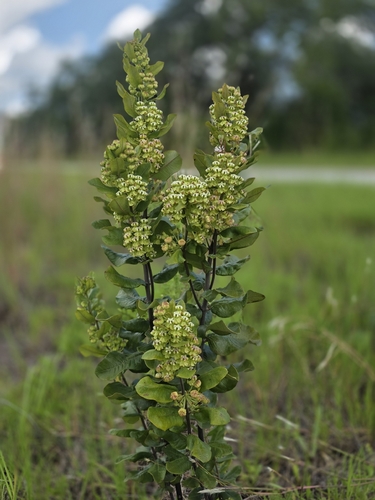
The Velvet-Leaf Milkweed (Asclepias tomentosa) is a resilient, sun-loving perennial herb native to the southeastern United States. Thriving in the harshest sandy conditions, this fascinating wildflower plays a vital role in coastal plains and sandhill ecosystems. Its common name is a nod to the soft, velvet-like hairs coating its stems and leaves, giving the plant a silvery-green shimmer in the bright sunshine. Like other members of the milkweed genus, it is famous for its milky, toxic latex sap and its ecological role as an indispensable host plant. It stands out with its uniquely pale, yellow-green to bronze flower clusters that bloom throughout the warm summer months. This species is a hardy survivor, well-adapted to wildfire-prone environments and nutrient-poor soils, making it an ecological anchor for countless native pollinators.
Habitat: Found in dry, sandy upland habitats such as sandhills, scrublands, open pine flatwoods, and coastal dunes.
This herbaceous perennial typically grows upright, reaching heights of 30 to 80 centimeters. The most distinctive feature is the dense, soft coating of short, woolly hairs on the stems and leaves, creating a velvety texture. Its leaves are oppositely arranged, lance-shaped to oblong, and often slightly wavy along the margins. The flowers, which cluster in terminal or upper-axillary umbels, display a subtle, pale greenish-yellow, cream, or bronze coloration with hoods that curve outward.
Category
PlantsRarity
Common
Danger
1/5 · Very low
Snaps
Be the first to snap!
Its seeds are attached to silky, fluffy hairs called coma, which catch the wind like tiny parachutes to disperse over long distances.
Monarch caterpillars that feed on this plant store its cardenolide toxins in their own bodies, making them highly poisonous to avian predators.
The species name 'tomentosa' translates to 'covered with densely matted woolly hairs,' directly referring to its signature velvet leaves.
The dense coat of fine hairs on its leaves and stems reduces water loss from transpiration and reflects harsh solar radiation.
Produces a sticky, milky latex rich in toxic cardenolides that deters generalist herbivores.
Possesses a deep, robust woody taproot that allows the plant to quickly regenerate from underground reserves after wildfires.
As an autotrophic plant, it manufactures its own energy from sunlight, water, and carbon dioxide through photosynthesis.

Danaus plexippus
The larvae feed exclusively on the toxic foliage, acquiring chemical protection from predators.
Danaus gilippus
The caterpillars utilize the plant as an essential food source, sequestering its cardenolides.

Oncopeltus fasciatus
Feeds on the seeds and plant fluids, often congregating in large numbers.
Apis mellifera
Visits the unique greenish flowers to forage for nectar and acts as an effective pollinator.
No trait badges are assigned for this object yet.
No aliases listed yet.
Collections for this object will appear here as more themes are added.
Danger
1/5 · Very low
No special safety notes yet.
Start with the whole plant, then compare leaf arrangement, leaf edges, stems and any flowers or fruit. Opposite leaves grow in pairs; alternate leaves come one at a time along the stem. These details tell you far more together than a single green leaf does. Plant Identifier: upload a photo and compare the visible details.
30-80 cm
3-10 years
As an autotrophic plant, it manufactures its own energy from sunlight, water, and carbon dioxide through photosynthesis.
Found in dry, sandy upland habitats such as sandhills, scrublands, open pine flatwoods, and coastal dunes.
Photosynthesis
14-30 days
Zoom in to split clusters and explore where this object has been snapped.
Recent snaps will appear here as new observations are added.
Take the discovery with you
Snap it with Snappit to identify it, learn what makes it special, and add the discovery to your collection.