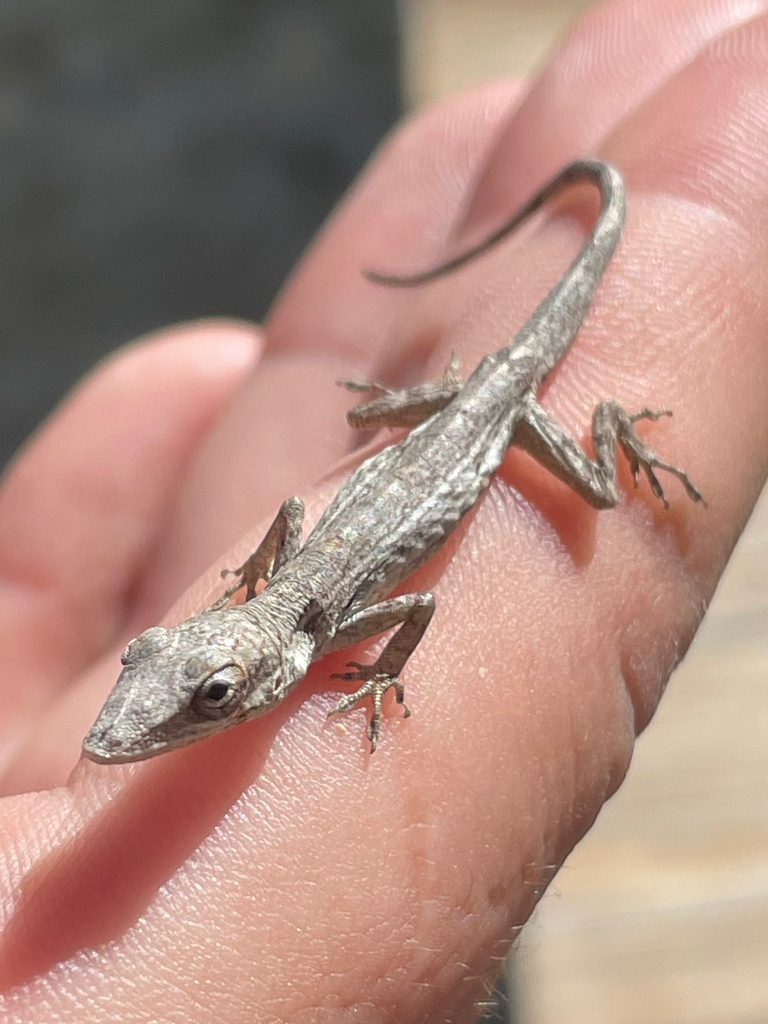





West Indies Anole
Anolis oligaspis
The West Indies Anole is a small lizard that loves to bask in the sun! It can change colors to blend in with its surroundings, making it a master of hide-and-seek in the tropical forests.
Habitat: Tropical forests
The West Indies Anole is a slender lizard with a long, tapering tail. It can display vibrant green to dull brown coloration, often with a paler belly. Males are easily identified by their prominent, inflatable throat dewlap.
Category
ReptilesRarity
Common
Danger
1/5 · Very low
Snaps
Be the first to snap!
Anoles are "solar-powered," warming up by basking in the sun each morning!
Each eye can move separately, letting them look forward and back at once!
They can sleep upside down, clinging to leaves for safety!
They drink by licking tiny water droplets off leaves and other surfaces!
West Indies Anole has the ability to change its skin color because it helps them blend in with surroundings and hide from predators.
West Indies Anole can flash its colorful dewlap because it helps them communicate with other anoles and attract mates.
West Indies Anole can cling to smooth surfaces because of special sticky scales on its toes, helping them climb walls.
These small lizards are insectivores, primarily feasting on a variety of small invertebrates.

Falco sparverius
A common bird of prey.
Alsophis sanctorum
A snake predator in its range.
Gryllus assimilis
A primary food source.
Musca domestica
Eats many small insects.
Social animals live in organized groups, cooperating for survival benefits such as foraging, defense, and raising offspring.
Arboreal animals live primarily in trees, utilizing them for shelter, food, and protection from predators.
Camouflaged describes organisms that possess coloring or patterns that allow them to blend into their environment.
Colorful describes organisms or objects displaying a wide range of bright and distinct colors.
This trait identifies organisms whose diet primarily consists of insects and other small invertebrates.
Forest habitats are terrestrial environments dominated by dense tree cover, supporting a high diversity of plant and animal life.
Diurnal animals are primarily active during daylight hours, typically resting or sleeping at night.
No aliases listed yet.
Danger
1/5 · Very low
Always watch lizards from a distance and don't try to catch them.
Compare toes, scales, head shape, crests and tail proportions. Many lizards can drop and regrow their tails, so a short tail isn't always a species trait. Lizard Identifier: upload a photo and compare the visible details.
10-20 cm
0.005-0.02 kg
2-5 years
7 km/h
These small lizards are insectivores, primarily feasting on a variety of small invertebrates.
Tropical forests
Foraging
Zoom in to split clusters and explore where this object has been snapped.
Recent snaps will appear here as new observations are added.
Take the discovery with you
Snap it with Snappit to identify it, learn what makes it special, and add the discovery to your collection.