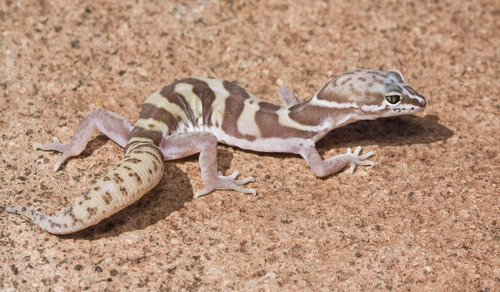


Western Banded Gecko
coleonyx variegatus
The Western Banded Gecko (Coleonyx variegatus) is a charming and highly adaptable reptile native to the arid desert regions of the southwestern United States and northern Mexico. Unlike most other geckos, this nocturnal creature belongs to the family Eublepharidae, meaning it possesses moveable eyelids and lacks adhesive toe pads. It navigates sandy and rocky environments with slender, clawed toes, hunting for small invertebrates under the cover of darkness. This small reptile is often compared to a miniature leopard due to its beautiful spotted and banded patterns, which provide exceptional camouflage against desert soils. Despite its delicate appearance, the Western Banded Gecko is remarkably resilient, utilizing a variety of survival strategies, including vocalizations and tail autonomy, to thrive in harsh, water-scarce environments.
Habitat: Found in arid deserts, rocky canyons, and sagebrush flats, typically taking shelter under rocks, in burrows, or beneath debris during the day.
Measuring roughly 10 to 15 centimeters in total length, the Western Banded Gecko is characterized by its slender body, soft, translucent skin, and prominent, dark-colored movable eyelids. Its body coloration consists of alternating bands or splotches of yellow, cream, and deep brown or tan, which cover its back and long, thick tail. It has delicate, clawed toes instead of sticky toe pads, and a pale, almost white underbelly that contrasts with its patterned back.
Category
ReptilesRarity
Common
Danger
1/5 · Very low
Snaps
2
They possess specialized oil glands on their skin that help them conserve precious moisture in their arid, dry desert habitats.
Unlike most geckos, they can close their eyes to sleep because they possess fully functional, movable eyelids.
When threatened, they often raise their tail and arch it over their back, mimicking the stance of a venomous desert scorpion to deter predators.
When threatened by a predator, the gecko can voluntarily discard its tail, which continues to wiggle and distract the attacker while the lizard escapes.
It can emit high-pitched squeaks or chirping vocalizations to startle predators or communicate distress when handled.
Unlike most geckos that have clear spectacles over their eyes, it has functional eyelids that protect its eyes from abrasive desert dust and sand.
Feeds primarily on a wide variety of small nocturnal insects and arachnids found on the desert floor.
Age differences: Juveniles eat smaller, soft-bodied insects like termites and small flies, while adults consume larger beetles and spiders.
Crotalus cerastes
Predator that hunts the Western Banded Gecko in sandy desert washes.
Reticulitermes hesperus
Important prey item for both juvenile and adult Western Banded Geckos.
No trait badges are assigned for this object yet.
No aliases listed yet.
Collections for this object will appear here as more themes are added.
Danger
1/5 · Very low
No special safety notes yet.
Compare toes, scales, head shape, crests and tail proportions. Many lizards can drop and regrow their tails, so a short tail isn't always a species trait. Lizard Identifier: upload a photo and compare the visible details.
10-15 cm
0.005-0.015 kg
5-10 years
Feeds primarily on a wide variety of small nocturnal insects and arachnids found on the desert floor.
Found in arid deserts, rocky canyons, and sagebrush flats, typically taking shelter under rocks, in burrows, or beneath debris during the day.
Active Foraging
1-2
Zoom in to split clusters and explore where this object has been snapped.

Arizona, US
You might spot Saguaro and Graham's Nipple Cactus.
View guide →

Arizona, US
You might spot Saguaro.
View guide →

California, US
You might spot Crotalus Cerastes, Creosote Bush, and Bladderpod.
View guide →
Take the discovery with you
Snap it with Snappit to identify it, learn what makes it special, and add the discovery to your collection.