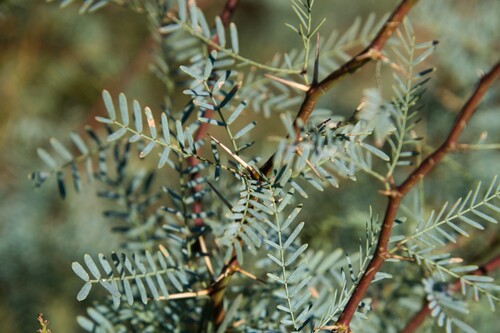


Western Honey Mesquite
neltuma odorata
The Western Honey Mesquite is an incredibly hardy and iconic deciduous shrub or small tree native to the arid desert regions of southwestern North America. Renowned for its remarkable survival strategies, this plant thrives where few others can, acting as a crucial keystone species in fragile desert ecosystems. It provides vital shade, nesting sites, and nutrition for a vast array of wildlife, from desert mammals to native pollinators. Historically, it has held great cultural and practical significance for Indigenous peoples, who utilized almost every part of the plant for food, medicine, tools, and fuel. Its sweet, nutrient-dense seed pods remain a celebrated wild forage food today, embodying the resilience and abundance of the American desert landscape.
Habitat: Typically found in dry desert washes, sandy plains, grasslands, and along ephemeral streams across the arid Southwest.
This species typically grows as a multi-trunked shrub or small tree, reaching heights of 3 to 10 meters, with a highly branched, spreading canopy. Its branches follow a characteristic zig-zag pattern and are armed with sharp, stout thorns up to 5 centimeters long at the leaf bases. The leaves are bright green, feathery, and bipinnately compound, giving the tree a light, airy texture. In spring and summer, it produces dense, cylindrical flower clusters resembling pale yellow or cream-colored catkins, which give way to long, flattened, straw-colored seed pods that hang in heavy clusters.
Category
PlantsRarity
Common
Danger
1/5 · Very low
Snaps
1
Because it fixes nitrogen, other desert plants often cluster beneath its canopy, creating diverse 'island' habitats of fertile soil in an otherwise barren landscape.
Its seed pods are rich in protein and fructose, possessing a natural sweetness that allows them to be ground into a delicious, gluten-free baking flour.
The taproot of a honey mesquite can penetrate deeper into the earth than almost any other North American plant, reaching depths equivalent to a 15-story building.
Develops an extraordinarily deep taproot system that can reach depths of up to 45 meters or more to access underground aquifers.
Works symbiotically with soil bacteria to convert atmospheric nitrogen into nutrients, enriching the surrounding desert soil.
Can shed its leaves during extreme, prolonged dry spells to drastically reduce water loss and survive severe drought conditions.
As an autotrophic plant, the Western Honey Mesquite synthesizes its own food using sunlight, water, and carbon dioxide through the process of photosynthesis.
Apis mellifera
Provides nectar and pollen, while the bees facilitate pollination of the tree's flowers.

Sylvilagus audubonii
Feeds extensively on the fallen sweet seed pods and young shoots of the mesquite.
Oncideres cingulata
The adult beetles girdle the twigs of the tree to lay eggs, which can prune and damage branch tips.
No trait badges are assigned for this object yet.
No aliases listed yet.
Collections for this object will appear here as more themes are added.
Danger
1/5 · Very low
No special safety notes yet.
The easiest way to identify Western Honey Mesquite is to use the Snappit nature identifier app.
300-1000 cm
50-150 years
As an autotrophic plant, the Western Honey Mesquite synthesizes its own food using sunlight, water, and carbon dioxide through the process of photosynthesis.
Typically found in dry desert washes, sandy plains, grasslands, and along ephemeral streams across the arid Southwest.
Photosynthesis
Zoom in to split clusters and explore where this object has been snapped.
Take the discovery with you
Snap it with Snappit to identify it, learn what makes it special, and add the discovery to your collection.












.jpg&width=800)



_001.jpg&width=800)




