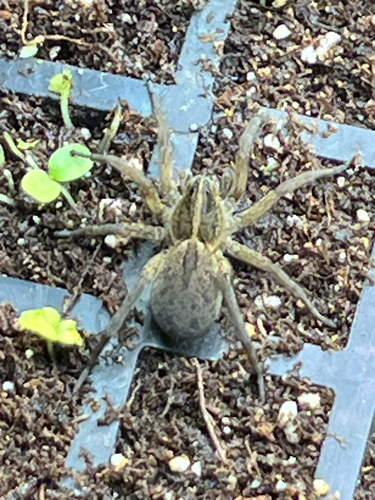
Wetland Giant Wolf Spider
tigrosa helluo
The Wetland Giant Wolf Spider is a fascinating creature that is great at hunting! With its long legs and fast movements, it can catch insects in a flash!
Habitat: Wetlands, marshes, and near ponds or lakes.
The Wetland Giant Wolf Spider is a large, robust spider with a hairy body, typically dark brown or grey. It often features darker stripes or blotches on its abdomen and a distinctive pale stripe on its cephalothorax, setting it apart from smaller wolf spiders.
Category
InvertebrateRarity
Common
Danger
1/5 · Very low
Snaps
10
Female wolf spiders are known to carry their babies on their backs like a furry backpack!
If a wolf spider loses a leg, it can regrow a new one when it molts its old skin!
They have excellent night vision, making them formidable hunters after the sun sets.
Unlike most spiders, wolf spiders don't spin webs to catch food; they chase it down!
Wetland Giant Wolf Spiders can sprint quickly and have excellent vision because of their eight eyes, helping them actively hunt prey on the ground.
Wetland Giant Wolf Spiders have a unique ability to carry their egg sac and then their baby spiders on their back, protecting them from danger.
Wetland Giant Wolf Spiders can run across water surfaces and even dive beneath the water, helping them escape predators or catch aquatic prey.
These agile hunters eat many small insects and other tiny creatures.

Gryllus pennsylvanicus
a common insect prey in its habitat
Anoplius americanus
This wasp paralyzes spiders to lay eggs on them
Aedes aegypti
These spiders help control mosquito populations near water
Didelphis virginiana
Opossums are opportunistic omnivores that prey on spiders
Solitary animals live alone for most of their lives, only interacting with others for mating or parental care.
Camouflaged describes organisms that possess coloring or patterns that allow them to blend into their environment.
This trait identifies organisms whose diet consists entirely or primarily of animal tissue.
Aquatic habitats encompass environments where organisms live predominantly in water, including oceans, rivers, lakes, and wetlands.

Nocturnal animals are primarily active during the nighttime hours, typically resting or sleeping during the day.
Danger
1/5 · Very low
Always observe spiders from a distance and do not touch them.
The easiest way to identify Wetland Giant Wolf Spider is to use the Snappit nature identifier app.
2.2 cm
1 g
1.5 years
These agile hunters eat many small insects and other tiny creatures.
Wetlands, marshes, and near ponds or lakes.
Pursuit
150-250
Zoom in to split clusters and explore where this object has been snapped.
Mar 31, 2026
Hastings Hill Historic DistrictPhoto attribution
no rights reserved
License: CC0 1.0 ↗
Image may be shown cropped inside the card frame.

Ohio, US
You might spot Widow Skimmer, Eastern Pondhawk, and Bee.
View guide →

Illinois, US
You might spot Eastern Fox Squirrel, Amur Honeysuckle, and Poison Hemlock.
View guide →

Illinois, US
You might spot Ivory Gull, Bald Eagle, and Eastern Fox Squirrel.
View guide →

Nebraska, US
You might spot Showy Milkweed and Straight-Lined Wave.
View guide →

Pennsylvania, US
You might spot Harlequin Bug, White-Tailed Deer, and Bee.
View guide →

Connecticut, US
You might spot Multiflora Rose, Christmas Fern, and Striped Wintergreen.
View guide →
Take the discovery with you
Snap it with Snappit to identify it, learn what makes it special, and add the discovery to your collection.