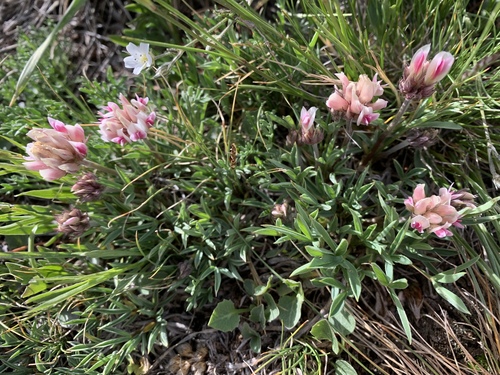


Whiproot Clover
trifolium dasyphyllum
The Whiproot Clover (Trifolium dasyphyllum) is a resilient perennial herb native to high-altitude environments. This unassuming member of the pea family is a marvel of alpine adaptation, thriving in conditions where many other plants struggle. Its name, 'whiproot,' aptly describes its tough, rhizomatous root system, which anchors it firmly in rocky, often windswept soils and helps it spread vegetatively. Despite its harsh habitat, it plays a vital ecological role, contributing to soil stabilization and nitrogen enrichment in nutrient-poor alpine meadows. It's a testament to nature's ability to flourish in extreme conditions, often forming small, vibrant patches of green and purple against the rugged mountain landscape.
Habitat: Whiproot Clover is typically found in alpine and subalpine zones, thriving in open meadows, rocky slopes, talus fields, and tundra environments.
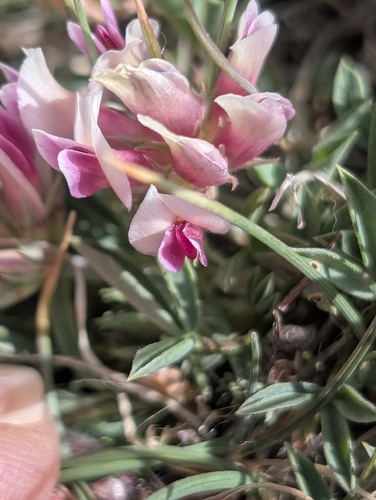
Whiproot Clover is a low-growing plant, typically reaching 5-20 cm in height. Its leaves are trifoliate (three leaflets), often slightly hairy, and can vary in color from green to reddish-bronze, especially in exposed conditions. The distinctive flowers are arranged in dense, spherical to egg-shaped heads, usually 1.5-3 cm across. The individual pea-like flowers are predominantly pinkish-purple to rosy-red, fading to lighter hues or white with age, and are often subtended by hairy bracts. Its rhizomatous roots are tough and fibrous, extending horizontally to secure the plant.
Category
PlantsRarity
Common
Danger
1/5 · Very low
Snaps
1
Despite its small size, it contributes significantly to the nutrient cycle in its ecosystem by enriching the soil with nitrogen, benefiting other alpine plants.
Its tough 'whiproots' not only help it anchor in harsh, windswept soils but also play a crucial role in preventing soil erosion on steep mountain slopes.
The plant's leaves often develop a reddish tinge in direct sunlight or cold temperatures, a protective mechanism common in alpine flora.
Whiproot Clover can be found at elevations exceeding 4,000 meters (13,000 feet) in the Rocky Mountains, showcasing its incredible high-altitude resilience.
Like other legumes, Whiproot Clover forms a symbiotic relationship with Rhizobium bacteria in its root nodules, converting atmospheric nitrogen into a usable form, enriching the poor alpine soils.
It possesses a robust, creeping rootstock (rhizome) that allows it to spread vegetatively, colonizing harsh, unstable slopes and forming dense mats that help stabilize the soil.
Adapted to the harsh alpine climate, this clover can withstand freezing temperatures, strong winds, and short growing seasons, allowing it to flourish where few other plants can.
As an autotroph, Whiproot Clover produces its own food through photosynthesis, utilizing sunlight, carbon dioxide, and water. It absorbs essential mineral nutrients from the soil via its root system.

Bombus spp.
Pollinator, essential for reproduction.

Marmota flaviventris
Grazes on foliage, impacting plant growth.

Odocoileus hemionus
Grazes on foliage in alpine areas.
Rhizobium spp.
Symbiotic nitrogen fixation in root nodules.
No trait badges are assigned for this object yet.
No aliases listed yet.
Collections for this object will appear here as more themes are added.
Danger
1/5 · Very low
No special safety notes yet.
The easiest way to identify Whiproot Clover is to use the Snappit nature identifier app.
5-20 cm
0.005-0.05 kg
5-15 years
As an autotroph, Whiproot Clover produces its own food through photosynthesis, utilizing sunlight, carbon dioxide, and water. It absorbs essential mineral nutrients from the soil via its root system.
Whiproot Clover is typically found in alpine and subalpine zones, thriving in open meadows, rocky slopes, talus fields, and tundra environments.
Photosynthesis And Nutrient Absorption
Zoom in to split clusters and explore where this object has been snapped.
Jun 7, 2026
IndependencePhoto attribution
(c) Corin, some rights reserved (CC BY)
License: CC BY 4.0 ↗
Image may be shown cropped inside the card frame.
Take the discovery with you
Snap it with Snappit to identify it, learn what makes it special, and add the discovery to your collection.













.jpg&width=800)



_001.jpg&width=800)




