





White-winged Scoter
Melanitta deglandi
The White-winged Scoter is a unique duck with striking white wing patches. They love to dive underwater to find tasty food like clams and snails. These birds are often seen in coastal areas during winter.
Habitat: Coastal areas
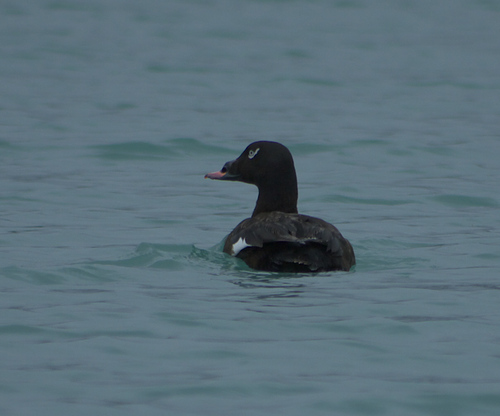
The White-winged Scoter is a large, bulky sea duck, predominantly black with a distinct white patch on its secondary wing feathers, visible in flight and at rest. Males have a bulbous orange-yellow bill with a black knob at the base, while females have a dusky bill and plainer head.
Category
BirdsRarity
Common
Danger
1/5 · Very low
Snaps
1
Their fluffy, dark ducklings are almost black, perfectly camouflaged in their marshy nests!
They can stay underwater for over a minute, using wings to 'fly' for food!
Unlike many ducks, they nest in freshwater but prefer saltwater oceans for winter!
White-winged Scoters migrate over 3,000 miles from the Arctic to southern coasts!
White-winged Scoters can dive over 60 feet deep because of their dense bones and powerful legs that help them reach food.
They have excellent underwater eyesight that helps them spot clams and mussels in murky seafloor environments.
The White-winged Scoter has a strong, broad bill that helps them crush hard-shelled mollusks and crustaceans.
These diving ducks mostly feast on tasty shellfish and crustaceans found at the bottom of the water!
Age differences: Ducklings eat more insect larvae; adults primarily consume marine invertebrates.

Mytilus edulis
Primary food source found on the ocean floor.
Macoma balthica
Key food source for scoters, found in shallow waters.

Haliaeetus leucocephalus
Adult eagles may prey on weak or young scoters.

Vulpes vulpes
Known to raid nests, eating eggs and young ducklings.
Feathered describes animals, primarily birds, possessing a covering of feathers.
Characterized by having toes connected by a membrane, typically aiding in swimming.
Social animals live in organized groups, cooperating for survival benefits such as foraging, defense, and raising offspring.
Filter feeders obtain nutrients by straining suspended food particles and small organisms from water.

Coastal habitats are dynamic environments located along the interface between land and sea, influenced by tides, waves, and saltwater.

This trait identifies organisms whose diet consists entirely or primarily of animal tissue.

Diurnal animals are primarily active during daylight hours, typically resting or sleeping at night.

Marine habitats encompass all saltwater environments of the Earth's oceans, supporting an immense diversity of aquatic life.

Migratory animals undertake seasonal movements from one region to another, typically in response to changes in climate or food availability.
No aliases listed yet.
Danger
1/5 · Very low
Always watch birds from a distance and don't try to touch them.
The easiest way to identify White-winged Scoter is to use the Snappit nature identifier app.
48-58 cm
80-99 cm
0.85-1.8 kg
10-15 years
80 km/h
These diving ducks mostly feast on tasty shellfish and crustaceans found at the bottom of the water!
Coastal areas
Zoom in to split clusters and explore where this object has been snapped.
Jul 24, 2010
Brooks River Archeological DistrictPhoto attribution
(c) Robert Webster, some rights reserved (CC BY-SA)
License: CC BY-SA 4.0 ↗
Image may be shown cropped inside the card frame.

Alaska, US
You might spot Brown Bear, Common Merganser, and Sockeye Salmon.
View guide →
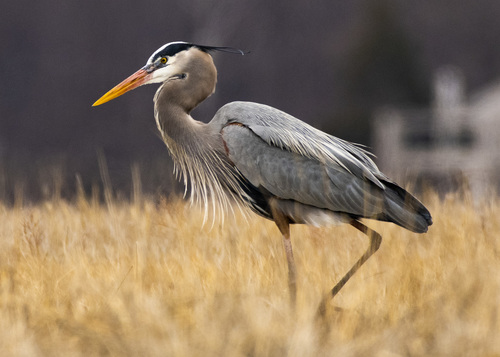
Georgia, US
You might spot Great Blue Heron and Double-Crested Cormorant.
View guide →

Massachusetts, US
You might spot American Herring Gull and Common Eider.
View guide →

Massachusetts, US
You might spot Long-Tailed Duck, American Herring Gull, and Purple Martin.
View guide →
Take the discovery with you
Snap it with Snappit to identify it, learn what makes it special, and add the discovery to your collection.




.jpg&width=800)







