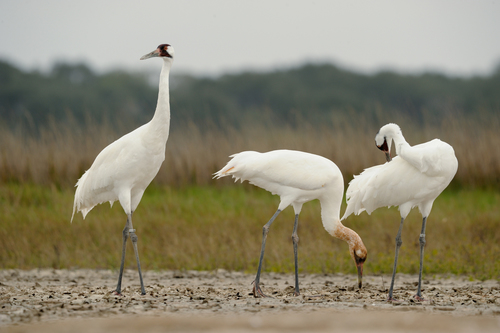


Whooping Crane
grus americana
The Whooping Crane is one of North America's most iconic and rarest birds, renowned for its majestic stature, striking white plumage, and haunting, trumpet-like calls. Standing as the tallest bird in North America, this species has become a legendary symbol of wildlife conservation. By the mid-20th century, habitat loss and hunting had decimated their numbers to a mere 15 individuals, bringing them to the very brink of extinction. Intensive, creative recovery efforts—including the famous use of ultralight aircraft to teach captive-bred chicks migration routes—have helped the population slowly rebound. Today, these elegant birds captivate birdwatchers and scientists alike with their elaborate courtship dances, which feature energetic leaps, bows, and wing-flapping, as they continue their precarious journey toward a secure future.
Habitat: Typically found in shallow wetlands, marshes, wet prairies, and coastal estuaries during breeding, migration, and wintering.
Standing nearly five feet tall, the adult Whooping Crane is a stunning, snowy-white bird with long, slender black legs and a long neck. It has a distinctive patch of bare, bright red skin on its crown, bordered by black feathers along the side of its face and throat, and a sharp, wedge-shaped yellowish bill. In flight, its massive wings reveal prominent black wingtips (primary feathers), which are otherwise hidden when the bird is at rest. Juveniles are easily distinguished by their mottled cinnamon-and-white plumage, lacking the bright red crown of the adults.
Category
BirdsRarity
Common
Danger
1/5 · Very low
Snaps
Be the first to snap!
They form monogamous pairs that mate for life, displaying intense loyalty and performing elaborate dances to reinforce their bond annually.
To teach captive-reared cranes how to migrate, conservationists dressed in non-human-like crane costumes used ultralight aircraft to guide the young birds from Wisconsin to Florida.
Whooping Cranes are the tallest birds in North America, standing nearly as tall as an average adult human.
Possesses an elongated trachea coiled within the breastbone, allowing it to produce incredibly loud, resonant, trumpet-like vocalizations that can carry for several kilometers.
Uses warm rising thermal air currents to soar effortlessly to altitudes of up to 4,000 meters, conserving energy during its long-distance migrations.
Performs highly complex, synchronized courtship dances involving dramatic jumps, wing sweeps, head-bobbing, and grass-tossing to establish and reinforce life-long pair bonds.
An opportunistic feeder that eats a wide variety of animal and plant matter found in wetlands and agricultural fields, shifting its diet depending on the season.
Age differences: Chicks consume high amounts of protein-rich insects and small invertebrates, while adults consume more grains and tubers.

Callinectes sapidus
Blue crabs are a critical, primary winter food source for the cranes in their coastal Texas wintering grounds.
Lycium carolinianum
Wolfberry bushes produce berries that serve as a crucial plant-based energy source for cranes during the winter.

Lynx rufus
Bobcats are significant predators of whooping crane chicks and nesting adults, especially in shallow-water marshes.
No trait badges are assigned for this object yet.
No aliases listed yet.
Collections for this object will appear here as more themes are added.
Danger
1/5 · Very low
No special safety notes yet.
Compare the silhouette, bill shape, tail length, wing bars and markings around the eyes. The same small brown bird at your feeder can look quite different in breeding plumage, winter plumage or its first year. Bird Identifier: upload a photo and compare the visible details.
125+ cm
200+ cm
6+ kg
22+ years
70 km/h
An opportunistic feeder that eats a wide variety of animal and plant matter found in wetlands and agricultural fields, shifting its diet depending on the season.
Typically found in shallow wetlands, marshes, wet prairies, and coastal estuaries during breeding, migration, and wintering.
Zoom in to split clusters and explore where this object has been snapped.
Recent snaps will appear here as new observations are added.

Michigan, US
You might spot Whooping Crane, Wild Teasel, and Redside Dace.
View guide →

Louisiana, US
You might spot Panthera Pardus Orientalis and Sumatran Orangutan.
View guide →

Wisconsin, US
You might spot Whooping Crane, Sarus Crane, and Sandhill Crane.
View guide →
Take the discovery with you
Snap it with Snappit to identify it, learn what makes it special, and add the discovery to your collection.