





Bobcat
Lynx rufus
Bobcats are medium-sized wild cats with beautiful spotted fur. They are great at climbing trees and love to explore their surroundings!
Habitat: Woodlands, forests, and deserts
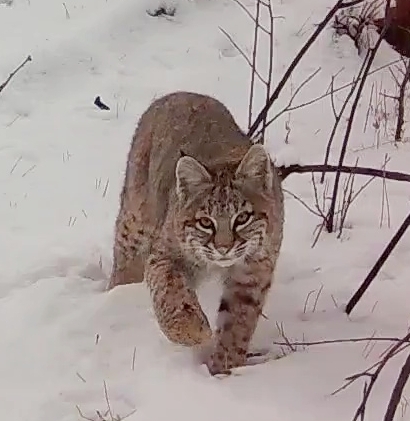
The Bobcat has tawny to grayish-brown fur with distinct dark spots and stripes, especially on its legs and face. It is easily recognized by its short, 'bobbed' tail, prominent white patches behind its tufted ears, and a ruff of fur around its cheeks.
Category
MammalsRarity
Common
Danger
2/5 · Low
Snaps
29
A Bobcat's short, 'bobbed' tail is how it got its unique name!
Bobcats can purr, growl, hiss, and even let out a 'scream' call!
Each Bobcat has unique spot patterns, like human fingerprints!
They are expert climbers, often resting or watching from tree branches!
Bobcat can move silently because of its padded paws that help them sneak up on unsuspecting prey.
Bobcat has amazing tufted ears that help them pinpoint tiny sounds from very far away.
Bobcat has large eyes that help them see clearly in the dark when hunting at night.
Bobcats are expert hunters who mainly eat small animals they catch with stealth and speed!
Furry describes animals possessing a dense covering of soft hair or fur.
Possessing prominent sensory hairs or vibrissae, often around the snout.
Solitary animals live alone for most of their lives, only interacting with others for mating or parental care.
Arboreal animals live primarily in trees, utilizing them for shelter, food, and protection from predators.

Forest habitats are terrestrial environments dominated by dense tree cover, supporting a high diversity of plant and animal life.

This trait identifies organisms whose diet consists entirely or primarily of animal tissue.

Describes a species whose presence and role have a disproportionately large effect on its environment.

Nocturnal animals are primarily active during the nighttime hours, typically resting or sleeping during the day.
Danger
2/5 · Low
Bobcats are wild animals and should be admired from a distance. It's best to enjoy them in nature without getting too close.
The easiest way to identify Bobcat is to use the Snappit nature identifier app.
65-100 cm
6-14 kg
10-12 years
48 km/h
Bobcats are expert hunters who mainly eat small animals they catch with stealth and speed!
Woodlands, forests, and deserts
Ambush
Zoom in to split clusters and explore where this object has been snapped.
Feb 19, 2026
Sioux County CourthousePhoto attribution
(c) Colin Croft, some rights reserved (CC BY)
License: CC BY 4.0 ↗
Image may be shown cropped inside the card frame.

California, US
You might spot Western Fence Lizard and California Brittlebush.
View guide →

Connecticut, US
You might spot Bold Jumping Spider and American Tuliptree.
View guide →

Alabama, US
You might spot American Beautyberry, White-Tailed Deer, and Peppervine.
View guide →

New Hampshire, US
You might spot Eastern Red-Backed Salamander and Eastern Newt.
View guide →

California, US
You might spot White Globe Lily, Rose Campion, and Pipevine Swallowtail.
View guide →

California, US
You might spot Western Fence Lizard, Duck, and California Brittlebush.
View guide →
Take the discovery with you
Snap it with Snappit to identify it, learn what makes it special, and add the discovery to your collection.




.JPG&width=800)

.jpg&width=800)





.jpg&width=800)
