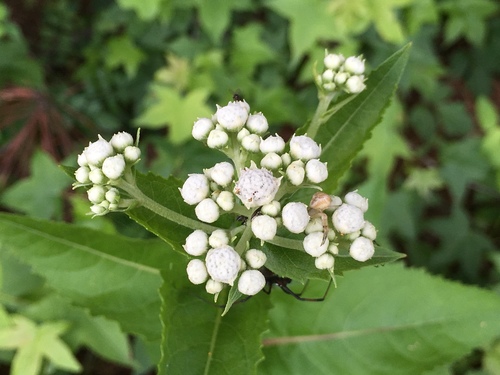


Wild Quinine
parthenium integrifolium
Wild Quinine is a robust, long-lived perennial wildflower native to the tallgrass prairies, glades, and open woodlands of eastern and central North America. This resilient member of the aster family is renowned for its dense, flat-topped clusters of woolly, cauliflower-like white flowers and its deep, drought-resistant root system. Historically utilized by Native Americans and early settlers for medicinal purposes, it serves as an invaluable anchor species in modern prairie restoration and conservation efforts. Its tolerance for poor soil and extreme weather makes it a favorite among native plant gardeners seeking to support local biodiversity.
Habitat: Thrives in dry to moist tallgrass prairies, savannas, limestone glades, and open woodlands with well-drained soils.
Growing to a height of 60 to 120 centimeters, Wild Quinine features erect, stiff stems that are often tinged with purple. Its large, dark green basal leaves are rough and sandpapery with distinct serrated edges, resembling those of a dock plant. The stem leaves are alternate and decrease in size as they ascend. The most distinctive identifier is the flat-topped terminal cluster of small, compact, button-like flower heads. These flower heads are creamy white and velvety, lacking the prominent petal-like ray florets typical of daisies, giving them a unique woolly or beaded appearance.
Category
PlantsRarity
Common
Danger
1/5 · Very low
Snaps
3
During World War I, when imports of cinchona bark were cut off, Wild Quinine was used as an emergency substitute to extract a fever-reducing medicine.
The dried flower heads retain their clean white color long after the plant has died back, making them popular in dried floral arrangements.
Unlike most members of the daisy family, its flower heads completely lack showy ray petals, resulting in their distinct, cauliflower-like appearance.
Possesses an extensive and deep taproot system that allows the plant to access moisture far below the surface during severe droughts.
Synthesizes bitter sesquiterpene lactones within its foliage to deter browsing herbivores and destructive insects.
Features coarse, sandpaper-like leaf surfaces that help reduce moisture loss by breaking up drying wind currents.
As a photosynthetic producer, Wild Quinine manufactures its own energy from sunlight, carbon dioxide, and water while drawing key minerals through its root system.
Lasioglossum vierecki
Serves as a reliable source of pollen and nectar for native pollinating insects.
Meleagris gallopavo
Forages on the mature seed heads during the late fall and winter months.
No trait badges are assigned for this object yet.
No aliases listed yet.
Collections for this object will appear here as more themes are added.
Danger
1/5 · Very low
No special safety notes yet.
The easiest way to identify Wild Quinine is to use the Snappit nature identifier app.
60-120 cm
5-15 years
As a photosynthetic producer, Wild Quinine manufactures its own energy from sunlight, carbon dioxide, and water while drawing key minerals through its root system.
Thrives in dry to moist tallgrass prairies, savannas, limestone glades, and open woodlands with well-drained soils.
Photosynthesis
Zoom in to split clusters and explore where this object has been snapped.

New York, US
You might spot Rock Pigeon, American Robin, and Spotted Lanternfly.
View guide →

Illinois, US
You might spot American Robin, Monarch, and Duck.
View guide →

Missouri, US
You might spot Painted-Cup Paintbrush and Great Spangled Fritillary.
View guide →

Illinois, US
You might spot Butterfly Milkweed and Prairie Blazing Star.
View guide →

Illinois, US
You might spot Illinois Bundleflower, Wild Bergamot, and Cup Plant.
View guide →
Take the discovery with you
Snap it with Snappit to identify it, learn what makes it special, and add the discovery to your collection.











.jpg&width=800)



_001.jpg&width=800)




