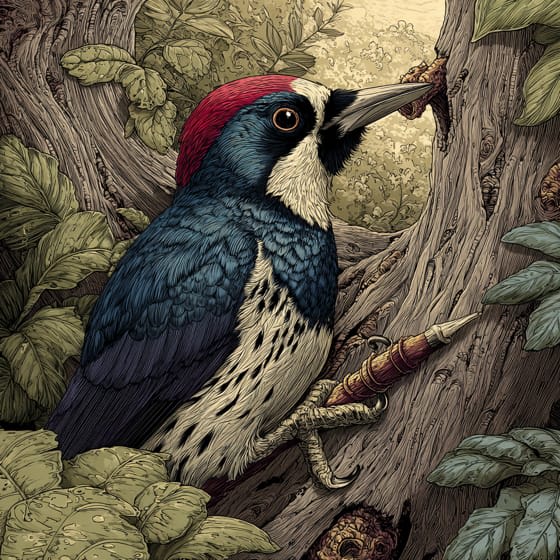





Woodpecker Finch
Cactospiza pallida
The Woodpecker Finch is a clever bird that uses tools like sticks to find insects to eat. It lives in the Galapagos Islands and has a unique beak that helps it survive in its environment.
Habitat: Coastal areas
The Woodpecker Finch has dull olive-brown plumage above, with a paler, streaked underside. Its sturdy, pointed beak helps it look for food, and it lacks the bright colors of many other finches.
Category
BirdsRarity
Rare
Danger
1/5 · Very low
Snaps
Be the first to snap!
Only birds apart from humans and great apes known to use tools regularly!
These amazing birds live only on the remote Galápagos Islands, found nowhere else!
They smartly pick the best twig or spine to fit the specific insect.
Young Woodpecker Finches learn tool use by carefully watching their parents, just like human children!
Woodpecker Finches can expertly use twigs or cactus spines to pry insects from bark, a rare bird skill.
This finch has a strong, pointed beak that helps it probe crevices and bark for hidden insect prey.
Woodpecker Finches can quickly climb tree trunks and branches because of their strong legs and gripping claws.
These clever birds primarily eat insects and larvae found hidden in tree bark and crevices.
Buteo galapagoensis
A top predator in the islands that hunts small birds.
Scalesia pedunculata
Provides crucial habitat and food sources (insects) within its bark.
Anartia jatrophae
The finch preys on the caterpillars and adult insects.
Naranjina aliciae
These beetles are a common insect prey for the finch.
Wildlife encompasses all undomesticated animal and plant life existing in their natural habitats.
Feathered describes animals, primarily birds, possessing a covering of feathers.
Arboreal animals live primarily in trees, utilizing them for shelter, food, and protection from predators.
This trait identifies organisms whose diet primarily consists of insects and other small invertebrates.

This trait describes organisms that manipulate external objects to achieve a specific goal.

Coastal habitats are dynamic environments located along the interface between land and sea, influenced by tides, waves, and saltwater.
No aliases listed yet.
Danger
1/5 · Very low
Observe these birds from a safe distance to avoid disturbing their natural behavior.
The easiest way to identify Woodpecker Finch is to use the Snappit nature identifier app.
14-15 cm
20-25 cm
0.02-0.03 kg
5-8 years
35 km/h
These clever birds primarily eat insects and larvae found hidden in tree bark and crevices.
Coastal areas
Zoom in to split clusters and explore where this object has been snapped.
Recent snaps will appear here as new observations are added.
Take the discovery with you
Snap it with Snappit to identify it, learn what makes it special, and add the discovery to your collection.




.jpg&width=800)











