
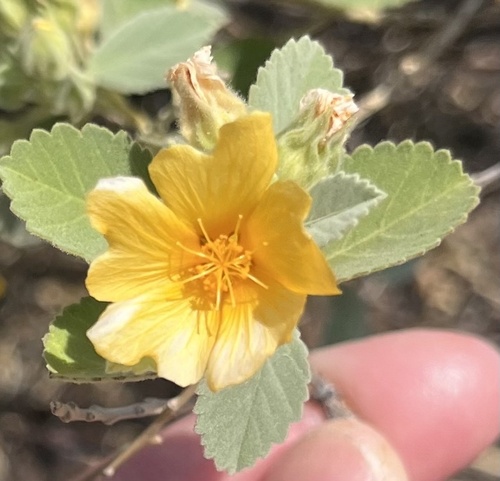


Yellow ʻIlima
sida fallax
The Yellow ȅIlima (Sida fallax) is an exceptionally resilient and culturally revered shrub indigenous to Hawaii and other tropical Pacific islands. Belonging to the mallow family (Malvaceae), this striking plant is legendary for its vibrant yellow-to-orange flowers, which are painstakingly gathered and hand-woven into prestigious leis. Historically, these delicate garlands were associated strictly with Hawaiian royalty (aliȅi), earning the plant a status of deep cultural honor. Beyond its human connections, the species is highly valued for its ecological toughness, acting as a crucial pioneer plant in harsh volcanic soils. Depending on its habitat, it exhibits remarkable variation, adapting seamlessly to different ecological niches across the Pacific.
Habitat: Thrives in sunny, wind-swept coastal shrublands, dry forest margins, and barren low-elevation lava fields.
The Yellow ȅIlima is identified by its five-petaled, golden-yellow to rich orange flowers measuring 2 to 3 centimeters in diameter, which bloom continuously throughout the year. Its leaves are heart-shaped or spade-shaped with finely serrated borders, covered in a dense layer of fine, velvety hairs that give them a distinct silvery-green or grayish sheen. The plant's growth form varies dramatically; in coastal environments exposed to heavy winds and salt, it grows as a low, prostrate ground cover reaching only 15 centimeters in height, whereas in sheltered inland areas it matures into an upright, woody shrub reaching up to 300 centimeters.
Category
PlantsRarity
Common
Danger
1/5 · Very low
Snaps
Be the first to snap!
In traditional Native Hawaiian medicine, the flowers and root bark were used to prepare remedies for mild illnesses and to ease childbirth.
It can take up to 1,000 individual, hand-picked ȅIlima blossoms to weave a single, highly prized royal lei.
The Yellow ȅIlima is the official island flower of Oȅahu, Hawaii.
The leaves feature a dense coat of velvety hairs that shield the plant from harsh, salty winds and reduce moisture loss.
It adapts its growth habit to its environment, forming a sprawling ground cover in coastal winds or a tall shrub in sheltered inland forests.
An extensive root system and specialized leaf structure allow it to survive and bloom in arid, sun-baked volcanic soils.
As an autotroph, it produces its own energy via photosynthesis, utilizing sunlight, carbon dioxide, and water.
Udara blackburni
Polinated by and serves as a larval host plant for this endemic Hawaiian butterfly.
Apis mellifera
Frequently visited by honey bees for nectar and pollen extraction.
Pinnaspis strachani
An invasive scale insect that infests the stems and leaves, sucking sap and weakening the plant.
No trait badges are assigned for this object yet.
No aliases listed yet.
Collections for this object will appear here as more themes are added.
Danger
1/5 · Very low
No special safety notes yet.
Start with the whole plant, then compare leaf arrangement, leaf edges, stems and any flowers or fruit. Opposite leaves grow in pairs; alternate leaves come one at a time along the stem. These details tell you far more together than a single green leaf does. Plant Identifier: upload a photo and compare the visible details.
15+ cm
As an autotroph, it produces its own energy via photosynthesis, utilizing sunlight, carbon dioxide, and water.
Thrives in sunny, wind-swept coastal shrublands, dry forest margins, and barren low-elevation lava fields.
Zoom in to split clusters and explore where this object has been snapped.
Recent snaps will appear here as new observations are added.

Hawaii, US
You might spot Yellow ʻilima, Red-Tailed Tropicbird, and White Leadtree.
View guide →

Hawaii, US
You might spot Yellow ʻilima, Indian Tulip Tree, and Yellow Tang.
View guide →
Take the discovery with you
Snap it with Snappit to identify it, learn what makes it special, and add the discovery to your collection.

















