

Yellow Peppercress
lepidium flavum
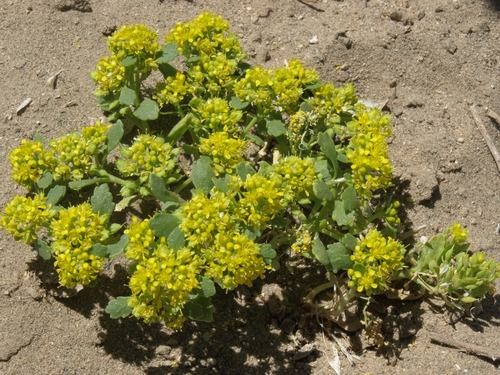
Yellow Peppercress (Lepidium flavum) is an endearing desert annual that brings a splash of cheerful color to the arid basins of the southwestern United States and northern Mexico. Belonging to the mustard family (Brassicaceae), this hardy little plant thrives where many others fail, colonizing alkaline flats, dry lake margins, and sandy creosote scrublands. It responds dramatically to winter rains, carpet-bombing the desert floor with low-growing mats of yellow blooms during the early spring. As a pioneer species, it plays a vital role in stabilizing sandy soils and providing early-season sustenance for desert pollinators and herbivores.
Habitat: Found in dry, sandy, or highly alkaline desert environments, including alkali sinks, clay flats, and creosote bush scrub.
This low-profile annual herb features prostrate to decumbent stems extending 5 to 30 centimeters along the ground, forming dense, fleshy mats. Its small leaves are deeply lobed or toothed, often with a slightly succulent texture to retain water. During its peak blooming period, it displays clustered racemes of tiny, bright yellow flowers, each featuring the characteristic four petals of the mustard family. Following pollination, it produces flat, heart-shaped or notched seed pods known as silicles.
Category
PlantsRarity
Common
Danger
1/5 · Very low
Snaps
Be the first to snap!
In years of heavy winter rainfall, Yellow Peppercress can participate in desert 'superblooms', turning arid basins into vast yellow carpets.
Its seeds possess a peppery flavor, a characteristic shared with many members of the mustard family, giving the plant its common name.
The species name 'flavum' is Latin for yellow, pointing to its bright, cheerful flowers that stand out against drab desert soils.
Capable of thriving in highly saline and alkaline soils where most other plants would suffer from osmotic stress.
Launches a rapid life cycle, germinating quickly after winter rains to bloom and set seed before the extreme heat of summer.
Grows flat against the ground to minimize exposure to dehydrating desert winds and to reduce moisture loss.
Like other plants, Yellow Peppercress is an autotroph that generates its own energy through photosynthesis, utilizing sunlight, carbon dioxide, and water.

Gopherus agassizii
The desert tortoise grazes on the nutritious foliage of the Yellow Peppercress during the spring.

Pontia protodice
Caterpillars of this butterfly feed on the leaves of Brassicaceae plants including Lepidium species.
Apis mellifera
Bees visit the yellow blossoms for nectar and pollen, aiding in the plant's reproduction.
No trait badges are assigned for this object yet.
No aliases listed yet.
Collections for this object will appear here as more themes are added.
Danger
1/5 · Very low
No special safety notes yet.
Start with the whole plant, then compare leaf arrangement, leaf edges, stems and any flowers or fruit. Opposite leaves grow in pairs; alternate leaves come one at a time along the stem. These details tell you far more together than a single green leaf does. Plant Identifier: upload a photo and compare the visible details.
5-30 cm
0.01-0.05 kg
0-1 years
Like other plants, Yellow Peppercress is an autotroph that generates its own energy through photosynthesis, utilizing sunlight, carbon dioxide, and water.
Found in dry, sandy, or highly alkaline desert environments, including alkali sinks, clay flats, and creosote bush scrub.
Zoom in to split clusters and explore where this object has been snapped.
Recent snaps will appear here as new observations are added.
Take the discovery with you
Snap it with Snappit to identify it, learn what makes it special, and add the discovery to your collection.