
Snappit logo
Snappit
Get App
Generic illustration, not a photograph of this venueIllustration
ParkIT

Foreste Casentinesi, Monte Falterona and Campigna National Park

The most satisfying visit starts with choosing one part of the park.

About

The most satisfying visit starts with choosing one part of the park. Campigna suits a forest-focused day with flexible walking distances; Camaldoli pairs a compact botanical circuit with monastic history; La Verna brings wooded limestone cliffs and Franciscan heritage; Acquacheta is the choice for a longer waterfall walk. These places are spread across mountain valleys, so trying to collect them all in a day means spending much of it in transit. Leave room for a quiet lunch, an interpretive stop or simply the slower pace that a woodland path invites. Take the ultimate field guide with you: use the Snappit app to identify birds, plants, and animals on your trip.

The national park was established in 1993, but the relationship between people and trees is much older. At Camaldoli, monastic life and the cultivation of silver fir developed together over centuries. Campigna’s impressive fir stands also reflect deliberate forestry rather than an entirely untouched landscape. Sasso Fratino offers an important contrast: protected as a strict reserve from 1959, it allows natural forest processes to unfold with very limited human interference. Its old beech forest became part of the UNESCO World Heritage beech-forest site in 2017.

What to do here

Use the official nature trails as your starting point, then match the outing to your energy and the conditions. The options below are separate days or alternatives, rather than stages of one continuous tour.

Seasonal info

Forest colour, flowing water and snow vary with altitude and recent weather. Choose your actual route after checking conditions, rather than treating a calendar month as a guarantee.

Accessibility

Campigna has a purpose-designed short sensory trail. Elsewhere, a short distance or a “nature trail” label does not establish step-free access. Ask about the surface and facilities that matter to you.

Don't miss

1

Campigna’s silver-fir woods and flexible forest-road walking

2

The Camaldoli nature circuit and its monumental trees

3

La Verna’s woodland, limestone and Franciscan history

4

The Acquacheta valley and the waterfall celebrated by Dante

Walks and routes

Campigna: a short sensory introduction

Start beside the small forestry museum, near Albergo Granduca, for Un sentiero per tutti…i sensi. The park describes a nearly level 350-metre trail through the Viale dei Tigli, with interpretive features that invite a slower look. It is a good choice when you want a taste of the forest without committing to a long hike. Allow around half an hour to explore, longer if you enjoy the stops.

Designed for blind and partially sighted visitors, wheelchair users and people with limited mobility. Wet ground and mud can reduce usability; confirm current access and your specific needs before travelling.
Campigna: a short sensory introduction

Campigna: Strada delle Cullacce

For a longer, less steep outing, try the gravel Strada delle Cullacce and its “Alberi che toccano il cielo” interpretation. The road runs 5 km each way, making 10 km if you go to its end and return; the route card allows about four hours of walking. Turn back earlier if that better suits your day. The interest is the succession of trees and the forest around you, not a summit to reach.

The operator describes a broadly level gravel road with rest stops for walkers and cyclists. Gravel and distance still matter for wheels; do not assume that the whole road meets the short sensory trail’s accessibility standard.

Campigna: Strada delle Cullacce

Campigna: the silver-fir nature circuit

If you prefer a shorter walk with more climbing, the Campigna nature trail explores the Fosso Abetio fir woods. The official leaflet describes a circular route of about 3.5 km with 200 m of ascent and two hours including stops. Its theme is silver fir: look at how the tall trunks shape the forest, while the interpretation explains why these stands also tell a story of planting and timber.

This is a woodland hiking circuit with ascent, distinct from the short accessible sensory trail.

Campigna: the silver-fir nature circuit

Camaldoli: trees beside the monastery

The Camaldoli nature circuit is a rewarding choice if you like identifying trees and understanding how a forest has been used. The official leaflet gives a 2.6 km circular route, 100 m of ascent and two and a half hours with interpretation stops. It introduces the woodland around the monastery, including the celebrated Miraglia chestnut. Keep the walk unhurried, then leave a separate slot for the religious buildings rather than treating them as another trail checkpoint.

Expect a woodland path and some climbing. The nearby monastery and the Sacro Eremo are separate places, so check the walking or road connection if you want to visit both.

Camaldoli: trees beside the monastery

La Verna: woodland, rock and pilgrimage

At Chiusi della Verna, the official nature trail brings the geological and human history of La Verna together. Its leaflet describes an approximately 2.5 km circular outing taking about two hours with stops, beginning by the visitor-centre area and reaching the sanctuary surroundings. Old paving and limestone outcrops give the walk a different character from Campigna’s fir woods. This is the nature circuit, not a measured summit itinerary for Monte Penna.

Uneven stone and woodland surfaces call for steady footing. A visit to the sanctuary can be planned separately from the full walk; confirm suitable entrances and facilities directly if you need step-free access.

La Verna: woodland, rock and pilgrimage

Acquacheta: a longer valley walk

Set aside the day’s main walking time for the nature trail from San Benedetto in Alpe along CAI 407. The official leaflet gives about 9 km out and back, 250 m of ascent and four and a half hours including stops and return. The waterfall is the famous destination, but the route continues the valley’s story through old mill and settlement remains toward Piana dei Romiti. Dante used the waterfall as an image in Canto XVI of the Inferno.

A sustained valley hike rather than a short viewpoint stop. Leave enough time and energy for the return, and avoid approaching wet edges or entering fast-flowing water.

Acquacheta: a longer valley walk

A relaxed first day

Choose Camaldoli: allow the morning for the nature circuit, take a lunch break, then visit whichever religious or museum spaces are open. Alternatively, stay at Campigna and pair the short sensory trail with as much of Strada delle Cullacce as feels comfortable. These are editorial ways to pace a day, not packaged or guaranteed operating itineraries.

Things to try

Keep a local indoor option

If the weather makes woodland walking unattractive, Camaldoli’s ornithological museum or the forestry museum near Badia Prataglia can keep the day connected to nature, provided they are open. Religious buildings have their own visiting arrangements and worship schedules. Check first rather than driving across the park in search of a fallback.

Wildlife and habitats

European beech

Beech is widespread at the park’s higher elevations. Its deciduous canopy makes the difference between fresh spring green and autumn colour especially striking. Look at woodland from the path without trampling the ground around old trees.

Silver fir

Silver fir belongs naturally to these mountains, but Campigna’s extensive fir stands also reflect centuries of deliberate forestry. The nature trail makes that distinction part of the visit.

Red deer

Red deer are part of the park’s wild mammal community. Late-September rutting calls are a seasonal highlight; join a responsible guided outing rather than trying to approach the animals.

Roe deer

Roe deer also occur here. Treat any encounter as a chance moment and give the animal space to move away; there is no dependable public viewing spot promised by this guide.

Grey wolf

The wolf is the park’s largest predator. Learning about its role in the forest is a more realistic aim than planning your day around a sighting.

Black woodpecker

Black woodpecker is among the birds associated with the park’s mature forest. Large old trees and cavities are part of what makes these woods valuable for woodland birds.

Rosalia longhorn beetle

This blue-and-black beetle depends on dead wood in mature forest. Park conservation work has supported its habitat in beech woods. Adults are active in summer, but leave logs and bark untouched rather than disturbing habitat to find one.

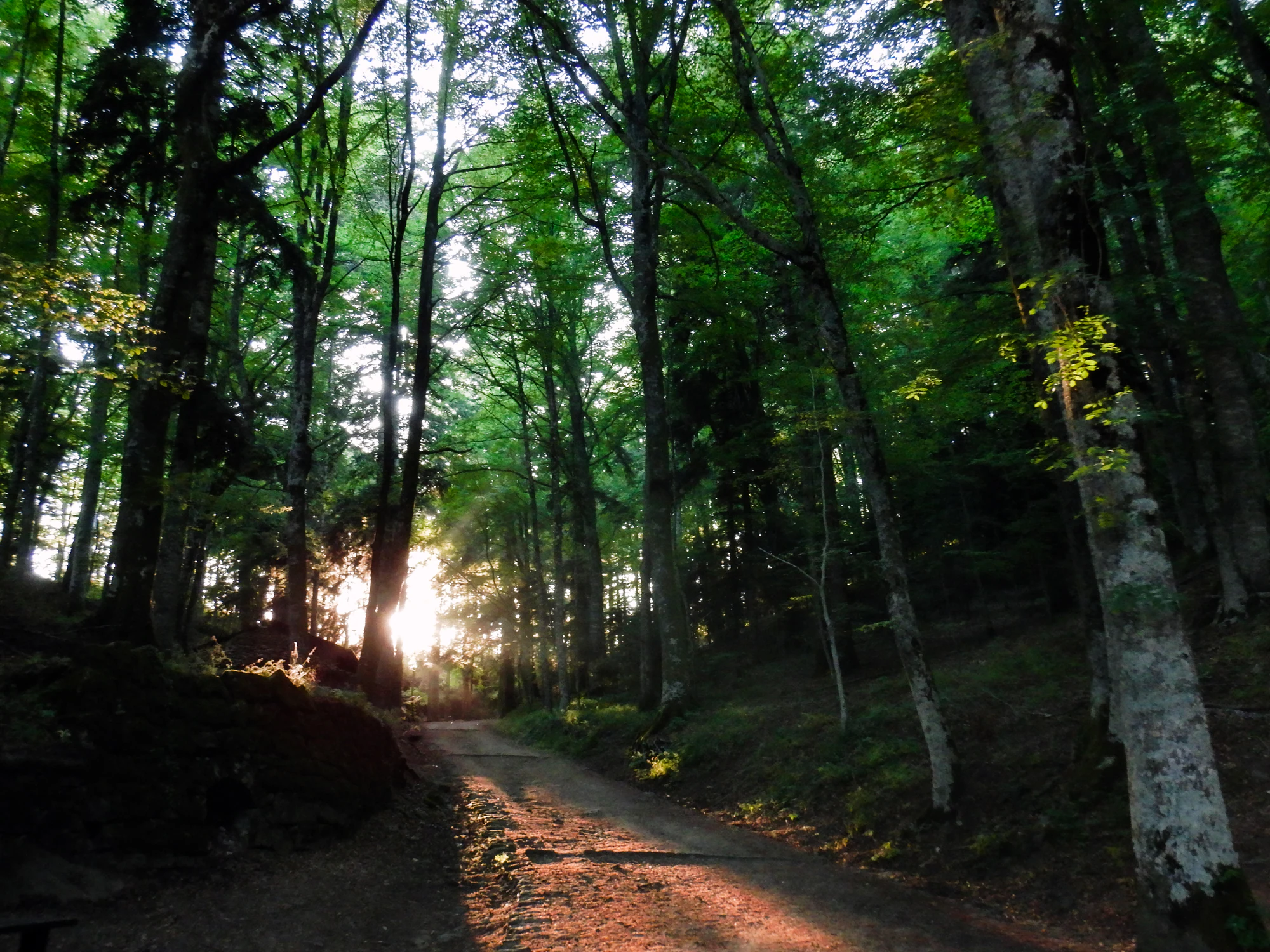
Low sunlight reaches a winding woodland path beneath tall leafy trees; no sanctuary building is visible.

Evening light on a forest path near La Verna, July 2022.

“Al calar del sole nella faggeta.jpg” — Albarubescens, via Wikimedia Commons. CC BY-SA 4.0. Unmodified offered original. · Creative Commons

Stories and discoveries

Old forest includes fallen trees

A fallen trunk is not simply a sign of neglect. Dead wood supports insects and other organisms, and the park’s LIFE Eremita work has deliberately increased suitable habitat for forest beetles. Seeing that cycle changes the way a woodland walk feels: an ageing tree and the life around it are part of the same living forest.

When to visit

Spring: leaves and flowing valleys

Choose Camaldoli for trees coming into leaf, or consider Acquacheta when recent conditions make the valley walk suitable. Its leaflet recommends April–June among the preferred periods. Rain can make a waterfall more dramatic while also making the approach less comfortable; check the forecast and surface before setting out.

Summer: make the most of the canopy

The shaded Campigna and Camaldoli options are appealing for a slower forest day. Start with the walk, keep water and food with you, and leave space for an indoor or cultural stop later. Summer is also the adult season for Rosalia, though finding one is never assured.

Autumn: separate the rut from the colour

The park highlights late September for deer calls and late October for forest colour. Those are useful seasonal clues, not fixed appointments: weather and elevation shift the display. Choose a base for more than one night if you want flexibility, and leave plenty of daylight for the return walk.

Winter: change the plan, not just the clothing

Snow, ice and rime can transform the higher forest. Choose winter outings suited to your equipment and experience, or use a local guide. A summer route description does not establish winter suitability. A short cultural visit may be a better choice when walking conditions are poor.

Getting there and practical advice

Information, meals and overnight stays

Camaldoli’s park information point supplies maps and publications, helps with excursions and houses the Biggeri ornithological collection. Badia Prataglia’s information point is another useful stop, with the Carlo Siemoni arboretum and forestry museum nearby. Opening days are seasonal. Arrange meals and overnight accommodation in advance if your plan depends on them, and carry what you need for the walk rather than counting on an open refreshment stop.

Before you drive or set off

Checked on 19 October 2026: the park reports the Corniolo/San Martino junction–Passo della Braccina road closed to ordinary vehicle traffic until 30 October. Recheck your approach and the live trail notices before leaving. The list is indicative, so an unlisted path is not confirmed open. The park information office is +39 0575 503029.

Choose the gateway before the journey

For the Tuscan side, the park points to the Casentino towns via the SR71 from Arezzo or the SR70 from Florence; Chiusi della Verna is reached from Bibbiena via the SP208. On the Romagna side, Forlì gives access to the Montone valley toward San Benedetto in Alpe and the Bidente valley toward Santa Sofia. Select the actual village or trailhead, not just “the national park”, as your destination.

Without a car

The park lists rail gateways at Bibbiena, Poppi, Pratovecchio and Stia, with Pontassieve and Contea-Londa for the western Tuscan side, and Faenza, Forlì and Cesena in Romagna. These are onward-travel gateways rather than trailhead stations. Use the current local bus planners, Autolinee Toscane or Start Romagna, and check both outward and return services for your date before booking a base.

Ask about the whole outing

For Campigna’s sensory trail, ask about the approach from parking, recent mud, the condition of interpretive features and a suitable toilet, as well as the path itself. At La Verna or Camaldoli, confirm the particular building and entrance you intend to use. The information available here does not establish an uninterrupted accessible chain from transport to every facility.

Sources and useful links

Wildlife you might spot

7

Each card links to a full Explore page with photos, traits, and fun facts.

Snap map for this place

Start with the big picture, then zoom in to explore individual wildlife observations around this place.

Loading map…

Good to know before you go

Download the official route sheet before setting out; do not rely on reception in the forest.

Bring water, food, a waterproof layer and footwear with grip, even for a short outing.

Keep to marked paths and leave dead wood, plants and wildlife undisturbed.

Check the return journey before committing to a bus-based walk.

Frequently asked questions

No ordinary sightseeing access is offered to the strict reserve. Entry is reserved for specifically authorised research. Enjoy the permitted forest routes around Campigna and elsewhere in the park instead; a path approaching the reserve is not permission to cross its boundary.
It is a proper half-day walk: the official nature-trail leaflet gives about 9 km return and 250 m of ascent. Choose it for children who already enjoy that amount of walking. Campigna’s short sensory trail is a much gentler starting point.
Plan around the individual places and activities you want to use. Guided outings, accommodation, indoor visits and special-access arrangements can have their own booking or charging rules. Check those directly before travelling; a published walking route is not an all-inclusive admission ticket.
The park asks visitors to keep dogs on a lead and pick up after them. Check separate restrictions with any accommodation or religious site you plan to enter.
The photograph was taken on a woodland path near La Verna, toward its Monte Penna. The Monte Penna viewpoint reached by CAI trail 225 near Badia Prataglia is a different place. Check the full place name when choosing a route.
Both live in the park, but a walk is no guarantee of an encounter. A guided nature outing can help you understand their ecology without seeking out resting animals. Keep a respectful distance if wildlife appears, and never bait or pursue it.

Recent snaps at this place

Recent snaps will appear here as new observations are added.

View all ›

Take the discovery with you

Exploring Foreste Casentinesi, Monte Falterona and Campigna National Park?

Identify the wildlife you spot, learn as you go, and keep a collection of the adventure.

  1. 1Spot it
  2. 2Snap it
  3. 3Keep the discovery











