
Snappit logo
Snappit
Get App
Generic illustration, not a photograph of this venueIllustration
ParkKR

Suncheon Bay National Garden

The east grounds are the natural choice for the Lake Garden and many of the world gardens; the west brings the Korean Garden, tree collections and wetland-related displays together.

About

The east grounds are the natural choice for the Lake Garden and many of the world gardens; the west brings the Korean Garden, tree collections and wetland-related displays together. Space Bridge links the two sides. This is a cultivated national garden, distinct from the coastal Suncheon Bay Wetland farther south. Use the [official garden map](https://scbay.suncheon.go.kr/garden/0016/0001/0003/) to choose your entrance and a manageable set of stops. Wondering what that bird or insect is? Find out on your visit using the Snappit nature app.

The garden grew from the 2013 Suncheon Bay International Garden Expo, reopened permanently in April 2014 and became Korea’s first national garden on 5 September 2015. Another international garden expo followed in 2023. The collection has continued to change, so old expo maps are useful historical records rather than dependable guides to today’s entrances and attractions. [Garden history](https://scbay.suncheon.go.kr/garden/0006/0001/0001/).

What to do here

Choose three anchors rather than every attraction: the Lake Garden for the broad landscape, a world garden for a closer look at planting and design, and the Korean Garden for ponds, pavilions and a different mood. Leave time to sit between them. Visitors with young children can substitute an animal display or play area for the longer crossing.

Seasonal info

Summer calls for shade breaks; winter shifts attention to tree shapes and garden structure. Garden Dream boat trips are listed as suspended from December through March.

Accessibility

Wheelchair and stroller rental is listed, but availability and eligibility need checking. A garden-wide step-free circuit has not been verified. Plan around the main paths, ask staff about slopes and current detours, and treat hill viewpoints as optional rather than necessary to enjoy the landscape.

Don't miss

1

The Lake Garden’s sculpted hills and water-level views

2

Contrasting layouts in the world gardens

3

The Korean Garden’s palace, scholar and wish-garden themes

4

Cultivated trees with individual stories and changing seasonal beds

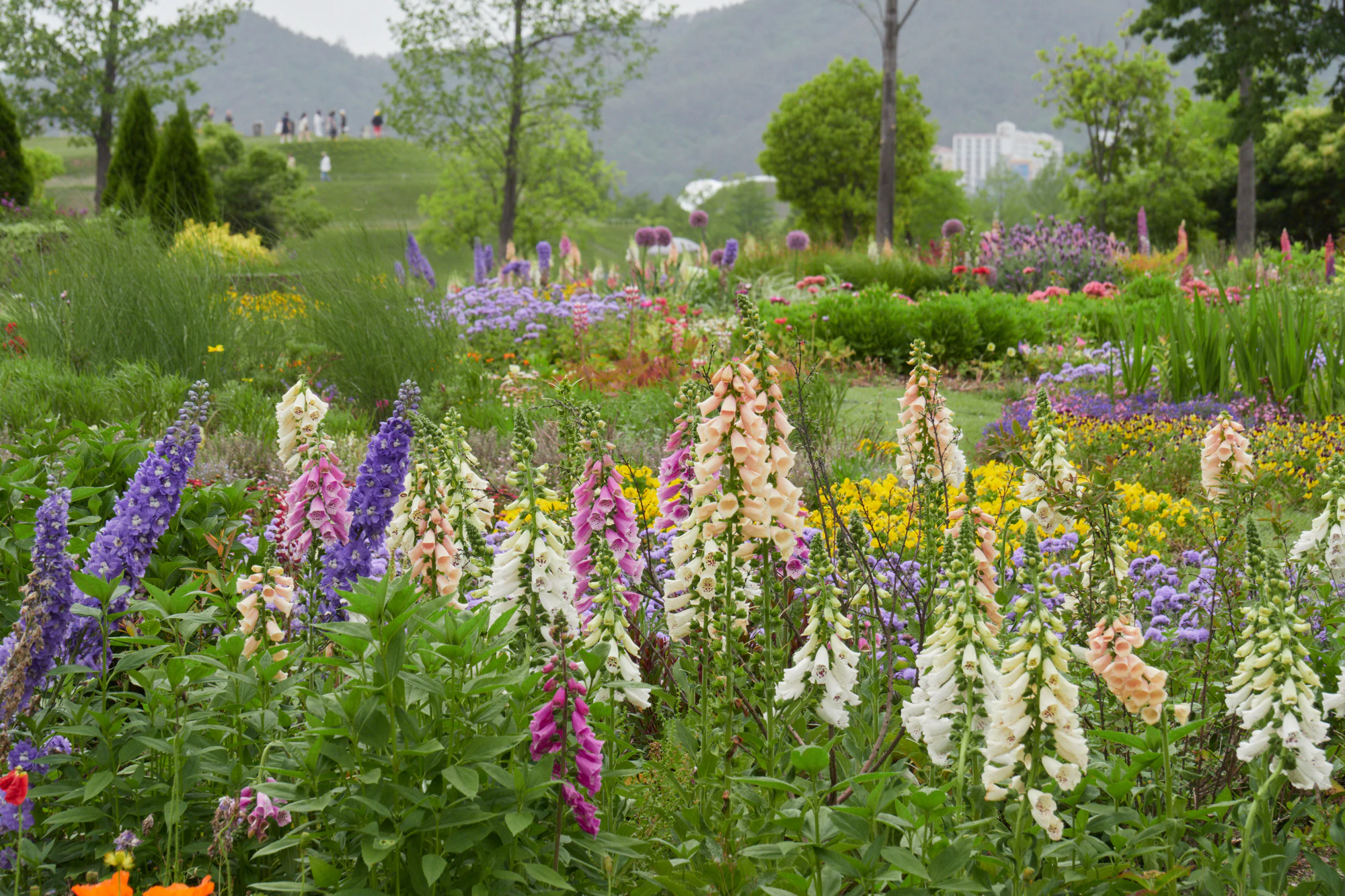
Tall cream, pink and purple flower spikes rise above yellow and lilac planting, with clipped green shrubs, trees, a grassy mound and hazy hills behind.

Layered flowerbeds and clipped planting at Suncheon Bay National Garden in an earlier photograph. The capture date and exact garden section are unknown; this is not a forecast of the flowers you will find on your visit.

“SuncheonBNG2959” by lumoplank, via Flickr, CC0 1.0. No changes. · Creative Commons 1 · Creative Commons 2

Walks and routes

East Gate: lake and world gardens

Start at East Gate and make the Lake Garden your main destination. Choose a small group of world gardens rather than trying to finish the entire collection: the Netherlands Garden for its windmill setting, France for formality, or Spain for a quieter citrus-garden idea. Return toward your starting gate when energy runs low. This is an editorial selection of stops, not a measured signed circuit.

Keep the hill climbs optional. Ask at the entrance for the most suitable main-path approach to your chosen gardens.


East Gate: lake and world gardens

West Gate: Korean Garden and trees

Enter at West Gate and choose the tree collection and Korean Garden as your focus. The Korean Garden brings together palace, scholar and wish-garden traditions; give the ponds and pavilions time instead of using them as a quick backdrop. If you want a shorter family visit, stay around the west-side animal and wetland-display area instead.

The Korean Garden occupies terrain associated with the arboretum; do not assume every pavilion or viewpoint has a step-free approach.

West Gate: Korean Garden and trees

Both sides with a deliberate crossing

For a longer visit, choose an east-side highlight, cross by Space Bridge, then explore a small west-side selection. Stop for food or a seated rest before adding another garden. If your vehicle is at the original gate, leave time to cross back; an exit on the opposite side is not a shortcut to your parked car.

A longer outing means sustained walking even when no hill is climbed. Shorten the plan at the bridge if needed.

Both sides with a deliberate crossing

A relaxed garden half-day

Spend the first part of the visit on one anchor garden, take a proper break, then add a contrasting area before returning. Leave the rest for another visit if flowers or a shaded bench hold your attention.

Garden plus coastal wetland

Spend the morning in a selected part of the garden, then transfer after an early meal. Before leaving, check the last connection back and how you will reach your accommodation. A sunset at the wetland can conflict with the last train. If you want to stay late there, arrange an independent road return rather than relying on the garden’s 20:00 closing time.

Things to try

Make a family-sized day

The west-side Children’s Zoo and associated bird-display areas can anchor a shorter outing. These are managed animal displays; they should not be confused with free-living birds in the coastal wetland. Check opening and any programme arrangements on the zoo page and let children choose one main stop rather than promising every attraction.

Try a garden workshop

Therapy Garden advertises fragrance-making and other sensory craft sessions. Treat these as optional activities and check the current programme, price and booking arrangements before adding one. Its published hours are 09:00–17:00 with weekly Monday closure, normally moving to Tuesday when Monday is a public holiday. Workshop information.

Photograph the planting, leave the bed intact

A long view across a border can show its layers without stepping among the plants. For close-ups, wait for a gap in the foot traffic and keep your equipment on the path. Check permission before bringing professional filming or recording equipment.

A shorter visit with an indoor stop

The garden History Hall beside the West Gate parking area offers exhibitions about the garden’s development; its page lists 09:00–18:00. It can give a short visit a useful indoor anchor, but confirm opening that day. In heavy rain, shorten the outdoor plan rather than trying to finish a cross-garden circuit. History Hall.

Wildlife and habitats

Plants to look for

The garden’s tree stories introduce several of its cultivated specimens. These are planting records, not wild-population sightings. Individual trees and seasonal displays can change; use current labels and leave flowers and seeds where they are.

Ginkgo

The tree collection includes the named “Five-Minutes-Before Ginkgo,” whose story tells of rescue from felling. Ask for its current label rather than trying to identify the individual tree from an old photograph.

Tulip Tree

The operator records a tulip tree donated by soprano Sumi Jo on Maple Tree Path. It is a planted tree with a personal story, distinct from the tulips used in seasonal flowerbeds.

Japanese Zelkova

A zelkova donated by singer Jang Sa-ik is associated with the Beast’s Rose Garden. The tree is a useful reminder to look above the flower display as well as down into it.

Rose of Sharon

The Mugunghwa Garden is devoted to cultivated rose of Sharon. Its flowering season offers a reason to return after spring bulbs have finished; ask which cultivars are blooming that week instead of expecting every plant to flower together.

Stories and discoveries

A miniature landscape of Suncheon

Charles Jencks designed the Lake Garden around the city’s geography. Its six hills recall surrounding mountains, the lake stands for the urban area, and the crossing deck represents the Dongcheon. The view makes more sense when you read it as a model of a city held among hills and water, rather than as unrelated ornamental mounds. Lake Garden interpretation.

The world gardens adapt their ideas

The national-themed gardens are designed interpretations rather than transplanted landscapes. Spain uses yuja citrus in place of oranges less suited to local growing conditions. The Netherlands Garden pairs tulip planting with a windmill and wooden-shoe sculptures. Looking for what has been adapted to Suncheon is part of the pleasure. World gardens.

Dream Bridge has become Space Bridge

Older guides may call the river crossing Dream Bridge. The operator now presents it as Space Bridge, a space-themed walk-through attraction. The children’s drawings associated with the earlier bridge were digitized as part of its renewal. Use the current name when asking for directions.

When to visit

Spring: choose a flowering area

The Netherlands Garden’s tulips are a natural spring focus. Ask what is at its best on the day and concentrate your visit there; a garden can be enjoyable before or after a headline display peaks.

Summer: slow down

Break the visit into shorter sections with indoor or seated pauses. Mugunghwa is a summer-to-autumn flowering focus. An evening garden visit may be more comfortable, but it provides less time for attractions with earlier closing hours.

Autumn: trees as well as flowers

Leave time for the tree collection and wooded paths alongside seasonal beds. Conditions differ between sunny open grounds and the shaded edges, so carry a layer if you plan to stay into the evening.

Winter: structure and shorter connections

Look at the relationship between bare branches, pavilions, water and sculpted ground. Plan a shorter outdoor visit on cold days. The SkyCube return timetable shifts one hour earlier in November, and Garden Dream boat trips are suspended December–March.

Getting there and practical advice

Opening and admission

As checked on 18 October 2026, the garden lists 09:00–20:00, with final admission at 19:00. The grounds close on the last Monday of each month. Individual rides and displays have shorter hours or extra closure days. Weather can alter arrangements. Check hours and closures before travelling.

Day ticket or evening visit?

Standard individual daytime admission is ₩10,000 for adults aged 19–64, ₩7,000 for teenagers aged 13–18 and ₩5,000 for children aged 7–12. This covers the garden and coastal wetland on the same day. Discounted night tickets are sold 17:00–19:00 for the garden only; they do not include wetland entry. Check concession eligibility and bring proof. Current ticket conditions.

Food, storage and family facilities

The official facilities map lists food outlets, cafés, a convenience store, nursing facilities, luggage storage, rentals and a medical centre. Locate what you need near your chosen route on arrival; opening hours vary. A café stop is easier to plan than carrying a picnic into grounds that restrict outside food. Facility locations.

Arriving from Suncheon

The city’s directions page lists bus 66 from the stop opposite Suncheon Station to National Garden East Gate. From the intercity bus terminal, it lists 66, 67 and 101 from the stop by Nonghyup across the road. Confirm the direction and current service before boarding. For a taxi, show the Korean garden name and your chosen gate. Arrival directions.

SkyCube is a separate transfer

SkyCube links Garden Station on the west side to Suncheon Bay Station near the coastal wetland. The 4.6 km rail journey takes roughly 8–12 minutes, but you still have about 1 km to walk to the wetland’s Mujingyo entrance, or can use the Reed Train. The latter is free for SkyCube passengers. Budget separately for SkyCube: standard adult/teen fares are ₩8,000 return or ₩6,000 one-way. Transfer guide · Fares.

Plan the return before boarding

SkyCube normally closes every Monday, moving to the next weekday if Monday is a public holiday. First trains leave Garden Station at 10:00 and Suncheon Bay Station at 10:20. Last departures are 18:00 from the garden and 18:30 back from Suncheon Bay Station in March–October, or 17:00 and 17:30 in November–February. The final Reed Train from Mujingyo leaves ten minutes before the last garden-bound SkyCube. Leave a generous margin: busy return queues can exceed 30 minutes, and the two services are not a guaranteed last-minute connection. Operator timetable.

Arrange assistance before a long circuit

Ask the customer centre about the route between your selected gate, toilets and gardens, especially if you need to avoid steps or steep sections. The published rental page specifies eligibility for manual and powered wheelchairs; it does not establish available stock or the suitability of every path. Confirm those details directly before relying on a rental.

Transfers need their own access check

The SkyCube FAQ asks passengers to fold strollers and warns that return boarding may involve a queue. Wheelchair loading dimensions, boarding assistance and the entire onward wetland link have not been verified here. Ask the operator about your particular mobility aid before making the transfer central to your plans. SkyCube FAQ.

Sources and useful links

Wildlife you might spot

4

Each card links to a full Explore page with photos, traits, and fun facts.

Snap map for this place

Start with the big picture, then zoom in to explore individual wildlife observations around this place.

Loading map…

Good to know before you go

Choose East Gate or West Gate deliberately, and save your arrival gate in your phone so you can return to the correct parking area.

Keep the admission ticket. One re-entry is allowed that day; ask for the exit stamp before leaving.

The garden’s late closing time does not extend the last SkyCube, Reed Train or individual attraction departure.

Bring comfortable walking shoes, sun protection and an unopened commercially bottled drink. Outside food and alcohol are prohibited; eating is restricted to designated places.

Stay out of flowerbeds and avoid blocking narrow paths for portraits. Drones, collecting plants and smoking are prohibited.

For same-day questions, the garden customer centre is 061-749-3114; SkyCube enquiries are 061-740-0600.

Frequently asked questions

No. The national garden is a designed landscape in the city; the wetland is a separate coastal reed-bed and mudflat destination. A standard daytime admission ticket covers both on the same day. The discounted garden night ticket does not include wetland entry.
Use East Gate for a visit centred on the Lake Garden and world gardens, or West Gate for the Korean Garden and tree collections. If you have limited time, return through the same gate rather than committing to a cross-garden walk.
Ordinary pets and visitor bicycles or recreational electric vehicles cannot enter. The rules exempt special-purpose animals such as guide dogs and allow wheelchairs and strollers. A separate dog-play area is listed outside West Gate; check its arrangements before travelling.
No. Its composition is also worth seeing from the paths beside the water. Choose a viewpoint climb only if the route is open and comfortable for your group; do not climb grass banks or use closed sections for a better photograph.

Recent snaps at this place

Recent snaps will appear here as new observations are added.

View all ›

Take the discovery with you

Exploring Suncheon Bay National Garden?

Identify the wildlife you spot, learn as you go, and keep a collection of the adventure.

  1. 1Spot it
  2. 2Snap it
  3. 3Keep the discovery






