Give Ueno enough time to be a park, rather than a corridor between museums. Start on the raised ground around Takenodai Square and its fountain, then work your way toward Shinobazu Pond. The change from tree-lined paths to open water is the heart of this visit. Two or three hours lets you make that journey at an unhurried pace, with room to stop when something catches your eye.
The trees give you something to notice outside blossom season. Ginkgo leaves open like small fans; Japanese zelkova has a spreading crown and bark that flakes in patches. Both are listed among the park’s principal trees. Pause to compare their leaf shapes and the way their branches spread overhead. With children, choose one leaf shape to find again farther along the path, without pulling leaves from branches.
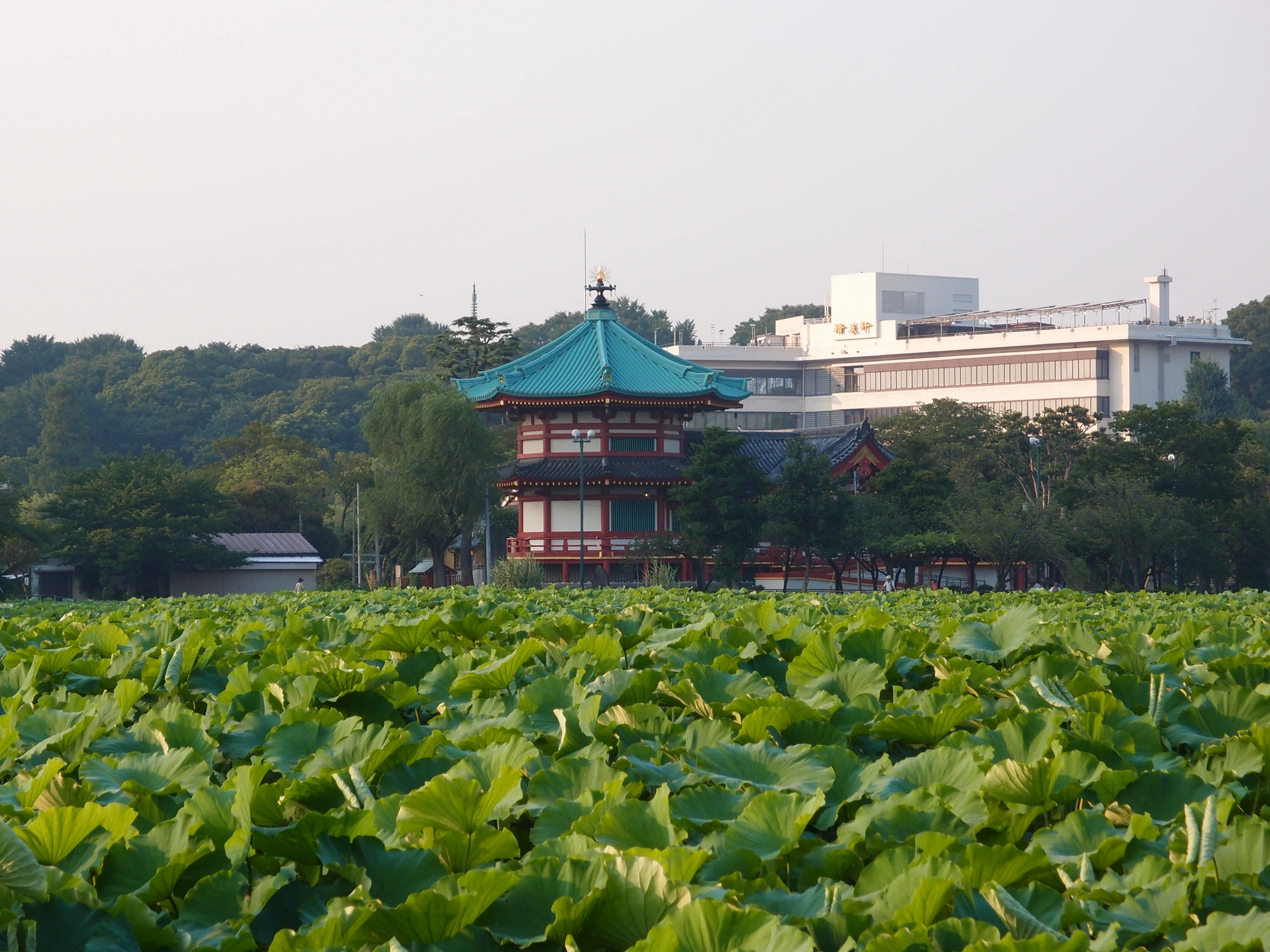
Down at Shinobazu, the name covers three connected-looking but distinct sections: the Lotus Pond, the Boat Pond and the Cormorant Pond. The public lotus-viewing deck and boat-pond paths are the focus here. The Cormorant Pond lies within the zoo’s West Garden boundary, so a park walk does not give access to every shore. Bentendo, the octagonal temple hall beside the water, is a useful landmark as you explore the public paths and causeways. Its present building dates from 1958.
In summer, the lotus leaves can become the main landscape. They rise above the water, with pink flowers among them in season. Come early for open blooms, then look more closely at the difference between a closed bud, a flower and a developing seed head. Later in the year, shift your attention from flowers to birds and the changing trees. Black-headed gulls and grey herons have been documented at the public pond; these are wild visitors, with no guarantee that a particular bird will be there when you arrive.
Spring brings a different kind of energy. The main cherry avenue is a place to enjoy hanami, the custom of spending time beneath the blossom, but it can be very crowded. Ueno’s cherries are not all one variety: the park’s collection includes early-flowering trees and Somei-yoshino, followed by later double-flowered cultivars. Look at the flowers you actually find instead of expecting the whole park to bloom on one date.
There is history within the walk, too. Kiyomizu Kannon-do was founded in 1631 and modeled on Kyoto’s Kiyomizu-dera; it was moved to its present site in 1694. Nearby, the Saigo Takamori statue includes a dog named Tsun, an easy detail for younger visitors to spot. If you would like an indoor second chapter, the National Museum of Nature and Science connects the afternoon to Japan’s natural history. Keep it optional: the park and pond already make a complete outing, and museum admission and opening arrangements are separate. Enhance your adventure: download the Snappit app to identify the local species you encounter.
Ueno became one of Japan’s first designated public parks in 1873, on land formerly belonging to Kan’ei-ji. The operator records its opening date as 19 October 1873. In 1924 the site was bestowed on Tokyo City, giving rise to the name Onshi, meaning imperial gift. Its temple buildings, monuments and cultural institutions reflect different stages of that story rather than one single founding moment. Kiyomizu Kannon-do predates the public park by more than two centuries, while the Saigo statue was unveiled in 1898 and today’s Bentendo was rebuilt in 1958.