Snappit logo
Snappit
Get App
Generic illustration, not a photograph of this venueIllustration
ParkComunidad de Madrid, Spain

El Retiro Park

El Retiro rewards a smaller plan than its famous name might suggest.

About

El Retiro rewards a smaller plan than its famous name might suggest. Spend time with the Parterre’s carefully shaped greenery and its broad, branching ahuehuete, then choose a second garden or a pause beside the Estanque Grande. Looking closely at two places is more satisfying than rushing between every monument.

This is a designed urban landscape with very different moods: formal garden rooms, shaded avenues, ornamental water and space for everyday recreation. The Rosaleda and the enclosed Jardines de Cecilio Rodríguez add another layer of garden design. Trees planted for beauty and shade share the park with free-living birds; the peafowl belong to a managed, introduced population.

Keep the art buildings as optional extras. As checked on 17 October 2026, the Palacio de Cristal is closed for restoration, while the Palacio de Velázquez has reopened. You can enjoy a worthwhile outdoor visit without entering either building. Check the city’s park-alert page before leaving, because weather restrictions can close individual gardens or the whole park. Enhance your adventure: download the Snappit app to identify the local species you encounter.

El Retiro began as a royal pleasure ground in the seventeenth century, developed for Philip IV and his court beside the Buen Retiro palace. War damaged the estate, and later rulers reshaped it with new planting and buildings. After the revolution of 1868 the gardens passed to Madrid’s city council for public recreation. Their different layouts preserve that long sequence of changes. The park now forms part of the Paseo del Prado and Buen Retiro cultural landscape, inscribed on UNESCO’s World Heritage List in 2021.

What to do here

Begin with the Parterre: compare clipped shapes with the ahuehuete’s spreading limbs, using the botanical signs to identify what you see. Add the Estanque Grande for a waterside pause, or choose the Rosaleda and Cecilio Rodríguez gardens if flowers and formal planting appeal more. The city’s marked Senda Botánica offers genuine short sections to follow rather than a single all-or-nothing tour.

Seasonal info

The main park normally opens daily from 06:00 to midnight in April–September and 06:00–22:00 in October–March. The Rosaleda and Cecilio Rodríguez gardens have shorter hours, given below. Rose beds and deciduous trees change through the year; winter is a good time to pay attention to trunks, branches and the garden’s layout.

Accessibility

Plan around a suitable entrance and a short section rather than assuming the whole park has the same surface or gradient. Ask the environmental information centre which open paths and toilets meet your needs. The city documents accessible-circuit improvements around Plaza de Honduras and Herrero Palacios; this does not make every botanical section step-free. The Alfonso XII tower has 97 steps and no lift.

Don't miss

1

The Parterre and its remarkable ahuehuete

formal planting beside a tree with an expansive, irregular shape.

2

The Estanque Grande and Alfonso XII monument

enjoy the waterside setting without booking a boat.

3

The Rosaleda in flower, with its garden structure worth noticing outside the rose season too.

4

Jardines de Cecilio Rodríguez

ordered hedges, fountains and the park’s managed peafowl population.

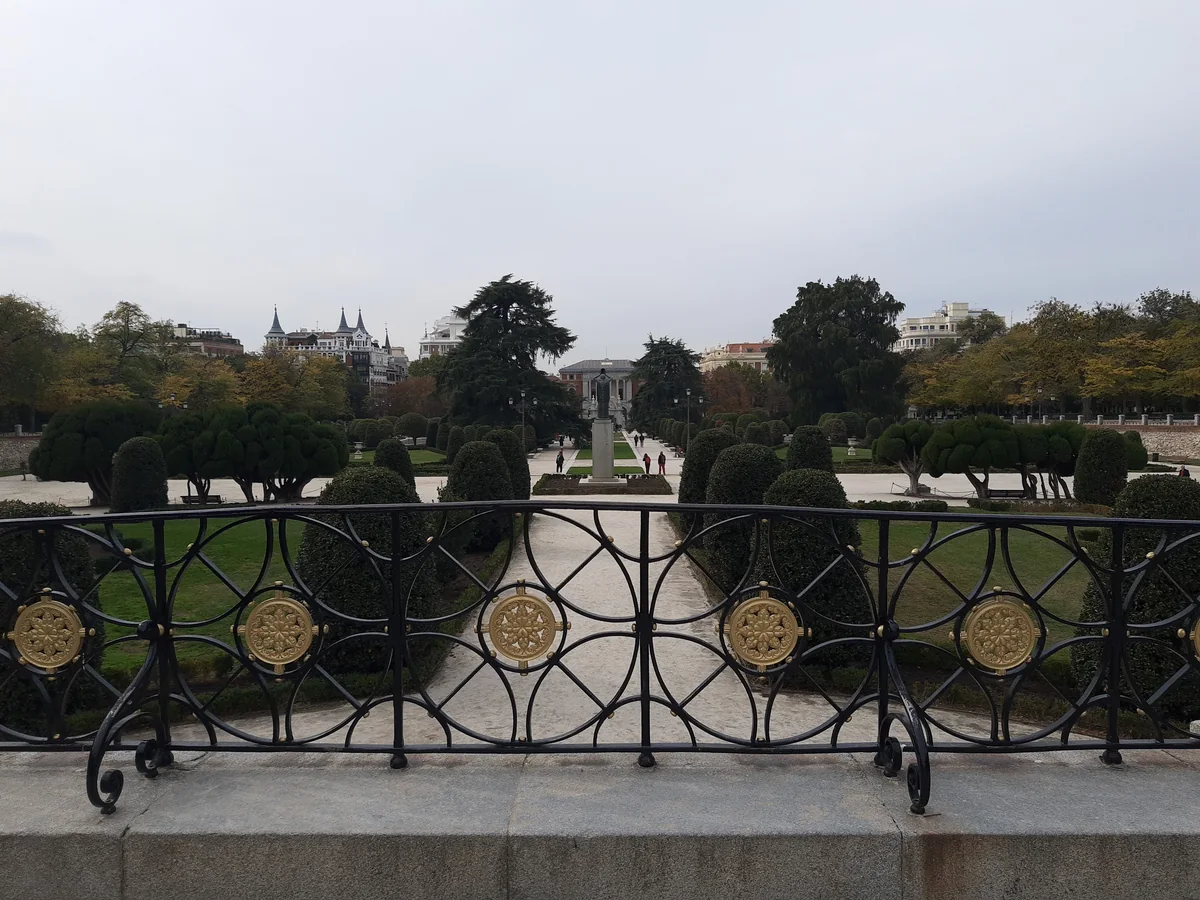
An ornamental black-and-gold railing overlooks symmetrical paths and rounded clipped trees, with distant visitors and city buildings under a grey sky.

The Parterre in El Retiro, looking west in October 2023. Clipped trees and geometric paths show the formal-garden side of the park.

Parterre, El Retiro, Madrid.jpg — Gerda Arendt / Wikimedia Commons / CC0 1.0 Universal Public Domain Dedication · Creative Commons 1 · Creative Commons 2

Walks and routes

Senda Botánica, section 1: the oldest gardens

Follow the official section called Los jardines más antiguos, which finishes at the Parterre. Its formal planting makes a good starting point for comparing garden design with natural tree shapes. Use the current leaflet and numbered signs; stop wherever a tree catches your attention.

Ask which approach to the Parterre best suits your wheelchair or pushchair; the botanical leaflet is not a step-free route guide.


Senda Botánica, section 1: the oldest gardens

Senda Botánica, section 2: remembrance and orchard

El Bosque del Recuerdo y el Huerto del Francés combines a memorial garden with an almond-tree area. Keep the memorial a quiet stop, then look for the different arrangement of orchard planting. In blossom season, leave time to enjoy a small area rather than adding a long circuit.

Check the chosen approach with the information centre if uneven surfaces or slopes are difficult.

Senda Botánica, section 2: remembrance and orchard

Senda Botánica, section 4: Campo Grande

El Campo Grande explores the landscape-style part of the park. The pond beside Palacio de Cristal has planted bald cypresses; the building’s restoration makes the trees and surrounding garden the focus for now. Follow only open signed paths around any work barriers.

Check current diversions before committing to this section; a clear onward step-free line is not guaranteed by the botanical map.

Senda Botánica, section 4: Campo Grande

Senda Botánica, section 5: Cecilio Rodríguez and Herrero Palacios

This official section links two garden areas with a strong formal character. Use the botanical labels to seek out the silver maple, then compare clipped planting, water and built details. The two areas have different access restrictions during alerts.

The city has documented pavement improvements in Herrero Palacios. Ask about the complete approach to the enclosed garden if you need a step-free visit.

Senda Botánica, section 5: Cecilio Rodríguez and Herrero Palacios

One unhurried hour, with room to linger

Make the Parterre your whole visit if time or energy is limited. Read a botanical label, pause at the ahuehuete, and spend a few minutes looking at the clipped planting. If you still feel like exploring, choose a nearby open avenue and turn back when you are ready. There is no need to complete a circuit.

A garden-led half-day

Choose the Parterre plus either the Estanque Grande or the southern gardens. In rose season, give the Rosaleda more time; at other times, compare it with Cecilio Rodríguez. Plan a proper rest between areas and finish when your group has had enough. Rowing or an exhibition works best as a separately timed extra, rather than something squeezed in before closing.

The complete official Senda Botánica totals 8 km across seven independently usable sections. You do not need to walk all of it. The choices here are actual sections of that trail; use the official leaflet for their mapped lines and on-site signs for any diversion.

Things to try

A family tree-and-shape challenge

Choose one labelled tree and sketch its outline without picking anything. Find a planted shape that looks carefully clipped, then one that spreads freely. Compare two leaves already lying on a path and return them there. Keep everyone on permitted paths and away from water edges.

Optional paid rowing on the Estanque Grande

Published prices checked 17 October 2026 are €6 per boat on weekdays and €8 on Saturdays, Sundays and public holidays, for 45 minutes and up to four people. Children under 14 need an adult aged 18 or over. Operating hours are separate from park hours, with a midday break and a seasonal final session. Check availability and reserve through the municipal centre, Madrid Móvil or the official sports booking service. Confirm any work-related disruption before paying.

Optional reserved Alfonso XII viewpoint

The tower visit needs advance booking through the Pasea Madrid programme. There are 97 stairs and no lift, so the lakeside view of the monument is the simpler choice if steps are a problem. Check the programme for the next available sessions rather than assuming a walk-up visit.

Optional art at Palacio de Velázquez

Reopened in June 2026, this Reina Sofía exhibition venue offers free entry. Its published hours are 10:00–21:00 in April–September and 10:00–18:00 in October–March, with rooms cleared ten minutes before closing. It closes on 1 and 6 January, 1 May and 25 December, and between exhibitions; 24 and 31 December finish at 17:00. Check the current show and bag rules before arriving. Palacio de Cristal remains closed for works.

Guided environmental activities

The Centro de Educación Ambiental organises walks, workshops and exhibitions. Browse its current programme and the conditions of the activity you want; a listed service does not mean every session is available without booking.

Listen as you explore

Use the city’s official audio-guide page if you prefer a little history alongside your walk. Pick a few stops and keep the volume low enough to hear other path users.

Light rain, with the park open

Shorten the garden visit and consider a currently open exhibition at Palacio de Velázquez or Casa de Vacas after checking their own timetable. Wet paving and steps can be slippery. Palacio de Cristal is not an indoor fallback during restoration.

A park closure or severe weather

Switch to an indoor plan outside the park and return another day. Do not enter a restricted garden or wait beneath trees for conditions to improve. Follow the city’s instructions even if your booked activity or an old photograph suggests normal access.

Wildlife and habitats

The Parterre’s ahuehuete

The municipal leaflet identifies this planted tree as Taxodium mucronatum. Look at its candelabra-like branching from the path. Its precise age is unknown. Pause far enough back to see how its main limbs fan out.

Silver maple

Use the botanical label in Cecilio Rodríguez to find the silver maple, then compare its branching shape with the clipped planting around it.

Aleppo pine

Look for the labelled Aleppo pine around the Rosaleda. Stand back to take in the whole crown; do not enter protected planting beds for a closer view.

Common yew

Near Palacio de Velázquez, use the botanical sign to identify the yew. Observe from the path and keep clear of any protection around its roots.

Common blackbird

Pause at a planted edge and watch for a long-tailed bird moving on the ground. Adult males are black with an orange-yellow bill; females are browner. Use several features rather than colour alone.

Great tit

Look for a small, active bird with yellow underparts in trees and listen before moving on. A quiet minute can be more useful than searching a large area.

Indian peafowl

In Cecilio Rodríguez, give the peafowl space to move and let them approach or walk away on their own. These are managed garden birds, so enjoy them without feeding, touching or blocking their path.

Trees here are part of a planted garden collection. Blackbirds and great tits are free-living wild birds; the peafowl are managed introduced garden birds. Sightings vary. Watch quietly, do not feed animals, and leave nests, roots and planted beds undisturbed.

Stories and discoveries

A tree’s age is not its arrival date

The ahuehuete’s exact age is uncertain. Its long presence in the Parterre matters more than a neat anniversary, and a very old transplanted tree elsewhere in the park is a different kind of history.

A landscape larger than one park

The UNESCO inscription joins El Retiro with the Paseo del Prado and the Real Jardín Botánico. The shared heritage story does not make them one attraction with common entrance arrangements.

Buildings with former lives

The library’s pavilions once belonged to the Casa de Fieras zoo, while Casa de Vacas began as a dairy and milk shop. They are good reminders that the park has repeatedly found new uses for old buildings.

When to visit

Spring

Look for changing leaves and blossom, with May and June the main published rose months. Build in time for the garden you most want to see and leave another for a future visit if paths are busy.

Summer

Start early for a shorter shaded walk, or after 10:00 for the enclosed gardens. Carry water and check the park alert before setting off. Shade is helpful, but it is not a reason to ignore a heat or tree-risk closure.

Autumn and winter

Enjoy foliage changes and, later, the clearer outlines of branches and formal beds. Plan enclosed-garden visits before 18:00, and do the outdoor part in daylight. Wind, heavy rain and other adverse conditions can change access at short notice.

Getting there and practical advice

Information and environmental centre

The Centro de Educación Ambiental is on Paseo Fernán Núñez; call +34 91 376 91 97 or use its contact page for help planning. Its current autumn/winter schedule, 16 September–31 March, is Tuesday–Saturday 10:00–14:00 and 15:30–18:00; Sundays and public holidays 10:00–15:00. Spring and summer hours differ, so check before making a special trip.

Toilets, water and somewhere to rest

The park has public toilets, drinking fountains and benches, but do not assume every toilet or fountain will be working. Ask for the nearest open facility and confirm accessible-toilet arrangements if essential to your visit. Carry your own water so you can choose a comfortable stopping point.

Refreshments

Kiosks and terraces offer places for a paid refreshment break. Their opening and prices are separate from the park’s, so carry a snack if your day depends on a particular meal time. Take your litter away and leave ornamental beds undisturbed.

Play and family breaks

There are children’s play areas in the park. Choose one close to your current garden instead of promising a cross-park detour when children are tired, and respect weather-related closures.

Library and cultural centre

The Eugenio Trías municipal library occupies former zoo pavilions and includes children’s reading areas. Casa de Vacas, near the boating lake, offers cultural programming and exhibitions. Check each venue’s own opening and programme before using it as an indoor stop.

Choose the side of the park first

Retiro station, on Metro line 2, serves the northern side; Ibiza, on line 9, is useful for the eastern side. Estación del Arte, on line 1, suits an approach from the Prado and Atocha side. Choose your first garden before routing to an entrance, particularly if you want to minimise walking.

Train and bus connections

Atocha is a useful rail arrival point for a visit from the south-west. For buses, use the official transport planner to find a stop near your chosen gate rather than taking any service described as serving “Retiro”. Check service changes and station lift status for your travel day.

Orientation

The main street edges are Alfonso XII to the west, Alcalá and O’Donnell to the north, Menéndez Pelayo to the east and Poeta Esteban de Villegas to the south. The named gardens are within this park; an address for one entrance is not a route to every attraction.

Garden paths and seating

The park’s adapted circuit includes seating improvements, work at the Plaza de Honduras drinking fountain and improved paving in Herrero Palacios. These are useful areas to ask about, but confirm your whole route, including the entrance and return. Allow for crowds, wet surfaces and temporary barriers.

Water and tower attractions

The rowing centre lists two boats suitable for wheelchair users and describes the facility as only partly accessible. Contact it about availability, the approach and boarding arrangements for your chair. The Alfonso XII tower has no lift and cannot provide a step-free visit.

Main park

Free ordinary entry. Daily, 06:00–00:00 from April to September and 06:00–22:00 from October to March. Always check entrance notices and weather restrictions.

Enclosed gardens

The Rosaleda and Jardines de Cecilio Rodríguez normally open daily 10:00–20:00 in April–September and 10:00–18:00 in October–March. Aim to visit these well before the main park closes.

Weather alerts

Madrid’s park alerts are separate from the normal timetable. Yellow alert restricts play, sports and older-person exercise areas and the Cecilio Rodríguez gardens. Orange adds further restrictions, including Herrero Palacios and outdoor events. Red closes El Retiro. Follow the official status map, barriers and staff instructions; do not wait under trees when an alert advises against it.

Restoration and changing access

Checked 17 October 2026: Palacio de Cristal remains closed for restoration. The city has also announced Estanque Grande works for late 2026. Check the museum and rowing-centre pages shortly before visiting, particularly if a building interior or boating is your main reason for coming.

Sources and useful links

Wildlife you might spot

6

Each card links to a full Explore page with photos, traits, and fun facts.

Snap map for this place

Start with the big picture, then zoom in to explore individual wildlife observations around this place.

Loading map…

Good to know before you go

Check Madrid’s official park-alert map and the signs at your entrance. Leave promptly if staff close the park; a normal opening timetable does not override an alert.

For Cecilio Rodríguez or the Rosaleda, plan for 10:00–20:00 in April–September and 10:00–18:00 in October–March, subject to restrictions.

Do not plan an indoor visit to Palacio de Cristal while restoration continues. Check Reina Sofía’s separate opening information for Palacio de Velázquez.

Bring water and sun protection, and use benches for breaks. Ask where the nearest open toilet is before starting a longer outing.

Enjoy birds at a distance, without feeding or chasing them. Keep dogs under control and follow the signs for each garden and facility.

Use the latest botanical leaflet

signs and tree stops were updated in 2025. Choose one section before adding another.

Keep children close beside water and on monument steps. Play areas can be restricted during weather alerts even when other parts of the park remain open.

If rowing matters to you, check the municipal sports centre before travelling. Work on the Estanque Grande was announced for late 2026, and operating arrangements can change.

Frequently asked questions

Ordinary entry to the park is free. Rowing is paid separately. The Alfonso XII tower viewpoint requires a reservation through Pasea Madrid; its outdoor monument can be appreciated without taking the tower tour. Individual activities and venues have their own arrangements.
No. The Rosaleda and Jardines de Cecilio Rodríguez normally open at 10:00, closing at 20:00 in April–September and 18:00 in October–March. Weather alerts can further restrict access.
It remained closed for restoration when checked on 17 October 2026. Palacio de Velázquez reopened in June 2026 and has its own exhibition timetable. Consult Reina Sofía before adding either building to your plans.
Its precise age is uncertain. The municipal botanical guide explicitly says so. Enjoy its unusual branching form without treating a traditional age estimate as a proven planting date.
There are adapted areas, but surfaces, entrances and individual attractions differ. Confirm a suitable approach and an open accessible toilet for your intended visit. The Alfonso XII tower is reached by stairs only; ask the rowing centre about its adapted boats if you want to go on the water.
It is a separate, independently managed destination outside El Retiro. This guide covers the park’s own gardens, including the Parterre, Rosaleda and Cecilio Rodríguez gardens.

Recent snaps at this place

Recent snaps will appear here as new observations are added.

View all ›

Take the discovery with you

Exploring El Retiro Park?

Identify the wildlife you spot, learn as you go, and keep a collection of the adventure.

  1. 1Spot it
  2. 2Snap it
  3. 3Keep the discovery