Ashizuri-Uwakai National Park follows the southwestern edge of Shikoku through Kochi and Ehime, taking in islands, deeply cut bays and inland mountains. For a first visit, settle on Tatsukushi in Tosashimizu rather than trying to cover the whole park. Here, a visitor center, unusual coastal rocks and a living coral community give you several ways to enjoy the same stretch of sea. Cape Ashizuri and the Uwakai coast are separate outings.
Start at Tatsukushi Visitor Center Uminowa. A look at its landscape model and exhibits helps turn the view outside into a story: why the coast has such strange shapes, what lives underwater, and how the sea connects to the land. Much of the interpretation is available in English. Check the day's tide and water-condition information, then ask staff which shore walk or boat option suits your group. The center is also a useful place to pause if someone needs a quieter start.
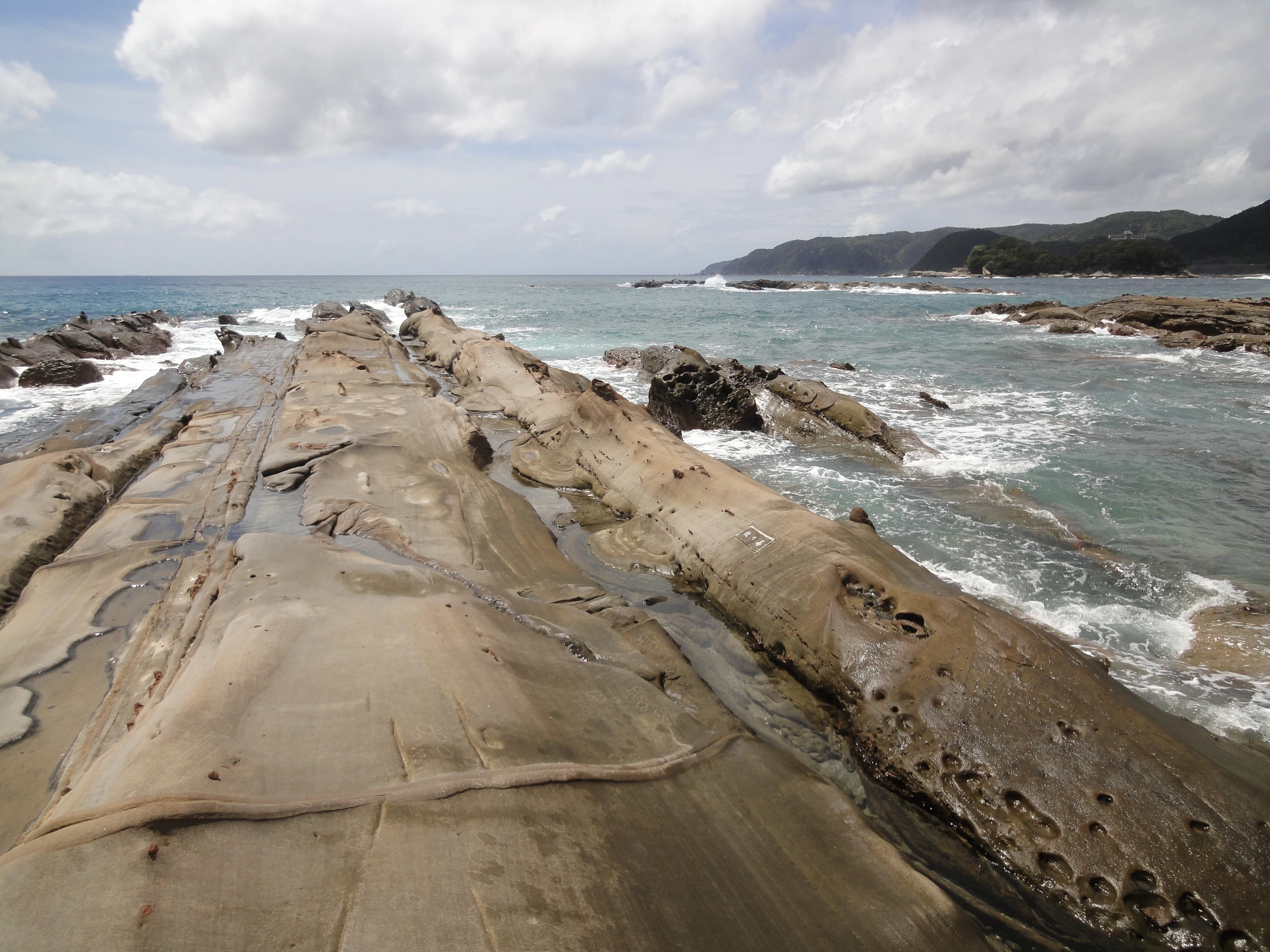
On the Tatsukushi Coast, the interest is often under your feet. Sandstone and mudstone laid down around 17 million years ago now carry ridges, folds, old ripple marks and traces of burrowing animals. Look for the long, jointed-looking rocks called Otake and Kotake, or 'large bamboo' and 'small bamboo.' They are rock formations, not petrified bamboo. A short, careful walk can be more rewarding than hurrying past every named feature. Ask at Uminowa which formations you can currently reach, and turn back when the surface or waves no longer suit you.
Coastal access needs particular care. A March 2026 notice closes the path from the Sakurahama-side entrance to Senjojiki after rockfall, and the city warned of a collapsed walkway section in June. Keep away from damaged sections and barriers. Ask staff for a currently open short walk; do not plan a complete shoreline circuit.
The water tells a different story. The warm Kuroshio Current helps support corals and fish associated with warmer seas here in temperate Japan. These are rich coral communities; they do not build the extensive reef landforms familiar from the Ryukyu Islands. A glass-bottom boat lets you look down into this habitat without swimming. In suitable conditions, a landing at Minokoshi adds another rocky coastline, known for honeycomb-like holes and sculpted sandstone. Arrange the return with the crew before stepping ashore.
SATOUMI, the nearby Ashizuri Aquarium, offers a closer, steadier look at animals in managed displays. Its sequence follows the connections between forest, river and sea, making it a good companion to the outdoor visit. An aquarium animal is not evidence that you will find the same species in the next rock pool. Outdoors, enjoy whatever the conditions reveal, leave wildlife alone and never reach into holes or pick up unfamiliar shells.
One important change affects older itineraries: the separate Ashizuri Underwater Observatory ended operations on 30 September 2026. SATOUMI is a different attraction. Make your day around Uminowa, the open shore areas, the aquarium and, when running, a boat trip. Take the ultimate field guide with you: use the Snappit app to identify birds, plants, and animals on your trip.
The area began as a quasi-national park in 1955. Tatsukushi was among Japan’s first marine park zones in 1970, and the enlarged Ashizuri-Uwakai National Park was designated on 10 November 1972. Its conservation story continues on land as well as underwater: heavy rain in 2001 carried large quantities of sediment into Tatsukushi Bay and damaged coral communities. A restoration council formed in 2006 brought residents, researchers and public bodies together around the bay and its catchment.