Takamanda circuit
A complete circuit within Takamanda, including animal stops and the Makatanda play area.
Use the main circuit for step-free movement. The chimpanzee lookout, some extra house levels and the raised play huts are not step-free.
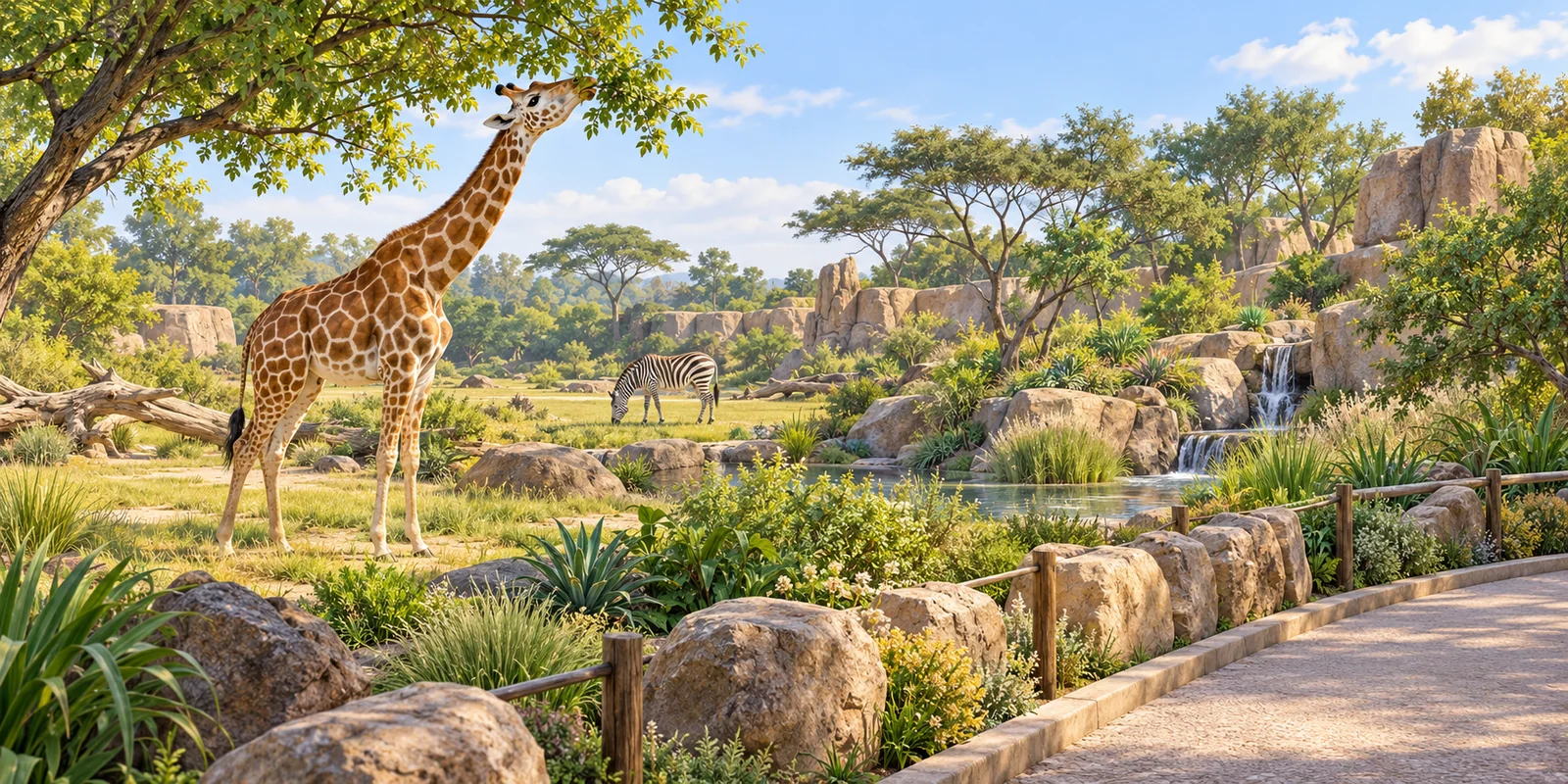 Illustration
Come to Zoo Osnabrück for a day of animal watching that moves between treetops, tunnels and underwater windows.
Come to Zoo Osnabrück for a day of animal watching that moves between treetops, tunnels and underwater windows. The Schölerberg setting gives the walk a woodland feel, with bends and slopes between the themed areas. Start by choosing two or three family favourites on the entrance map: trying to give every enclosure equal time can leave little energy for the places that really catch your attention.
Samburu brings you alongside reticulated giraffes, while the nearby Mapungubwe Ost enclosure holds Asiatic lions around a huge artificial baobab. In Angkor Wat, temple-style buildings frame Asian elephants, red pandas and Sumatran tigers. Manitoba suits a slower spell among forest animals; look for black bears outside and check the beaver lodge before moving on.
The changes in viewpoint are particularly good for children. At Wasserwelten Mariasiel, sit beside the underwater windows and watch seals and sea lions pass. Then exchange the big swimmers for tiny tunnel-dwellers in the Unterirdischer Zoo. Allow time for play as well: Makatanda's raised huts and the inclusive Thomas Philipps Familienspielplatz make useful breaks between animal stops. Explore the grounds like a pro—download the Snappit app to instantly identify animals and plants.
Zoo Osnabrück opened in 1936. Its more recent development is easy to trace through the themed areas: Samburu opened in 2004, Takamanda in 2010, Manitoba in 2017–18 and Wasserwelten Mariasiel in 2022.
For a first visit, begin near the entrance with the Unterirdischer Zoo, then head towards the lions and Samburu. Continue into Takamanda if your children want chimpanzees and the Makatanda adventure village. With a full day, add Manitoba, Angkor Wat and the Wasserwelten before returning through the western side of the zoo. Use the zoo map to adapt the order to your chosen stops.
Make one enclosure a proper observation break. At the chimpanzees, watch how individuals use different heights; at the marine mammals, compare the animals above and below the water. Keeper talks and feedings add context, with programmes advertised for weekends and the Lower Saxony/North Rhine-Westphalia school holidays. Check the day's list when you arrive.
The zoo opens throughout the year. Bring layers and shoes with grip for the hillside paths. The Sparkassen-Auenlandschaft adds a mist-play area for a warm-weather pause when operating. During 2026, Dinoversum's life-size animated dinosaur models are included in normal admission; the exhibition is scheduled to finish at the end of 2026. Optional VR experiences and guided dinosaur activities have separate charges and schedules.
The main circuit is step-free, but gradients, roots and stones can make the woodland paths demanding, especially in a manual wheelchair. Reserve a free mobility scooter or wheelchair in advance on 0541 951050. Elevated routes in Manitoba and Mapungubwe West offer accessible viewing; the ground-level path between the lynx and rhino enclosures is an exception. Some additional viewpoints and play structures require stairs, including the chimpanzee lookout and Makatanda's raised huts. Parts of the tiger temple are also excluded from the zoo's wheelchair-suitable description. The Thomas Philipps Familienspielplatz has inclusive play equipment, a communication board and an adult changing facility.
Walk the 120 m elevated section in Manitoba or the 152 m rhino walkway in Mapungubwe West for a different viewing angle.
The Unterirdischer Zoo has 120 m of dimly lit passages, with naked mole-rats, rats and bats to watch.
The Wasserwelten gallery puts you beside swimming seals and sea lions; the nearby Tetra-Aquarium adds an indoor stop.
Take Takamanda's 800 m circuit for chimpanzees and Makatanda, or choose the inclusive family playground at Manitoba's entrance.
A complete circuit within Takamanda, including animal stops and the Makatanda play area.
Use the main circuit for step-free movement. The chimpanzee lookout, some extra house levels and the raised play huts are not step-free.
A raised viewing section through the forest-animal area.
The zoo describes this area as wheelchair-suitable. Allow for the hilly approaches elsewhere in the grounds.
A raised section beside the rhino enclosure.
The elevated route is suitable for wheelchairs and pushchairs. Avoid the lower connection between the lynx and rhino enclosures if you need an accessible route.
A wooden viewing section through the northern-animal area.
The zoo describes Kajanaland as wheelchair-suitable; surrounding woodland terrain remains hilly.
Spend 2–3 hours around the underground zoo, lions and Samburu, with time to sit and watch. Add a playground only if your group still has energy.
Allow 4–6 hours. Begin with the entrance-side animals, continue to Takamanda, then choose Manitoba and Angkor Wat before lunch or a late break at Wasserwelten. Cut an area rather than rushing the last hour.
Choose one swimmer at Wasserwelten, then compare its outline at the surface and from the gallery. Ask children which view makes the flippers easiest to see.
After the giraffes, find the dik-diks in their house. Let each child describe an animal using size, ears and legs, while everyone else guesses.
At the lions, look closely at the artificial baobab. Its branches hold enrichment items: talk about how an enclosure can encourage animals to explore.
Try the Tetra-Aquarium for fish and reptiles, or the Unterirdischer Zoo for the tunnel displays. Plan the outdoor connection before setting off in heavy rain.
Give your eyes time to adjust, then follow the visible tunnel system. Watch one junction rather than scanning the whole display: an animal may pass through while you wait.
Use the raised viewing position by Samburu-Lodge to study the giraffes' patterned necks. If they are away from that side, scan the wider shared savanna enclosure.
Look for these small antelopes inside the giraffe house. After watching the giraffes, their very different size makes a good prompt for children to compare the two animals.
Look across the enclosure from the bridge, including resting places away from the artificial baobab. The tree's hanging enrichment points are worth noticing even while the lions rest.
Check both the outdoor enclosure and the hall. Choose one individual and watch its route through the space; the extra lookout gives another perspective if stairs suit your group.
From the elevated path, scan the trees and hammock as well as the ground. A resting bear can be easy to miss if you only look for movement.
Try the lodge viewing area when the outside pool looks empty. The underwater entrance connects the lodge with the pool, so a second look outside can be worthwhile.
Look up into the branches before searching at ground level. Pause where you have a clear public view and let your eyes pick out an animal among the foliage.
Spend a few minutes watching trunk movements and how the elephants share their space. Include the bathing and mud areas in your scan of the outdoor enclosure.
The raised walkway opens a view across the rhino enclosure and its wallow. Stay on that route if you need step-free access rather than using the lower lynx-side connection.
Sit on a bench in the sand cat house and search slowly. Their sandy coat blends with the enclosure; a patient look works better than a quick walk past.
Watch the California sea lions from the underwater gallery. Pick one animal to follow for a swimming pass, then compare its movements with those of the neighbouring harbour seals.
The underground bat grotto uses dim daytime lighting to create a night-like setting for visitors to watch the bats.
The Sparkassen-Auenlandschaft occupies the former sea-lion enclosure; the sea lions now live in Wasserwelten Mariasiel.
The adult changing room at the Thomas Philipps Familienspielplatz has a height-adjustable changing bench and mobile hoist. Bring your own changing mat and hoist sling; ask for the door code or use a Euro key.
Each card links to a full Explore page with photos, traits, and fun facts.
Start with the big picture, then zoom in to explore individual wildlife observations around this place.
Choose your ticket
Day-ticket prices vary with booking demand. Compare the official online shop before arrival; check dated entry conditions and any extras before paying.
Arrive by bus
Take M5 from Neumarkt to Kreishaus/Zoo, then follow signs for about eight minutes on foot. Check the current journey planner for connections.
Arrive by car
Use Klaus-Strick-Weg 12, 49082 Osnabrück. The main visitor car park is free; overflow sites can have different arrangements.
Keep walking manageable
Kajanaland's 230 m wooden walkway is another short viewing section. The links between areas add distance and hills, so plan pauses rather than one continuous march.
Bring the right wheels
You can bring a pushchair or your own pull-along wagon; wagon hire is unavailable. Scooters and balance bikes are not allowed. Leave pushchairs and wagons outside the penguin and pelican walk-throughs.
Plan lunch and changing
The Zoo-Restaurant at Wasserwelten has indoor seating and a children's play corner. Changing tables appear on the zoo map; ask at admission for the adult changing-room access code if needed.
Keep indoor stops flexible
Use the Tetra-Aquarium or underground zoo during a shower. Outdoor walks still connect them; food stands have differing opening days.
Watch quietly
Try another public viewing window or return later if an animal is hidden. Do not tap the glass. Dogs need a lead and cannot enter every animal house; follow signs and temporary diversions.
Recent snaps will appear here as new observations are added.

North Carolina, US
You might spot American Robin and Eastern Gray Squirrel.
View guide →

Florida, US
You might spot Anhinga, American Alligator, and Wood Duck.
View guide →

New Mexico, US
You might spot Wood Duck, Duck, and Canada Goose.
View guide →

Michigan, US
You might spot African Lion, Komodo Dragon, and Brown Bear.
View guide →
Take the discovery with you
Identify the wildlife you spot, learn as you go, and keep a collection of the adventure.