Snappit logo
Snappit
Get App
Generic illustration, not a photograph of this venueIllustration
ParkIT

Abruzzo, Lazio and Molise National Park

The best first visit starts with a choice: a manageable valley walk, a village-and-lake day, or a properly planned mountain hike.

About

The best first visit starts with a choice: a manageable valley walk, a village-and-lake day, or a properly planned mountain hike. You don’t need to cross the whole park to understand its appeal. Camosciara and Val Fondillo give you two different ways into the landscape; Pescasseroli and the villages around Lake Barrea offer useful bases. Leave room for a conversation at an information point, and for a change of plan if the weather or wildlife-protection rules demand it. Eager to name that creature? Identify any animal you find during your visit using the Snappit app.

The park began through private initiative in 1922 and received state recognition in 1923. Its name has included Lazio and Molise since 2001. That history helps explain why conservation here is inseparable from villages, common land and long-established use of the mountains. [Park history and identity](https://www.parcoabruzzo.it/pagina.php?id=546).

What to do here

Choose the Camosciara approach for a clearly defined walk to a short waterfall spur; choose lower Val Fondillo for time among woods and water. Add a village stop rather than rushing into a second mountain valley. The route choices below explain exactly what the published distances cover.

Seasonal info

Summer access controls protect sensitive chamois habitat. Autumn brings changing beech colours and the deer rut; winter requires a different level of route planning and equipment.

Accessibility

For a lower-effort day, combine a village visit with a short valley outing. Ask about the Dorotea mobility service before choosing your trail.

Don't miss

1

Camosciara’s approach and waterfall spur

2

Val Fondillo’s forest landscape

3

Old-growth beech conservation

4

Lake Barrea and its surrounding villages

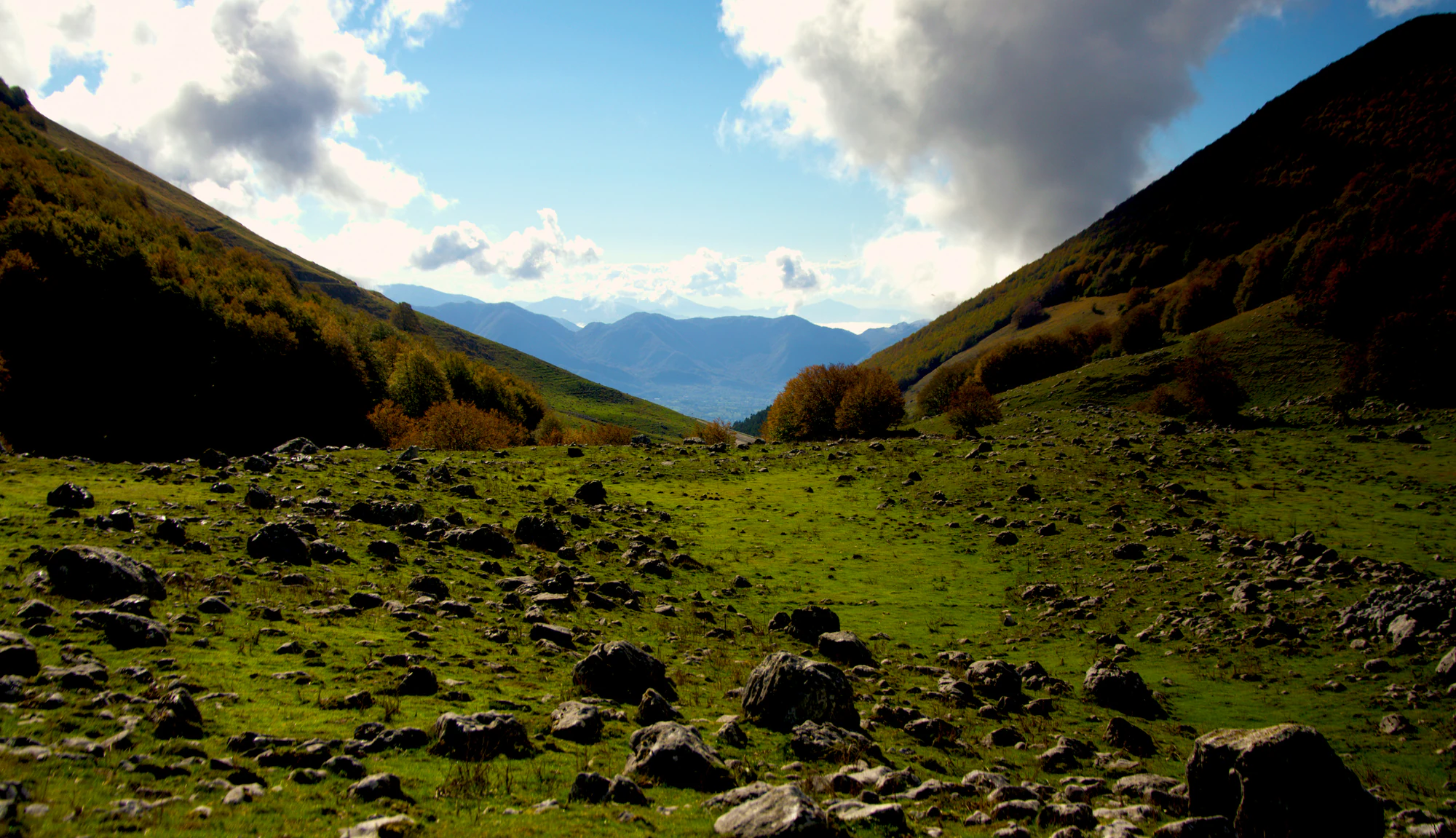
A grassy, rock-strewn valley between autumn-coloured wooded slopes, with distant mountain ridges beneath clouds and blue sky.

An autumn mountain landscape in Abruzzo, Lazio and Molise National Park, photographed in October 2020. The precise valley is not identified.

“Abruzzo landscape.jpg” — Zoe Olivieri, via [Wikimedia Commons](https://commons.wikimedia.org/wiki/File:Abruzzo_landscape.jpg). [CC BY-SA 4.0](https://creativecommons.org/licenses/by-sa/4.0/). Unmodified offered original. · Creative Commons

Walks and routes

Camosciara approach: G1

From Piana della Corte to Camosciara, the park publishes 2.45 km and 50 minutes, one way, with a T tourist grade. This is a useful first choice if you want a defined outing without committing to a high pass. Walk back the same way and leave extra time for pauses; about two to three hours for the approach, waterfall spur and return is an editorial allowance, not a park timetable. G1 route record.

The Dorotea service uses a designated part of G1. Confirm the usable section and equipment with staff; the route record does not establish independent wheelchair access.


Camosciara approach: G1

The waterfall spur: G5

At Camosciara, G5 continues to the waterfalls. Its published 272 metres and 10 minutes are for this short spur, not the journey from the valley entrance. Treat the cascades as the final detail of the outing, with time to return, rather than expecting a ten-minute visit from the parking area. G5 route record.

T is the published tourist grade. It is not a step-free certification; assess the footing, especially when wet.

The waterfall spur: G5

Val Fondillo: decide how far before you start

Begin at the forest visitor centre and ask staff to suggest a lower-valley out-and-back suited to your group. Do not confuse that shorter visit with the complete F2 crossing to Canneto via Passaggio dell’Orso: the Italian official record gives 15.76 km, seven hours and EE, for expert hikers. A full crossing needs fitness, suitable conditions and an arranged onward journey. Full F2 route record.

Ask about the designated lower section used by the Dorotea mobility service; the full crossing is unsuitable for a casual accessible outing.

Val Fondillo: decide how far before you start

Your first day

Choose Camosciara for the morning, with G5 only if the conditions and your group suit it. After returning, give the afternoon to Civitella Alfedena or a Lake Barrea viewpoint rather than adding a high-level hike. If you want interpretation indoors, check the temporary museum arrangements before setting out. Keep the afternoon flexible so there’s time to linger in the village.

With a second or third day

Spend another day around Opi and Val Fondillo, using a shorter return walk agreed at the visitor centre. With more time, consider Pizzone and the Le Forme upland basin on the Molise side, or the forested Canneto valley on the Lazio side. Plan each as a separate outing with local advice on the appropriate trail. A change of base lets you experience a different landscape without squeezing a long mountain crossing into a sightseeing day.

Things to try

Want a mountain day? Consider Lago Vivo carefully

Lago Vivo is a seasonal basin, often fullest with spring snowmelt. Reaching it is a mountain outing, quite different from seeing Lake Barrea from a village. The K5 record describes only a 345-metre connector from Selva Bella, so its ten-minute time must not be mistaken for the whole approach. Choose a complete itinerary with the park or a qualified guide, and check snow and weather before committing. Lago Vivo landscape context; K5 connector.

A quieter lake-and-village day

Lake Barrea gives you another way to spend time in the park: enjoy the view from an accessible public place, then explore one of its nearby villages at your own pace. The lake is a reservoir created by damming the Sangro in 1952, and is now a Ramsar wetland used by waterbirds. Bring binoculars; avoid disturbing the shore. For swimming or a waterside activity, check the local rules and use an authorized access point. Lake Barrea wetland.

When a mountain walk is the wrong choice

Ask about the forest exhibition at Val Fondillo or the Museo della Transumanza in Villetta Barrea, which focuses on the pastoral landscape and offers activities by arrangement. Call the latter on +39 340 3174515 for current hours. The temporary Civitella display is another possibility once its opening is confirmed. Don’t rely on Pescasseroli’s closed museum building as a rainy-day fallback. Transhumance museum.

Wildlife and habitats

Brown bear: the Marsican population

The Marsican brown bear, Ursus arctos marsicanus, is the park’s emblem and a distinctive central-Italian population. Enjoy the possibility of sharing its landscape without building your day around an encounter. Watch from a distance if one appears; never lure it with food. If a bear is close, withdraw cautiously and follow ranger instructions. Report a bear near a settlement to park staff. Marsican bear; bear guidance.

Gray wolf

The park supports wild Canis lupus, but wolves are elusive. Learning about their ecology is a more dependable aim than trying to find one. Civitella Alfedena’s managed wolf enclosure is a separate educational setting: seeing an animal there is not a wild sighting. Wild wolves in the park; Civitella visitor centre.

Red deer

Red deer were reintroduced here in the early 1970s. In September and October, the rut can add a deep, carrying soundtrack to the woods and clearings. Listen without walking towards the sound or crowding animals. Their presence around a road or village does not make them tame. Deer in the park.

European beech

European beech, Fagus sylvatica, forms much of the park’s forest. Smooth grey bark and oval leaves are useful starting clues; in autumn, the canopy brings a different palette to the slopes. Look from the path, leave fallen wood and plants where they are, and let the forest remain habitat rather than a collection of souvenirs. Park trees; beech identification.

Apennine chamois

The park’s chamois is Rupicapra pyrenaica ornata. Its recovery is an important conservation story, and sensitive mountain routes are managed partly for its protection. A guided outing can explain that story without promising an encounter. Keep your distance and stay on the authorized route. Apennine chamois.

Stories and discoveries

Why the beech woods matter

Five old-growth beech-forest components in the park joined the UNESCO World Heritage listing in 2017. Their value lies in ecological continuity and natural forest processes, not simply in a collection of large trees. These protected cores are strict-reserve areas: follow authorized trails and don’t seek an off-path “oldest tree” photograph. You can appreciate beech woodland without entering a sensitive core. The park’s UNESCO forests.

Water and rock shape the visit

Much of this landscape is limestone, shaped by both ice and dissolving water. Caves, hollows and springs are part of the same story: water can disappear underground and emerge farther down the mountain. At Camosciara, the rocky amphitheatre and its surface streams give that story a more visible form. Looking at the folds of a valley and the course of its water can be as rewarding as looking for an animal. The park’s landscape and geology.

When to visit

Spring and summer

Plan lower walks while snow still affects higher ground. In summer, start with a realistic route and keep a lower-level alternative for unsettled weather. Before booking a high hike, check whether wildlife access controls apply to your dates.

Autumn and winter

Autumn suits forest colour and listening for the deer rut, but daylight shortens and facilities may switch to limited opening days. In snow or ice, choose a winter-appropriate guided outing rather than using a summer route description as reassurance. Weather planning.

Getting there and practical advice

Pescasseroli: check what is actually open

As checked on 19 October 2026, the Centro Natura’s museum building is closed for energy-efficiency works begun on 9 July; the garden and animal-care area remain the offered visit. The published autumn schedule is Friday to Sunday, 10:00–17:30, with specified holiday exceptions. The temporary adult admission is €3. Confirm the current arrangement and children’s prices before travelling. Animals here are in a managed care setting, and dogs are not admitted. Visitor-centre notice; dated works announcement.

Civitella Alfedena: temporary museum arrangements

The main wolf museum is still marked temporarily closed. A partial exhibition and information point are offered at Centro Culturale Orsa Maggiore, Via Nazionale 45, with free entry. Confirm that location and the day’s opening with the centre at +39 0864 890141 or +39 366 9067503; the page also carries seasonal schedules, which should not be read as a reopening of the main museum. Current visitor-centre information.

Val Fondillo and everyday supplies

The Val Fondillo centre interprets the relationship between forests and the people who have used them. Its page asks visitors to check hours directly: +39 334 7004555. Before walking, ask about toilets, water, parking arrangements and any local services you need. Carry your own water and food rather than depending on a refuge or refreshment stop. Val Fondillo visitor centre.

Arriving by car

Choose your overnight base or trailhead before asking navigation for “the park”. From Rome, the authority suggests the A24/A25 via Celano or Pescina, or the A1 via Ferentino and Sora–Forca d’Acero. From Naples, the approach via Caianello, Venafro and Alfedena reaches the southern side. Check road and weather conditions, particularly around passes, and use designated parking. Official arrival guidance.

Using public transport

Avezzano is a useful rail-to-bus planning point, with onward TUA connections. Check the operator for your exact destination and travel date: the current Pescasseroli–Avezzano notice concerns school services from September 2026, not a promise of a convenient daily sightseeing timetable. Work out the return before booking accommodation, and ask how you will cover the final stretch to the trailhead. TUA winter timetables; dated connection notice.

The Dorotea service

The park advertises free powered off-road chairs for designated routes in Camosciara, Val Fondillo and the Difesa di Pescasseroli. Arrange this in advance: a companion is required, equipment availability matters, and staff must confirm the suitable section and conditions. For Camosciara contact +39 0864 890141; for Val Fondillo +39 0863 9113200 or +39 0863 9113350; for Pescasseroli +39 0863 9113221. Mobile coverage is incomplete in these areas, so discuss the recovery procedure too. This is an assisted service, not a claim that the entire G1, F2 or C1 is independently accessible. Dorotea details and conditions.

Check sensitive-route access before you book

For 25 July–13 September 2026, access to I1 through Val di Rose, F1 to Monte Amaro and L1 to Monte Meta required a paid, prebooked outing with appointed guides from Tuesday to Sunday; access was prohibited on Mondays. That period has ended. For a later visit, check the current notice rather than carrying those dates forward or assuming that every restriction has disappeared. Dated park access notice.

Simple rules with a real purpose

Stay on official permitted trails, particularly in the more protected zones. Leave flowers and other natural material in place; don’t light fires or disturb wildlife. Dogs are permitted on only selected marked routes and must be leashed there. Check the route-specific limits before you travel. Visitor code.

Sources and useful links

Wildlife you might spot

4

Each card links to a full Explore page with photos, traits, and fun facts.

Snap map for this place

Start with the big picture, then zoom in to explore individual wildlife observations around this place.

Loading map…

Good to know before you go

Carry a usable offline map, water, layers and a waterproof; decide your turnaround time before leaving the valley.

Check the exact trail code before taking a dog. A leash alone does not make every route permissible.

Keep food and litter secure. Never feed wildlife or approach an animal for a closer photograph.

Ask about toilets, drinking-water availability and the return journey at your starting point; don’t assume mountain facilities will be open.

Frequently asked questions

There is no general park-entry charge. Individual centres, parking, guided excursions and regulated activities can have their own fees. A free visit does not remove route restrictions. [Park visitor code](https://www.parcoabruzzo.it/pagina.php?id=618).
No. A good day here can be about forest, tracks, landscape and conservation without a bear sighting. Never feed, follow or surround an animal. Use a qualified guide for interpretation, not a guarantee of wildlife.
G1 with the optional G5 waterfall spur is a useful route to assess first, provided its length and conditions suit your children. Include the return journey: G5’s ten minutes does not include getting to Camosciara.
A short lower-valley visit can be arranged to suit your group. The full F2 route is a seven-hour expert crossing. Decide your turnaround point with staff rather than assuming the whole trail stays easy.
It is a historical landscape photograph dated October 2020 by its contributor. The precise valley is not identified, so use it as landscape context, not for route-finding or current conditions.

Recent snaps at this place

Recent snaps will appear here as new observations are added.

View all ›

Take the discovery with you

Exploring Abruzzo, Lazio and Molise National Park?

Identify the wildlife you spot, learn as you go, and keep a collection of the adventure.

  1. 1Spot it
  2. 2Snap it
  3. 3Keep the discovery