Snappit logo
Snappit
Get App
Generic illustration, not a photograph of this venueIllustration
ParkNormandie, FR

Harcourt Estate Arboretum

Begin with one question: what makes a tree recognisable before you read its label?

About

Begin with one question: what makes a tree recognisable before you read its label? At Harcourt, the answer might be a branching outline, an unusual leaf or the texture of a trunk. The collection brings together trees from different parts of the world; the operator lists more than 500 species. Choose a few to get to know rather than treating the whole garden as a checklist.

The castle gives the collection a memorable setting, but the trees deserve most of your time. Look across a crown from a little distance, then examine whatever details can be seen from the path. Keep a photograph of the label alongside your tree photograph: it is much more useful later than a folder full of unidentified trunks. Unlock an interactive field guide for this spot: get the Snappit app to identify nature on the go.

Louis-Gervais Delamarre bought the neglected estate in 1802 and used it to test trees and forestry methods. He left it to the agricultural academy in 1827; the collection arboretum took formal shape in 1833. That sequence matters: the landscape grew from an experiment in cultivation, rather than beginning simply as a decorative garden. Today the Département de l’Eure looks after the estate.

What to do here

Pick up the visitor plan at reception and ask where to find Lebanon cedar, giant sequoia and ginkgo on paths suitable for your group. Build a short visit around those three trees, add the castle exterior if you have time, and finish with a picnic or a sketch.

Seasonal info

For 2026, the operator identifies the Automnales on 17–18 October, 10am–6pm, as the final weekend before the high season closes. The winter Arbora Lumina programme is a separate evening experience, with reopening advertised for 13 November. A winter event does not establish ordinary daytime garden access.

Accessibility

Ask reception to help select a manageable daytime route. The operator describes most paths as stabilised, with some uneven, unpaved or sloping sections. This is not a guarantee that every specimen tree or forest path is accessible.

Don't miss

1

Compare Lebanon cedar, giant sequoia and ginkgo as three very different tree shapes.

2

See how a collection founded for forestry experiments became a visitor garden.

3

Read the castle’s defensive and residential sides from its open grounds.

4

Look for the contrast between historic specimens and newer landscape planting.

Walks and routes

A three-tree visit through the arboretum

Start at reception with the estate plan. Ask staff to mark three suitable stops: Lebanon cedar, giant sequoia and ginkgo. Visit them in the order that best fits the open paths and your group’s needs, returning towards reception when you have had enough. This flexible discovery visit has no prescribed loop or advertised distance; the printed plan and current signs provide the wayfinding.

Keep the chosen trees close to the easiest paths identified by staff. If reaching a specimen requires an awkward surface or slope, substitute another tree visible from your route rather than treating the list as compulsory.
At the first tree, stand back and describe its outline. Is the crown narrow, rounded or spread into layers? Choose a word before checking the name.

At the second, study the trunk from the path. Sketch a small rectangle of bark texture, then a simple silhouette of the whole tree. Comparing the two scales makes the drawing more interesting.

At the third, look at leaves or needles through binoculars if needed. Use the label to test your identification, and note one feature you would recognise again.

If everyone still has energy, add the open castle exterior. Otherwise finish with a seated break and compare your three pictures. A short visit with memorable trees is a perfectly good result.

Things to try

Make a tree portrait

Try a three-part photograph: the complete tree, a recognisable detail and its label. Keep all three together. A second visit can use the same framing to reveal seasonal change; a different camera angle alone can make comparisons misleading. Avoid blocking a narrow path while composing the picture.

Read the castle without going inside

From the permitted exterior paths, compare the western defensive face with the eastern residential one. Towers and enclosing walls speak of protection; the larger classical windows reflect later ideas of comfort. This contrast gives children a concrete question: which side looks better suited to keeping people out, and which to letting light in?

Look at the younger garden too

A May 2026 gardener interview describes a newly planted welcome area, compositions inspired by the Monet anniversary and the young “Alborea” space. Ask where these can be seen during your visit. Comparing a new planting with an established tree invites a different kind of looking: imagine which gaps will close and which views the gardeners may want to preserve.

Shorten the outdoor plan

In light rain, make a shorter tree visit with waterproof clothing and a notebook you can put away quickly. Wet bark can be visually interesting, but keep your attention on footing. In strong wind, thunderstorms or an estate weather closure, postpone the tree walk. The closed castle interior should not be treated as a sheltered fallback.

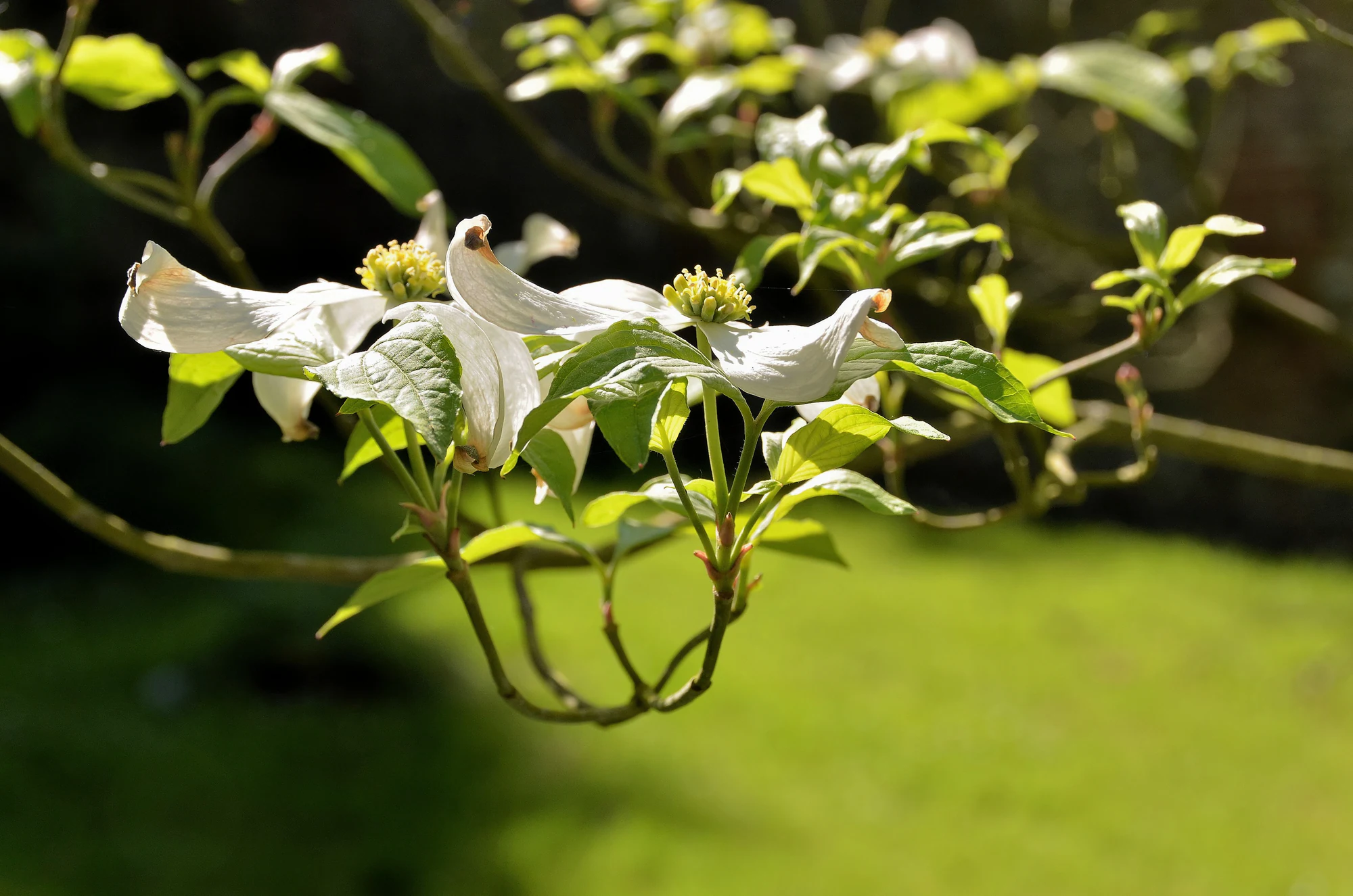
Sunlight catches white flower-like bracts with some brown tips and green leaves on a branch, against a softly blurred green garden.

A flowering branch in Harcourt’s arboretum, Eure, photographed in May 2018. This historical close-up shows a detail of the collection, rather than the garden’s overall layout or what is flowering today.

“Château d'Harcourt (Eure) - Arboretum” — Patrick Monchicourt (Morio60), CC BY-SA 2.0. Source: https://www.flickr.com/photos/morio60/49912120412/. License: https://creativecommons.org/licenses/by-sa/2.0/. Original photograph unchanged. · Creative Commons

Wildlife and habitats

Lebanon cedar

Look for the broad, layered branching that older cedars can develop, then find needle clusters if a branch is visible from the path. Its upright, barrel-shaped cones are a useful clue. Compare the crown with a more narrowly shaped conifer nearby; a distant view often explains the tree better than standing directly beneath it.

Giant sequoia

The reddish, fibrous bark is a striking starting point. In its native Californian forests, thick bark helps protect giant sequoias from the heat of some fires, although severe fires can still kill them. See how the bark’s texture differs from the cedar’s; there is no need to touch or peel it to appreciate the contrast.

Ginkgo

Look for leaves shaped like little fans, sometimes with a notch dividing the blade. They turn yellow in autumn before falling. Try drawing one outline without looking at your paper, then compare it with the real leaf: its distinctive shape is a satisfying identification clue even for a beginner.

Black walnut

A black-walnut leaf is divided into several leaflets along one central stalk. What looks like a small branch can therefore be a single leaf. Compare that arrangement with a ginkgo leaf. The ridged bark offers a second clue, but let the tree’s label settle the identification rather than relying on one feature alone.

Stories and discoveries

A collection and a habitat can occupy the same ground

The department’s ENS atlas records late mowing and sheep grazing in Harcourt’s arboretum grasslands, associated with the appearance of several orchids. It also describes experimental trees within the adjoining broadleaved woodland. This is documented management history, not a promise of sheep or flowering orchids on your visit. Look from the path at the difference between shorter and taller vegetation rather than stepping into it.

The garden is still changing

Harcourt’s oldest story is experimentation: deciding what to plant, seeing how it grows and passing on that knowledge. New landscape work continues that habit of making and observing. A young tree with support stakes can be as revealing as a large specimen: consider how much growing space has been left around it and how its shape might develop.

When to visit

Spring and summer

In leaf, compare broad leaves with needles and watch how the crown filters light onto the ground. On a warm day, organise your longest drawing or identification stop in shade and leave the more exposed castle view for a shorter look. The green parts of the garden can change markedly without any need to find a rare species.

Autumn and the winter boundary

Autumn brings a chance to compare ginkgo yellow with the colours of other deciduous trees. Timing varies with weather, so choose a date for the outing itself rather than expecting a guaranteed peak-colour weekend. Once the daytime season ends, book only a specifically advertised opening; the evening light programme has its own ticket and rules.

Getting there and practical advice

Food, toilets and a pause

Toilets, picnic facilities and a shop are listed by the estate. La Cabane Gourmande provides light refreshments, with opening hours that can change by season or event. Bring water and a picnic if your day depends on a guaranteed meal; check the kiosk’s service when you arrive.

Tickets and guided visits

Select the correct daytime visit or named event before buying. Check its current price and date; the ticket page warns that purchases cannot be exchanged or refunded. For an organised visit, ask about current guide availability rather than assuming a tour leaves at fixed intervals.

Arriving by car or bicycle

Use the visitor entrance and free parking on rue de la Gare, Harcourt. Bicycle parking and a repair kit are listed at the entrance building. The estate links to the Évreux–Pont-Authou greenway connection; check the local connecting route before cycling, since a nearby greenway is not necessarily the same as a traffic-free ride to the gate.

Arriving by public transport

NOMAD coach line 214, between Évreux and Honfleur, serves HARCOURT – Église. Use the current timetable for both directions and your exact travel date; the operator’s page links the timetable effective from 1 September 2026. Plan the final walk from the stop and allow a margin for the return coach.

Shape the daytime visit around your needs

Tell reception what surfaces and gradients work for you, then choose a short route with an easy return. There are benches and shaded stopping places. Some paths are uneven and can be awkward with a pushchair. Ask specifically about the route to the toilets and your selected trees rather than relying on a general statement that the estate is accessible.

Night-event access needs a separate decision

Arbora Lumina includes forest paths described by the operator as narrow, irregular, sometimes woodchip-covered and in places steeper than 5%. The operator does not offer a fully accessible alternative for the whole night route. Do not assume a comfortable daytime garden visit means that the evening experience will suit the same mobility needs.

Sources and useful links

Wildlife you might spot

4

Each card links to a full Explore page with photos, traits, and fun facts.

Snap map for this place

Start with the big picture, then zoom in to explore individual wildlife observations around this place.

Loading map…

Good to know before you go

Photograph the plant label as well as the tree; names alone can be surprisingly easy to mix up.

Choose your must-see trees at reception before setting off, particularly with a wheelchair or pushchair.

Use binoculars to inspect cones and higher branches without leaving a permitted path.

Bring a waterproof layer and shoes with grip; this is primarily an outdoor visit.

Leave cones, seeds, bark and fallen wood where they are. Draw or photograph what interests you.

Check the actual daytime ticket or event you are booking, together with its date and conditions.

Frequently asked questions

The interior is currently closed for conservation work. Open castle grounds and the arboretum remain part of the outdoor visit; follow any local barriers.
No. The operator currently allows access to only part of the forest. Ask which paths are open that day and do not extend the garden walk into an unsigned woodland circuit.
Dogs on leads are permitted during the ordinary daytime season. The night-time Arbora Lumina route excludes pet dogs; assistance dogs are permitted.
The featured cedar, sequoia, ginkgo and black walnut are part of Harcourt’s cultivated collection. Seeing one here is not evidence that it is a native or wild woodland species.

Recent snaps at this place

Recent snaps will appear here as new observations are added.

View all ›

Take the discovery with you

Exploring Harcourt Estate Arboretum?

Identify the wildlife you spot, learn as you go, and keep a collection of the adventure.

  1. 1Spot it
  2. 2Snap it
  3. 3Keep the discovery