Snappit logo
Snappit
Get App
Generic illustration, not a photograph of this venueIllustration
ParkCataluña, Spain

Park Güell

Park Güell rewards two kinds of looking.

About

Park Güell rewards two kinds of looking. There are the big moments: the tiled salamander, the curving bench around Plaça de la Natura, and stone columns that seem to grow out of the hillside. Then there are quieter details: a bird moving through the branches, the contrast between pine needles and olive leaves, or the shade beneath a planted slope. Leave time for both.

This was designed as a residential estate rather than a conventional public garden. The roads, viaducts, water systems and planting had to work with a steep site. That makes the landscape part of the architecture, rather than scenery around it. The former nursery at Jardins d’Àustria offers another way to read the park: notice the change from built structures to cultivated beds and trees.

For a manageable visit, book a timed entry, choose an entrance that suits your group and give yourself about two hours inside. Follow the signed circulation through the famous spaces, then add a short nature pause on an open path. The 195-metre Biodiversity Itinerary near Coll del Portell is a useful option when its approach is available. Current works affect nearby connections, so ask staff before setting off towards it.

This is also a neighbourhood green space. Walk considerately on the surrounding streets, keep noise down and resist treating the whole park as a photo backdrop. A single unhurried garden stop can be more satisfying than trying to reach every viewpoint. Unlock an interactive field guide for this spot: get the Snappit app to identify nature on the go.

Eusebi Güell commissioned Antoni Gaudí to plan a residential estate on the Muntanya Pelada hillside. Work began in 1900. Around sixty plots were envisaged, but the scheme attracted few buyers and construction stopped in 1914. The city agreed to acquire the property in 1922, and it opened as a municipal park in 1926. Gaudí retained existing carob and olive trees and designed ways to collect water on the sloping ground. Those practical decisions help explain why the engineering and vegetation belong together. Park Güell became part of the UNESCO World Heritage recognition of Gaudí’s work in 1984. Its present role combines heritage conservation, tourism and everyday use by Barcelona residents.

What to do here

Combine the main architectural spaces with close attention to the trees and garden beds. Use the park’s current map and staff advice to choose an open nature section. The Biodiversity Itinerary is an optional addition, subject to access around the works.

Seasonal info

Summer heat can make the climbs tiring, while winter brings shorter visitor-entry hours. Rain can make steps and uneven paths slippery. Check the park’s same-day notices during strong wind or heavy rain, and follow any closure or diversion rather than relying on an older map.

Accessibility

There are steep ramps, steps and irregular surfaces. The operator recommends the Carretera del Carmel entrance and provides a roughly 50-minute architectural itinerary for people with reduced mobility. Use its current accessibility map and ask staff about the best route, toilets and works for your needs. The separate upper-viaduct option is affected by nearby closures; do not assume all advertised connections are usable.

Don't miss

1

Mediterranean planting and birdwatching on open garden paths

2

The short Biodiversity Itinerary, when its approach is available

3

Plaça de la Natura and its undulating mosaic bench

4

The Hypostyle Room, salamander and stone porticoes

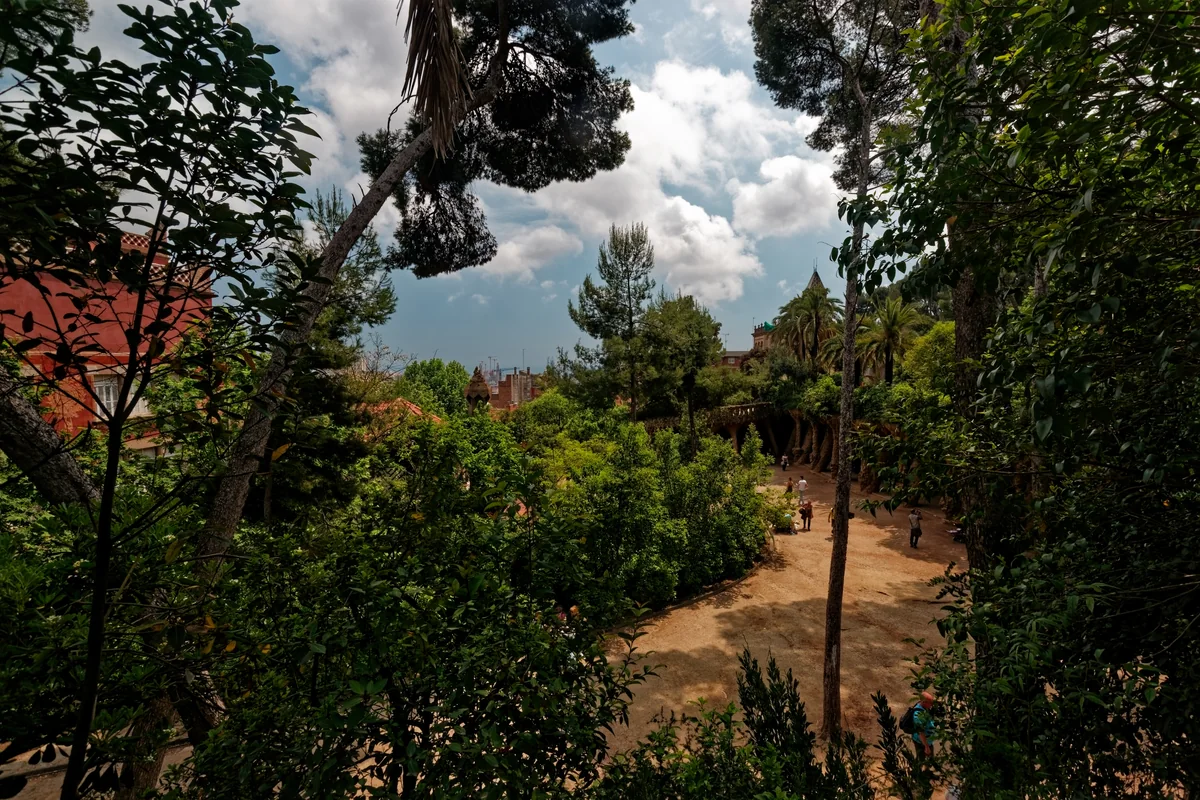
A broad ochre path curves through dense trees towards a shaded row of stone columns, with several small visitors along the path.

Garden paths, trees and stone columns in Park Güell, photographed in May 2011.

Barcelona - Parc Güell - View SSE towards Viaducte Güell (Parc Güell).jpg — Txllxt TxllxT / Wikimedia Commons / CC BY-SA 4.0 · Creative Commons

Walks and routes

Biodiversity Itinerary: a short optional nature stop

The official trail near Coll del Portell is 195 metres long. If staff confirm access, allow 20–35 minutes for slow looking rather than treating it as a fast connector. The approach from your entrance takes additional time. Focus on the planting and stop to listen from the public path.

The operator describes a granular-surfaced path. Ask staff about its approach, slope and present condition before committing with a wheelchair or pushchair; a short trail can still involve a difficult approach.


Biodiversity Itinerary: a short optional nature stop

The operator’s architectural itinerary

The reduced-mobility guide gives approximately 50 minutes for its architectural itinerary. Use that as a starting point, then allow extra time for queues, mosaics, garden views and rests. Follow the official map and on-site circulation rather than trying to connect the sights in a fixed order.

Carretera del Carmel is the recommended entrance. The park still has irregular surfaces and steep ramps; discuss your equipment and assistance needs with staff. Some sights are viewed from the recommended path rather than by using their steps.

The operator’s architectural itinerary

Upper viaduct and Casa Trias: check the works first

The operator also publishes an approximately 20-minute option along a viaduct towards Casa Trias. Keep it as a possible extra rather than part of your essential plan. Casa Trias is seen from outside; its interior is not open to visitors.

Although shown as a reduced-mobility option, present continuity and any diversion must be checked with staff. Do not infer that another hillside path is an equivalent accessible substitute.

Upper viaduct and Casa Trias: check the works first

A relaxed two-hour first visit

Start at your chosen entrance with the current map and a question about diversions. Give the principal monuments the largest share of your time, follow the signs through the controlled areas and take one seated break. Finish with a plant or bird observation on an open garden path. Leave the upper slopes for another day if anyone is tiring.

A nature-led visit with room to change plans

Ask about the Biodiversity Itinerary before committing to the Coll del Portell approach. If staff confirm a suitable open route, give the short trail an unhurried stop. If they do not, spend that time comparing vegetation along an open garden section instead. Add one or two architectural spaces, rather than feeling obliged to cover the entire park.

Things to try

A five-minute listening pause

Choose an open spot out of the flow of visitors and spend a few minutes without talking. Count different sounds rather than trying to name every bird. Wildlife varies from visit to visit; the park’s inventory is a starting point, not a checklist you need to complete.

Find a link between stone and plants

At an open portico or viaduct, compare the angle of a column with a branch or trunk nearby. Ask children which shapes look similar and which do different jobs. Keep clear of through routes and treat the stonework as something to observe, not climb.

Follow the idea of water

At the Hypostyle Room, think about what happens to rain falling on the square above. The original design collected and stored that water. Then look for how planted ground and paths respond to a slope, without leaving the visitor route.

Keep a poor-weather visit flexible

If the park remains open in light rain, shorten the outing and take care on steps and uneven surfaces. In strong wind, storms or an official closure, postpone the outdoor visit rather than seeking shelter under trees or continuing into a closed area. A house-museum ticket is a separate booking choice and is not a guaranteed last-minute wet-weather substitute.

Wildlife and habitats

Aleppo pine

Look up at the branching crowns, then compare their needle-like leaves with the broad leaves of nearby trees. Stay on the path while looking; roots and uneven ground deserve attention too.

Olive

Use an olive tree as a quiet observation stop: compare the two sides of a reachable leaf without picking it, and notice how the crown changes in moving light.

Holm oak

Compare a broad-leaved evergreen with a pine. A simple leaf-shape sketch is enough; there is no need to collect a sample.

Strawberry tree

If you find a labelled or confidently identified plant, look for differences between new and older leaves, flowers or fruit. Leave everything on the plant.

Mastic

Give the shrub layer its own moment instead of looking only at tall trees. Compare small leaflets and branching patterns from the path, without rubbing or breaking foliage.

Common blackbird

Pause near an open garden edge and watch for movement before reaching for a camera. A bird briefly feeding or perching can make a better observation than one followed through the beds.

European robin

Listen during a quiet pause, then watch without approaching. Keep a respectful distance and let the bird move away freely; recorded calls and food are unnecessary.

Stories and discoveries

A market that became a monument

The Hypostyle Room was intended as a market for the planned estate. Its 86 columns and decorated ceiling make more sense when you imagine an everyday neighbourhood space beneath the grand square.

A nursery became Jardins d’Àustria

This garden area was used as a municipal plant nursery after Park Güell became public. Its name recalls a gift of trees from Austria in 1977, a small international story within the larger garden.

The square is engineered ground

Plaça de la Natura is partly cut into the hillside and partly supported above the Hypostyle Room. The wavy tiled bench, associated with Josep Maria Jujol, works as an edge to that elevated space as well as a place to pause.

When to visit

Spring and autumn

Comfortable weather makes it easier to slow down for trees and bird activity. Book the slot you need, then check the forecast and works rather than assuming a particular season guarantees a quiet or uninterrupted visit.

Summer

Choose an early available tourist slot, carry water and reduce the number of climbs. The published 2026 calendar starts tourist-entry bands at 09:00 in July and August; check the calendar for your actual date.

Autumn and winter entry times

For 1 September–24 October 2026, published visitor-entry bands run from 09:30 to the last slot at 19:30. From 25 October–31 December 2026, the last slot is 17:30. These are entry bands, not a promise that all facilities stay open until a stated hour; check your date before booking.

Getting there and practical advice

Toilets and drinking water

The operator lists toilets at the Carretera del Carmel entrance, on Passeig de les Palmeres beside Plaça de la Natura, and near the Carrer d’Olot entrance. Locate an open toilet and water point on the current map when you arrive; carry your own filled bottle. Ask specifically about toilet access for your needs.

Breaks and picnics

Rest areas and fountains are marked on the official map. Eat a picnic only in designated areas, and keep all paths and viewing spaces clear. Do not assume that a quiet stretch of planting is a suitable place to sit or eat.

Museum choices

A standard park outing can stay outdoors. If you want an interior visit, compare the separate combined products for the Gaudí House Museum and the Casa del Guarda before booking. Capacity and admission arrangements can differ from the park’s.

Help with the visit

Park staff can explain the day’s circulation. For specific mobility needs or a loan wheelchair, contact the Visitor Support Service beforehand at [email protected]; availability needs confirmation. Download the official accessibility information before arriving.

Lesseps and the uphill approach

The operator gives about 20 minutes on foot from Lesseps on metro line L3, towards the Avinguda del Santuari de Sant Josep de la Muntanya entrance. Allow longer for a slower group and the climb. The FAQ currently warns that the Baixada de la Glòria escalators used from Vallcarca are out of service, so do not rely on that alternative.

Bus or taxi

H6 and D40 stop on Travessera de Dalt, with an uphill walk to the park. For a mobility-led arrival, plan around Carretera del Carmel, 23, the entrance recommended by the operator; Carretera del Carmel also has a taxi stand. Check your exact journey and service conditions before setting out.

Avoid driving to the gate

Most nearby street parking is reserved for residents. The operator points drivers to the paid BSM Travessera de Dalt–Park Güell car park, which still requires an approach to the park. Three spaces for accredited reduced-mobility vehicles are listed at the coach-parking area by Carretera del Carmel; confirm availability and eligibility before relying on them.

Plan around your entrance and equipment

Ask about the exact route between your arrival point, the monuments you want to see and a suitable toilet. A published reduced-mobility route does not mean every staircase, upper path or building interior is accessible. Tell staff whether you use a manual chair, powered chair, walking aid or pushchair, and check any assistance you may need.

Shorten the visit when necessary

The official architectural option and the optional upper-viaduct section are separate choices. Keep the first visit modest and add more only if the surface, crowds and energy levels suit your group. The works take priority over a printed route, especially around Coll del Portell, Forat del Vent and Casa Trias.

Sources and useful links

Wildlife you might spot

7

Each card links to a full Explore page with photos, traits, and fun facts.

Snap map for this place

Start with the big picture, then zoom in to explore individual wildlife observations around this place.

Loading map…

Good to know before you go

Buy from the official website before travelling and save the QR code offline. Include a ticket for every visitor, even a child whose admission is free.

Choose your entrance before leaving. The walk from public transport can be uphill; reach the access point with time to spare for your booked slot.

Check the disruptions page on the day. Ask specifically about the Biodiversity Itinerary and its approach before walking towards Coll del Portell.

Bring water, sun protection and shoes with grip. Plan a seated break before your group gets tired, rather than adding another climb automatically.

Follow the one-way signs and any second access controls around the busiest monuments. Do not climb on the salamander, walls or other heritage features.

Stay on paths, leave plants and wildlife undisturbed, and use only designated picnic areas. For an ordinary tourist visit, leave the bicycle outside.

A dog changes the visit

pets must be on a lead and cannot enter several headline spaces, including Plaça de la Natura and Jardins d’Àustria. Check the full exclusions before booking.

Arrange any professional or commercial photography with the operator in advance. A visitor ticket is not permission for a commercial shoot.

Frequently asked questions

For a tourist visit, plan to book admission: current visitor information includes the monumental, green and panoramic areas in the ticket. Barcelona residents have separate access arrangements, including Passi Verd. Do not rely on older advice that the gardens are generally free or that early and late resident hours are open to tourists.
Checked on 17 October 2026: general admission is €18; children aged 7–12 and visitors over 65 pay €13.50; children aged 0–6 enter free with a ticket. Other concessions apply, including disability-related admission. Confirm the applicable category and evidence required on the official booking site.
Entry is allowed for 30 minutes after the start time on the ticket; after that, the right to enter is lost. Once you leave, the same ticket does not allow re-entry. Keep your ticket during the visit.
The booking page offers distinct combined tickets for the Gaudí House Museum and the Casa del Guarda, or Porter’s Lodge. Choose the option you want rather than assuming a standard park ticket includes either interior. Casa Trias and Casa Larrard are not open for interior visits.
The published individual-booking policy allows date or time changes up to one day before the visit, subject to capacity. Ordinary cancellation and refunds are not offered; exceptional cases are considered individually. Read the current terms before buying.
Its short length does not establish step-free access. Ask staff about the current approach, surface and any barriers, especially during the works. For a mobility-led visit, start with the operator’s reduced-mobility itinerary rather than assuming the biodiversity trail will suit everyone.
Dogs must remain on a lead. Pets are excluded from Plaça de la Natura, the Hypostyle Room, the Dragon Stairway, Jardins d’Àustria and the Laundry Room Portico, so a dog-friendly walk will miss much of the standard monument circuit.
Children under 14 must be accompanied by a responsible adult. Individual bookings allow up to seven tickets per transaction; groups of eight or more should use the organised-group booking process. Choose a small number of stops and leave room for a break.

Recent snaps at this place

Recent snaps will appear here as new observations are added.

View all ›

Take the discovery with you

Exploring Park Güell?

Identify the wildlife you spot, learn as you go, and keep a collection of the adventure.

  1. 1Spot it
  2. 2Snap it
  3. 3Keep the discovery