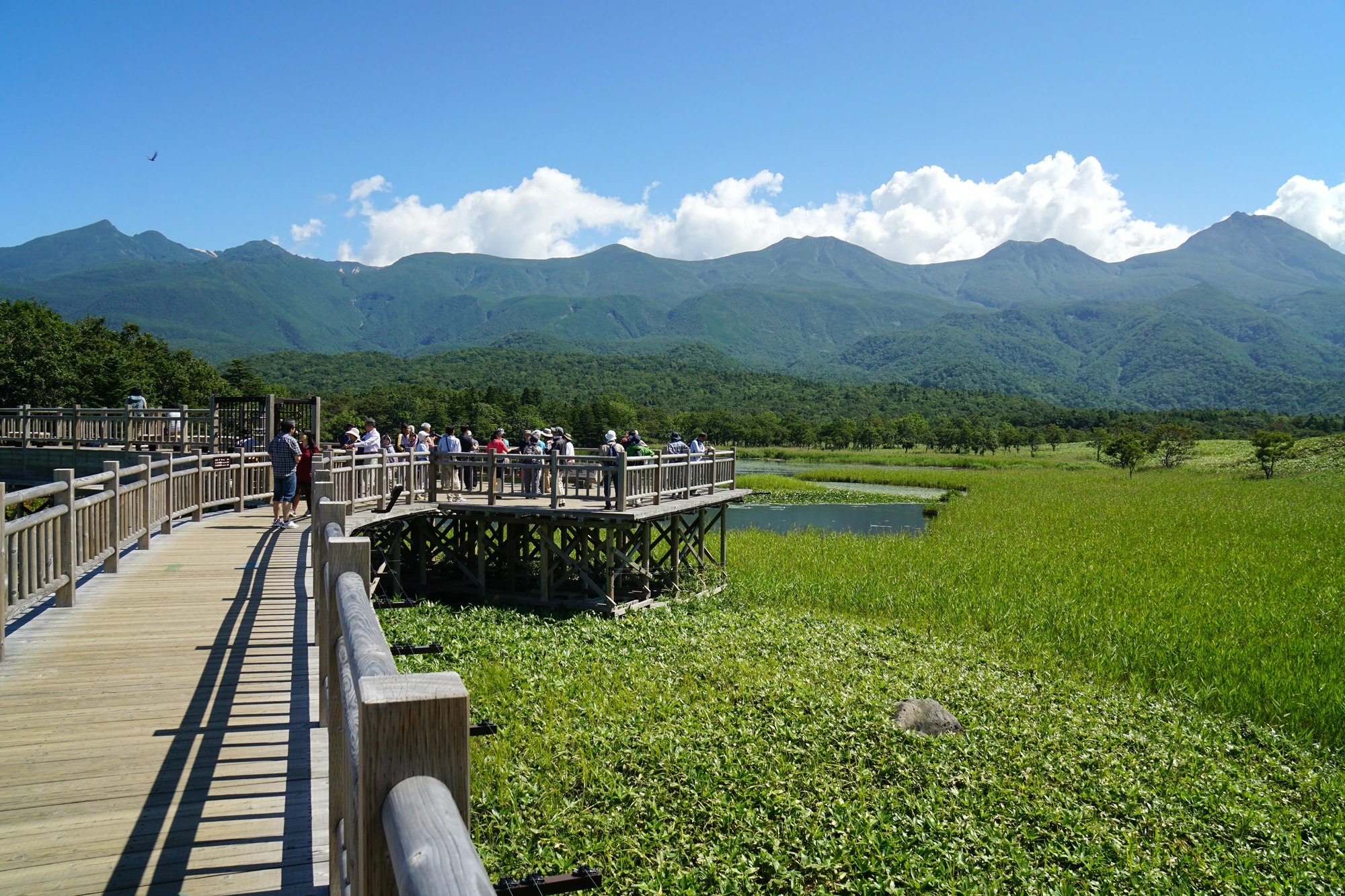
For a first visit to Shiretoko, start with a manageable corner of this very large landscape: Shiretoko Goko, the Five Lakes on the peninsula’s western side. Here, forest opens onto water, the mountain range rises behind it, and the elevated path adds views towards the Sea of Okhotsk. You can make this a short outing or spend several hours among the lakes. The important choice is which of the two walking systems suits your group.
The elevated boardwalk is the straightforward option. It runs about 800 metres each way to First Lake, with places to pause and take in the mountain and coastal views. Its raised structure and electric fence separate visitors from the ground below. There are no steps and the gradients are reduced for wheelchair access. You return along the same boardwalk; it does not continue around all five lakes. That makes it a good starting point for a family with a stroller, someone who needs a step-free route, or anyone wanting the landscape without committing to a forest walk.
The ground trails offer a closer view of the forest. The short circuit takes in two lakes, while the longer circuit visits all five. These are one-way routes entered through the Field House, and they eventually join the boardwalk through an exit-only connection. Expect uneven earth, roots and rocks rather than an accessible promenade. A guide can help you notice bear claw marks, woodpecker feeding signs and deer browsing that are easy to pass without understanding. Choose the longer walk because you want time to look closely, rather than treating five lakes as a box to tick.
Access rules are part of the visit. From May 10 to July 31, you must join a registered guide’s tour to use the ground trails. During the other open-season periods, you complete the entry procedure and a short briefing before walking independently. Bear activity can close the ground routes or stop a tour, so leave room in the day for a change of plan. The boardwalk has its own entrance and operating conditions. A closed ground trail is not an invitation to enter it from the boardwalk.
There is plenty to notice even if no large animal appears. The local wildlife calendar includes sika deer, black woodpeckers and great spotted woodpeckers. Watch from the path, listen without trying to attract birds, and ask a guide about the marks you find on trees. Brown bears live here too, but these walks are not a bear-tracking activity. Do not follow an animal, move closer for a photograph, or treat a quiet-looking forest as proof that no bears are present.
The lakes are also a useful introduction to Shiretoko’s larger story. Across the World Heritage area, seasonal sea ice helps sustain productive marine food webs, and salmon returning to rivers bring food from the sea to bears and other land animals. That does not mean salmon run through these five lakes; it is the wider connection between ocean, rivers and forest that matters. If you want that connection explained indoors, the World Heritage Conservation Center in Utoro is a useful stop before or after your lake visit. Enhance your adventure: download the Snappit app to identify the local species you encounter.
Shiretoko National Park was established on June 1, 1964, and the distinct Shiretoko World Heritage property was inscribed in 2005. The name Shiretoko comes from the Ainu word siretok, commonly rendered as “end of the earth.” Conservation here also has a community history: Shari’s 100 Square Meter Movement began in 1977 to protect former settlement land from development and restore forest. At the Five Lakes, the visitor-use system introduced in 2011 combines controlled ground-trail access with the elevated boardwalk. Its purpose is practical: protect vegetation while reducing conflict between people and bears.