Snappit logo
Snappit
Get App
Generic illustration, not a photograph of this venueIllustration
ParkKanto, Japan

Ueno Park

Give Ueno enough time to be a park, rather than a corridor between museums.

About

Give Ueno enough time to be a park, rather than a corridor between museums. Start on the raised ground around Takenodai Square and its fountain, then work your way toward Shinobazu Pond. The change from tree-lined paths to open water is the heart of this visit. Two or three hours lets you make that journey at an unhurried pace, with room to stop when something catches your eye.

The trees give you something to notice outside blossom season. Ginkgo leaves open like small fans; Japanese zelkova has a spreading crown and bark that flakes in patches. Both are listed among the park’s principal trees. Pause to compare their leaf shapes and the way their branches spread overhead. With children, choose one leaf shape to find again farther along the path, without pulling leaves from branches.

Down at Shinobazu, the name covers three connected-looking but distinct sections: the Lotus Pond, the Boat Pond and the Cormorant Pond. The public lotus-viewing deck and boat-pond paths are the focus here. The Cormorant Pond lies within the zoo’s West Garden boundary, so a park walk does not give access to every shore. Bentendo, the octagonal temple hall beside the water, is a useful landmark as you explore the public paths and causeways. Its present building dates from 1958.

In summer, the lotus leaves can become the main landscape. They rise above the water, with pink flowers among them in season. Come early for open blooms, then look more closely at the difference between a closed bud, a flower and a developing seed head. Later in the year, shift your attention from flowers to birds and the changing trees. Black-headed gulls and grey herons have been documented at the public pond; these are wild visitors, with no guarantee that a particular bird will be there when you arrive.

Spring brings a different kind of energy. The main cherry avenue is a place to enjoy hanami, the custom of spending time beneath the blossom, but it can be very crowded. Ueno’s cherries are not all one variety: the park’s collection includes early-flowering trees and Somei-yoshino, followed by later double-flowered cultivars. Look at the flowers you actually find instead of expecting the whole park to bloom on one date.

There is history within the walk, too. Kiyomizu Kannon-do was founded in 1631 and modeled on Kyoto’s Kiyomizu-dera; it was moved to its present site in 1694. Nearby, the Saigo Takamori statue includes a dog named Tsun, an easy detail for younger visitors to spot. If you would like an indoor second chapter, the National Museum of Nature and Science connects the afternoon to Japan’s natural history. Keep it optional: the park and pond already make a complete outing, and museum admission and opening arrangements are separate. Enhance your adventure: download the Snappit app to identify the local species you encounter.

Ueno became one of Japan’s first designated public parks in 1873, on land formerly belonging to Kan’ei-ji. The operator records its opening date as 19 October 1873. In 1924 the site was bestowed on Tokyo City, giving rise to the name Onshi, meaning imperial gift. Its temple buildings, monuments and cultural institutions reflect different stages of that story rather than one single founding moment. Kiyomizu Kannon-do predates the public park by more than two centuries, while the Saigo statue was unveiled in 1898 and today’s Bentendo was rebuilt in 1958.


What to do here

Begin with the fountain and a short tree-spotting walk, follow the cherry avenue, then choose a historic stop before heading down to Shinobazu Pond. Spend the longest pause on the public lotus-viewing deck or beside the Boat Pond. In flower season, compare lotus buds and open blooms; at other times, watch how birds move between water, air and resting places. A rowboat or pedal boat is an optional paid activity on the Boat Pond, while the science museum offers a separate indoor extension.

Seasonal info

Early and late cherry varieties extend the season beyond the main Somei-yoshino display. Lotus flowers generally open early and close gradually toward midday; a late-afternoon visit can still be lovely for foliage but is a poor bet for open flowers. Ginkgo color is usually a late-autumn feature, often from late November into December. In winter, exchange the expectation of a green lotus bed for a closer look at the pond and visiting waterbirds. Bloom and leaf-color dates vary each year.

Accessibility

The pond’s public perimeter paths are described in Tokyo’s 2026 accessibility guide as smooth and almost level, with a deck allowing close wheelchair views. The upper park sits above the pond: some southern approaches have stairs and steep slopes. JR Ueno Station’s Park Exit is the easier approach to the upper park. Use the operator’s current map for accessible routes and toilets; do not assume the shortest descent, a temple entrance or a boat boarding point is step-free. Confirm a suitable connection between upper park and pond if avoiding slopes is essential.

Don't miss

1

The public lotus-viewing deck at Shinobazu Pond, especially on a July or August morning.

2

The cherry avenue and its changing sequence of early, main-season and double-flowered blossoms.

3

Bentendo’s octagonal hall and the older Kiyomizu Kannon-do, giving the park walk a historical thread.

4

Ginkgo, Japanese zelkova and wild pond birds, with the National Museum of Nature and Science as an optional indoor extension.

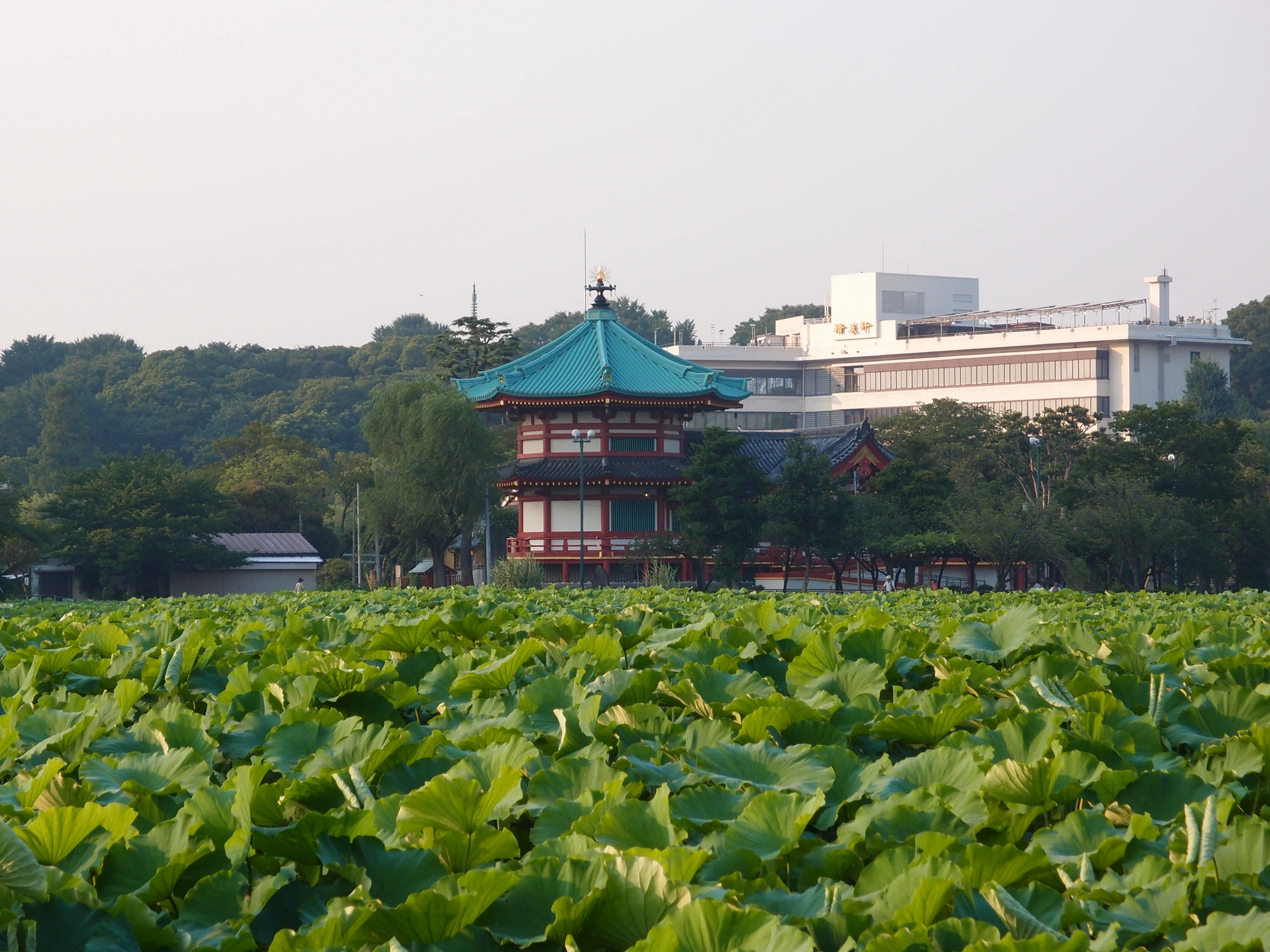
Dense green lotus leaves cover the foreground of Shinobazu Pond, with the green-roofed Bentendo hall and trees behind.

Broad lotus leaves fill Shinobazu Pond in front of Bentendo’s green roof. This photograph was taken in July 2013; flowers and foliage vary with the season.

Benten Hall @ Ueno Park — Guilhem Vellut, CC BY 2.0 (https://creativecommons.org/licenses/by/2.0/). Source: https://commons.wikimedia.org/wiki/File:Benten_Hall_@_Ueno_Park_(9254201976).jpg. Resized and recompressed as WebP; no crop or retouching. · Creative Commons 1 · Creative Commons 2

Walks and routes

Upper park to Shinobazu Pond

Start at JR Ueno’s Park Exit, visit Takenodai Square and the fountain, and follow Sakura-dori toward the southern landmarks. Choose the Saigo statue or Kiyomizu Kannon-do, then continue by open public paths to the lotus-viewing deck and Bentendo-side causeway. Finish with the public Boat Pond paths, or stop at the lotus pond if energy is running low. Follow signs around the zoo boundary rather than attempting to walk every shore.

Use the current barrier-free map to select a suitable connection down to the pond; the shortest southern descent can involve stairs or slopes. Check temple access and boat boarding separately with their operators.

Start on the upper plateau

From JR Ueno’s Park Exit, orient yourself at the fountain and Takenodai Square. Spend about 20–30 minutes on the fountain and nearby trees.

Follow the cherry avenue

Allow about 25–40 minutes for Sakura-dori and one historical stop. Choose Saigo’s statue or Kiyomizu Kannon-do rather than rushing to collect every landmark.

Slow down at the pond

Allow about 45–60 minutes for the public lotus deck, Bentendo-side paths and a birdwatching pause. Add a snack or rest break, and leave time for the return to your chosen station.

Go straight to Shinobazu

Make the public lotus-viewing deck your first destination in July or August. Spend 20–30 minutes observing flowers and leaves without blocking the deck.

Add one gentle extension

Use the remaining time for a public pond-edge stroll or a view toward Bentendo. Stop there if it is getting hot; the upper park and museum can be a separate visit.

Things to try

Compare two tree shapes

Choose a ginkgo leaf and a zelkova crown to look for along the paths. Sketch what distinguishes them, then check a tree label when you find one. Photograph details without picking or damaging plants.

Find the stages of a lotus flower

From the public deck, see whether you can find a bud, an open flower and a seed head. The answer may change with the season and hour, which is part of the exercise.

Make a quiet pond-watch stop

Pick a place that leaves the path clear and watch for several minutes. Notice whether a bird swims, flies, stands still or rests. Identify it only if the visible features support the name; an unidentified bird is still worth noticing.

Spot a small historical detail

Look for the dog beside Saigo’s statue, or compare Bentendo’s octagonal shape with Kiyomizu Kannon-do’s raised wooden hall. Follow each religious site’s visiting and photography instructions.

Try a short boat outing

Rent a rowboat, cycle boat or swan boat on the Boat Pond if operating conditions and your group’s needs suit it. Ask staff about boarding, life jackets and passenger rules. This is a separate paid activity, with no promise of step-free transfer.

National Museum of Nature and Science

The National Museum of Nature and Science offers a separate paid visit with Japan Gallery and Global Gallery displays. Standard hours checked on 16 October 2026 were 09:00–17:00, last entry 16:30; normally closed Mondays, or Tuesday when Monday is a national holiday, and 28 December–1 January. Regular permanent-exhibition admission was ¥630 for adults/university students, free for high-school students and younger; other concessions have conditions. Special exhibitions have separate arrangements. Part of Global Gallery 2F and B3 were closed at this check. Recheck the calendar and notices before relying on this option.

National Museum of Nature and Science

Wildlife and habitats

Public lotus-viewing deck and Lotus Pond edges.

Large leaves held above the water, pink flowers in season, and seed heads after the petals fall. Compare stages from the path rather than reaching into the bed.

July–August mornings for flowers; actual blooming varies.

Tree-lined park paths.

Fan-shaped leaves, often with a notch, changing from green to yellow in autumn.

Leaves through the growing season; late autumn for yellow color.

Upper-park tree cover; use tree labels where present.

A spreading, branching crown and bark that flakes in irregular patches. Make the bark pattern part of a tree-comparison game.

Tree form and bark can be observed in different seasons.

Public Shinobazu Pond paths and water views, without approaching resting birds.

Adults have a red bill and legs. The dark head is seasonal, becoming prominent toward spring; a pale winter head does not rule this bird out.

Look during the cooler months and into spring.

Scan the pond from existing public paths.

A large, long-necked bird with grey-blue wings and back; adults have a pale head with a dark stripe and a yellowish bill.

Pause quietly if a heron comes into view.

Stories and discoveries

Ueno’s official Onshi name recalls the park being given to Tokyo City in 1924.

The park’s cherry collection includes Komatsu-otome, named in 1989 from an original tree in Ueno Park.

No new cultivar database object is created.

The dog beside Saigo Takamori is named Tsun; the man and dog were made by different sculptors.

When to visit

spring

Prioritize the cherry avenue; compare early trees, Somei-yoshino and later double-flowered varieties. Peak blossom usually attracts heavy crowds. Flowering windows are seasonal guidance, not this year’s forecast.

summer

Start at the lotus pond early, then choose a shorter shaded walk or an indoor museum visit as the day warms. Bring water and use your own heat tolerance to decide how much to do.

autumn

Look for yellow ginkgo foliage late in the season and compare it with the shapes and colors of nearby deciduous trees.

winter

Treat it as a pond-and-history walk. Look for visiting waterbirds without expecting summer lotus leaves or flowers; the public paths remain the focus, not the zoo’s bird areas.

Getting there and practical advice

Ueno Park Office

Ask about current paths, closures and accessible-route options.

Park toilets

The official map marks toilets and wheelchair-accessible facilities around the upper park and pond. Some accessible cubicles have separate operating hours, so check the map and on-site signs rather than assuming every facility is available for the full park day.

Takenodai Square cafes

EVERYONEs CAFE and Starbucks are listed at Takenodai Square, useful for a planned break on the upper plateau. Opening hours, queues and seating availability are separate from the park’s hours.

Shinobazu Boat Pond boat hire

Rowboats accommodate up to three adults. Cycle and swan boats are listed for up to two adults and one child. Confirm how the operator classifies children and what is suitable for your party before paying.

JR Ueno Station, Park Exit

The practical starting point for the upper park. The operator gives an approximate two-minute walk from JR Ueno to the park; allow additional time within the station and to your chosen park stop.

Tokyo Metro Ueno or Keisei Ueno

The operator lists about four minutes from Tokyo Metro Ueno and one minute from Keisei Ueno to the park. These southern approaches are convenient for the pond area, but reaching the upper plateau can involve stairs or slopes.

Tokyo’s 2026 guide describes the pond-edge route as nearly level and the pedestrian deck as usable for close wheelchair views. This does not certify every causeway, temporary surface or the zoo-enclosed shore.

Avoid assuming that a direct descent is accessible. Consult the current official map and park office for the route that meets your needs. The older standalone barrier-free PDF still shows station works and was not used to promise current elevator hours.

Step-free boarding, wheelchair carriage and temple-interior access have not been verified. Check with the individual operator; no access guarantee is made.

Sources and useful links

Wildlife you might spot

5

Each card links to a full Explore page with photos, traits, and fun facts.

Snap map for this place

Start with the big picture, then zoom in to explore individual wildlife observations around this place.

Loading map…

Good to know before you go

Park entry is free. The operator lists 05:00–23:00, with entry outside those hours prohibited; this was checked on 16 October 2026. Museums, temple gates and boat hire follow their own schedules.

For lotus flowers, make the pond your first stop in the morning. You can visit the upper park later rather than spending the freshest part of the day getting to the water.

Choose JR Ueno’s Park Exit for the upper plateau. Station-to-park walking times do not include the walk across the park to the pond, and the quickest-looking southern routes may involve steps.

Keep children close at the water and leave room for others on the viewing deck. Bring drinking water and sun protection for a summer visit, and shorten the walk in uncomfortable heat.

Watch birds without feeding or following them. The park asks visitors not to feed animals; use binoculars or a zoom lens and let resting birds keep their space.

Check the boat-house page before budgeting. On 16 October 2026, the posted charge was ¥800 per 30 minutes for a rowboat or ¥1,000 for a cycle/swan boat, with different passenger limits and seasonal hours.

Dogs must stay on a controllable lead. Drones and radio-controlled models are prohibited. Stop safely before using your phone to identify a plant or bird.

If you add the science museum, check its calendar and gallery closures first. As checked on 16 October 2026, Global Gallery B3 was closed for renovation and part of 2F was also temporarily closed.

Frequently asked questions

Yes. The upper park, cherry avenue, public lotus-viewing deck and Boat Pond paths make a complete visit. The zoo is separately operated, and the Cormorant Pond is inside its boundary. Zoo animals are not wild park sightings.
Entry to the park is free, but it is not open all night: the operator lists 05:00–23:00. Boat hire, museums and some other facilities charge separately and have their own opening times.
July and August are the main season. Come in the morning, preferably early, because flowers gradually close toward midday. Exact flowering dates depend on the year; the broad green leaves remain a separate attraction.
It can be, especially on the public pond-edge paths and the upper park’s main routes. The difficult part can be the connection between the two levels. Use the accessible-route map, approach the upper park from JR Ueno’s Park Exit, and check gradients or elevator availability rather than following an unverified shortcut.
A relaxed park-and-pond visit fits into about 2–3 hours. A shorter pond visit can take 45–75 minutes. Boat queues, blossom crowds and museum visits add time.
The National Museum of Nature and Science is a useful alternative if it is open and fits your interests. Its permanent displays explore Japan’s natural environment and the wider history of life. Check the museum’s own admission page and current gallery notices before changing your plans.

Recent snaps at this place

Recent snaps will appear here as new observations are added.

View all ›

Take the discovery with you

Exploring Ueno Park?

Identify the wildlife you spot, learn as you go, and keep a collection of the adventure.

  1. 1Spot it
  2. 2Snap it
  3. 3Keep the discovery