Snappit logo
Snappit
Get App
Generic illustration, not a photograph of this venueIllustration
ParkNorthern Spain, Spain

La Rioja Botanical Garden

Give this garden a proper morning.

About

Give this garden a proper morning. The pleasure is in moving slowly between contrasting planted spaces: a maple collection, hedge-lined paths, water gardens and small trees shaped as bonsai. Labels reward a closer look, and you can mix a little plant learning with time simply sitting and noticing what is around you.

Start at reception for the explanation of the visit and the current route leaflet. The garden has grown through successive additions, so its numbered areas do not make a simple numerical walking sequence. Let the signs lead you, and choose a few things to investigate rather than trying to read every label.

This is also a working conservation and education project. The Fundación El Botánico maintains living collections and exchanges seeds with other institutions. The interpretation centre brings some of that work into the visitor experience through displays, illustrations and information about seeds and herbaria. It makes a useful beginning or ending to the outdoor walk. Unlock an interactive field guide for this spot: get the Snappit app to identify nature on the go.

Antonio Bartolomé Fernández began the project in 1985. Fundación El Botánico was established in 1994, and the garden opened to the public in 2005. Its purpose combines plant conservation, study and education. The seed-exchange catalogue shows how work beyond the visitor paths connects this small garden with other botanical institutions.

What to do here

Follow the self-guided collection paths, pause by the water, compare a few labelled trees and leave time for the interpretation centre. With children, ask at reception about the tasks available for them. A booked workshop can provide a more structured visit; check its particular date, fee and language.

Seasonal info

Opening changes substantially in late autumn and winter. The operator’s pages disagree about Sunday opening in November and early December, so confirm your date before setting off. Winter visits need an arrangement with the garden. Wet grass and smooth paved sections can change how comfortable the walk feels.

Accessibility

Grass paths and short steep ramps mean the best route depends on your mobility needs and the weather. An undated access survey reports 10–14% sections in the garden and a 14% ramp to the interpretation centre. Call ahead to discuss alternatives. The operator’s mobility vehicle is offered on weekdays only, subject to availability.

Don't miss

1

Maples and other labelled trees that invite close comparison

2

Ponds and planted water edges in the garden’s contrasting zones

3

Bonsai and the interpretation centre’s botanical displays

4

A self-guided visit that can grow into a family learning activity

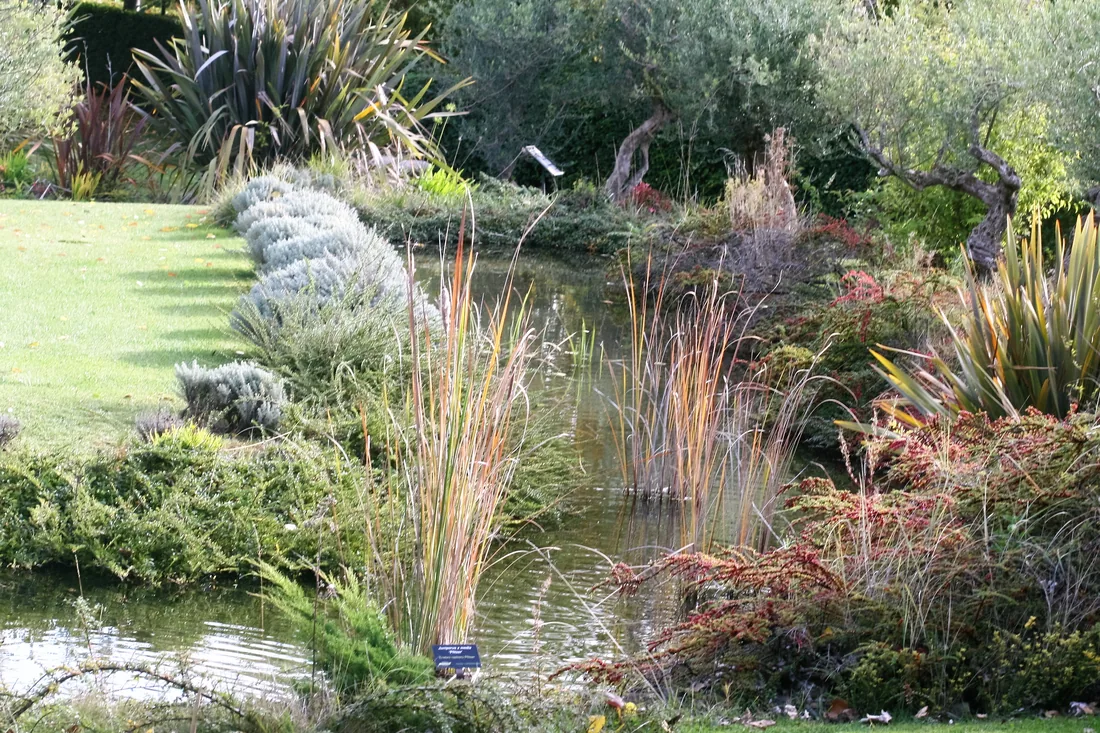
A narrow garden pond winds between lawns, reeds and mixed planted borders, with trees and small plant-identification plaques around the water.

A small pond and planted borders at Jardín Botánico de La Rioja, photographed in October 2016.

Pequeño estanque artificial en el Jardín botánico de la Rioja.jpg — Alberto Salguero / Wikimedia Commons / CC BY-SA 4.0 · Creative Commons

Walks and routes

The self-guided garden visit

Begin at reception, collect the current leaflet and follow the signs between the collection areas. La Arcería introduces the maples; Los Manzanos and La Rosaleda bring hedge-lined garden spaces; La Laguna and Hábitats Riojanos add water and contrasting planting. La Alameda, El Olivar, Aromas and the interpretation centre offer further choices along the signed visit. Follow the actual route rather than the area numbers: the garden explicitly warns that later additions changed their sequence. Ask whether the optional Pinetum is open.

The route includes grass and some paved sections. Ask staff to identify the gentlest links and any ramps you need to avoid; their suitability will depend on your chair or pushchair and the ground conditions. Arrange the weekday mobility vehicle separately if needed.


The self-guided garden visit

A relaxed first visit

Arrive near 10:00 on an opening day. Use the welcome explanation to choose your priorities, then allow roughly two hours for the signed garden visit. Finish with the indoor displays or a break, keeping the 14:00 closure in mind. If the children become tired, ask for a shorter return rather than trying to complete every zone.

A shorter visit with a clear focus

If you have only an hour, say so at reception and choose two nearby collections using the current leaflet. A few labels, one water stop and a look inside the centre can still make a worthwhile visit, but an hour is shorter than the garden’s recommended full visit. Agree a suitable way back before setting off.

For plant enthusiasts

Allow extra time beyond the usual two hours. Concentrate on one group, such as maples or bonsai, and compare labels carefully. Save detailed questions for staff when they are free. If a workshop is your main interest, build the rest of the visit around its confirmed timetable.

Things to try

Make a three-label challenge

Choose three plants with very different appearances. Before reading each label, describe the leaf shape, texture you can see and overall outline. Then compare the names and origins on the labels. Children can draw their favourites without collecting leaves or flowers.

Spend time with the bonsai

Look at how a small tree suggests a much larger landscape. Compare trunks, branching and the way each specimen is presented, then read its label. The garden’s permanent display is the work of contributors and volunteers; ask whether someone is available to explain it.

Look for water-garden details

At La Laguna and Hábitats Riojanos, stay on the visitor paths and notice reflections, leaves at the water’s surface and the difference between planted edges and open water. Keep young children close, and avoid leaning over or entering planted areas for a photograph.

Choose a workshop before you travel

The garden runs guided and educational activities on particular dates. Use the current agenda to choose one, then confirm its price, start time, booking method and language. Treat visiting animals in a demonstration as part of that activity, rather than as guaranteed wildlife around the paths.

Ask about the Pinetum

The conifer area is described as an optional addition, but the operator’s page still uses future-opening wording. Ask at reception whether you can visit it that day, where to join the route and how much extra time to allow.

Give the indoor displays more time

If the centre is open, spend longer with the illustrations and succulent display, then decide how much of the outdoor garden is comfortable. The indoor exhibits do not remove the need to negotiate the approach ramp. If surfaces are slippery or the weather worsens, ask staff for a shorter option or return another day.

Wildlife and habitats

Use the labels as your guide

The six trees below are documented in the garden’s cultivated living collection, in an inventory produced in 2020 and still linked by the operator in 2026. Ask staff which specimens are on view now. Collection records are useful starting points; they do not promise that every plant will be visible on your visit.

Japanese maple

Compare its labelled leaves with another maple nearby. Look at their outline, size and autumn colour without assuming that every cultivar is the same.

Norway maple

Use the label to make a second maple comparison. A drawing of one leaf can help children notice differences more carefully than a quick photograph.

European beech

Ask staff where a labelled beech can be seen, then compare its foliage and branching with the maples. Let the label settle the identification.

Holm oak

Look at a labelled specimen and compare the leaves with those of another oak, if one is on your route. Do not collect acorns or leaves.

Olive

The olive gives El Olivar its name. Look closely at the tree’s shape and foliage, using the label rather than treating every nearby evergreen as an olive.

Common yew

Compare the labelled yew with a broad-leaved tree on your route. Observe it without picking or tasting any plant material.

Stories and discoveries

The numbers tell a story of growth

The garden explains that successive extensions interrupted the numerical order of its zones. That is why a leaflet and the signs are more useful than deciding to walk from area 1 straight through to area 10.

A second collection is kept as seeds

The garden participates in seed exchange between botanical institutions. Its Index Seminum is a catalogue for scientific and conservation work, offering a glimpse of what happens beyond the ornamental planting that visitors see.

Look for Wollemi pine

The operator describes cultivated Wollemi pines, Wollemia nobilis, in La Alameda. Read the interpretation and ask staff which specimens are currently on view. Their presence in a botanical collection is part of a much wider story about conserving plant diversity.

When to visit

Spring: compare new growth

Use the maple and flowering-tree areas for a slow comparison of buds, new leaves and flowers. Choose what is at its best that day with help from reception. There is no single guaranteed week when all the collections flower together.

Summer: start early and take a proper break

Plan the outdoor part for the cooler part of an opening session, with sun protection and suitable shoes. Have your drink before or after the route in the permitted break area. Confirm the separate weekday afternoon session if that suits you better.

Autumn and winter: check the calendar first

Autumn is a good reason to spend time with the maples and deciduous trees. Allow flexibility for the weather and the timing of leaf colour. In late autumn and winter, settle the opening arrangements before making the journey; the Sunday discrepancy matters more than a colourful old photograph.

Getting there and practical advice

Tickets, cash and reservations

Standard admission is €7 for ages 12 and over, €3 for ages 3–11 and free below age 3. The operator requires cash. Individual visitors do not need a reservation during ordinary opening; school groups, special activities and winter visits have separate arrangements. Prices and conditions were checked on 16 October 2026.

Opening times and the autumn Sunday question

The dedicated visitor page’s 2026/2027 season runs from 28 February to the first Sunday in November, with daily opening 10:00–14:00. From 15 April to 15 September there is also an afternoon session, 17:00–20:00 on non-holiday Mondays to Fridays. For November to 8 December, the homepage includes Sunday mornings but the visitor page lists Saturdays, public holidays and long weekends. Call to confirm any late-autumn date, especially a Sunday. From 9 December 2026 to 26 February 2027, arrange a visit directly; confirm the exact dates when winter opening changes.

Reception and parking

Parking is opposite reception. Ask for the current route explanation before walking into the collections. If the gate is shut during advertised opening, the operator asks visitors to telephone +34 617 36 36 48 or +34 652 96 45 58.

The interpretation centre

The operator describes a covered visitor space with exhibitions, ticketing, a shop and information about seed conservation and herbaria. Scientific illustration and succulent displays are advertised inside and included in admission. Ask what is currently on view; the displays can change.

A break and a toilet stop

A café and terrace/meadow break area are advertised. Confirm service before relying on it for a meal. La Rioja Sin Barreras records an adapted visitor toilet reached from the terrace; ask about current access and availability when planning your route. Eating and drinking are not permitted along the collection route, except for babies.

Driving to the garden

The address used by the operator is Camino Viejo Hormilla–Azofra, s/n. Its directions use A-12 exit 117 from Burgos or Santo Domingo de la Calzada and exit 114 from Logroño or Nájera, followed by local signs. From Haro, it suggests Ollauri and Hormilla. Use the garden’s own arrival instructions so a navigation search for either village does not leave you at the wrong destination.

If you are not driving

Arrange the final journey and your return before travelling. Ask the garden about practical local options and the safest approach from your arrival point. Do not assume that a bus to a nearby village provides a suitable walk along the road to the entrance.

Garden paths and steep sections

La Rioja Sin Barreras’ undated survey describes compacted grass paths, some gradients and short paved ramps of 10–14%, with alternatives around most of those ramps. Ask staff to show you those alternatives and to check today’s surface conditions. This is particularly important after rain and for a heavy pushchair or wheelchair.

Approaching the centre and toilet

The same survey records a 6 m ramp at 14% from the parking area to the interpretation centre and a steep terrace approach. It also records an adapted visitor toilet via the terrace. Discuss the entire chain from parking to reception, garden and toilet before your visit; a usable garden section alone may not meet your needs.

The mobility vehicle

The operator says its special garden vehicle is available only on weekdays and that availability must always be requested. Call ahead about the date, boarding or transfer requirements, companions and the part of the garden it covers. Do not assume it is available for a weekend visit.

Sources and useful links

Wildlife you might spot

6

Each card links to a full Explore page with photos, traits, and fun facts.

Snap map for this place

Start with the big picture, then zoom in to explore individual wildlife observations around this place.

Loading map…

Good to know before you go

Check the date and opening hours before travelling, especially after the first Sunday in November. Call +34 617 36 36 48 or +34 652 96 45 58 if the online information is unclear.

Bring cash

the visitor page says admission cannot be paid by card. Standard admission is €7 from age 12, €3 for ages 3–11 and free below age 3; activities may have separate prices.

Pick up the route explanation at reception. Area numbers are not the walking order, and the optional Pinetum should be checked with staff before you add it.

Wear shoes with grip that can cope with wet grass. Barefoot walking is optional; keep your shoes with you and ask which sections suit it that day.

Arrange mobility support in advance. The garden vehicle is a weekday service, and you should confirm boarding arrangements as well as availability.

Keep children beside you near the water. Leave plants, seeds and other natural material where they are, and use labels without touching the specimens.

Eating and drinking are not permitted on the collection route, except for babies. Use the café/terrace area for a break and check what is available that day.

Pets cannot accompany visitors around the collection route. Ask about the reception arrangements before bringing one; discuss assistance-dog access directly with the garden.

Frequently asked questions

The operator says individual visitors do not need to reserve during regular opening. Arrange winter visits directly, and book workshops, guided groups or school visits according to their own instructions.
The standard prices checked on 16 October 2026 are €7 for ages 12 and over, €3 for ages 3–11 and free admission for under-3s. Bring cash. A special activity may cost more and may include garden admission; read its own terms.
During the main season, the published morning hours are 10:00–14:00 daily. Late-autumn days are more limited, and the two operator pages disagree about Sundays. Winter visits are by arrangement. Check the detailed opening times and confirm your date.
Discuss the route with staff before arrival: there are grass surfaces and some steep ramps. Ask about a route avoiding those sections, the interpretation-centre approach and the adapted toilet. A mobility vehicle is advertised only for weekdays, with availability to be agreed.
No. It is an optional part of the garden’s visitor offer. Comfortable shoes with grip are a sensible default, especially after rain.
The named trees in this guide belong to the cultivated collection. Their presence here should not be taken as evidence that they grow wild locally. Use current labels and ask staff where the plants you want to see are now.
Food and drink are restricted to the designated break areas, with an exception for babies on the route. Pets are not allowed around the collections; ask about reception arrangements and assistance-dog access before coming.
The interpretation centre has indoor displays, but much of the visit is outdoors. Check the centre and café arrangements, wear suitable shoes and shorten or postpone the garden walk if conditions make the paths uncomfortable.

Recent snaps at this place

Recent snaps will appear here as new observations are added.

View all ›

Take the discovery with you

Exploring La Rioja Botanical Garden?

Identify the wildlife you spot, learn as you go, and keep a collection of the adventure.

  1. 1Spot it
  2. 2Snap it
  3. 3Keep the discovery