Snappit logo
Snappit
Get App
Generic illustration, not a photograph of this venueIllustration
ParkBretagne, FR

Parc du Thabor

Thabor lets you compare three very different ways of arranging plants in one park: formal French beds, an English-style landscape and a botanical collection organised for study.

About

Thabor lets you compare three very different ways of arranging plants in one park: formal French beds, an English-style landscape and a botanical collection organised for study. Give the botanical and rose gardens the most time if plants are your main interest. The large trees make a rewarding second focus, especially outside the main flowering season.

This is a cultivated city garden with a long working life behind its attractive surfaces. The labelled collections invite you to notice choices: which plants are grouped together, how a rose has been bred, or how a broad tree crown changes a view. You can enjoy all of that without knowing a single Latin name. Pick one question to follow, rather than trying to read every label. Turn your visit into a safari! Use the Snappit app to scan and log wildlife sightings here.

The grounds belonged to the Benedictine abbey of Saint-Melaine before becoming a public garden. Denis Bühler’s nineteenth-century design brought together the landscape and formal sections, and the botanical garden moved to the eastern part in 1868. The present park preserves that meeting of pleasure garden and place of learning. Later additions, including the rose garden and the Catherinettes landscape, gave it further layers.

What to do here

Make the botanical garden and adjoining rose collection the centre of your visit, then add the formal beds and a look at the great trees. With children, alternate a short plant-finding activity with time at the play area. In winter, put the garden shapes and tree silhouettes first.

Seasonal info

Spring, summer bedding and autumn displays give the park different moods. The rose garden will not look like its June photographs all year; winter is better for studying branch patterns, the formal layout and the buildings.

Accessibility

Choose the Place Saint-Melaine or rue de la Palestine entrance if avoiding stairs. The rue de Paris entrance has a large staircase. A suitable entrance does not establish that every internal path is step-free or level; see the entrance-by-entrance advice below.

Don't miss

1

Follow the botanical collection’s unusual circular arrangement.

2

Compare old roses with newer garden creations.

3

Look up at the giant sequoias between the orangerie and aviary.

4

Contrast formal flowerbeds with the English-style landscape.

Walks and routes

A first visit: garden shapes, big trees and roses

Start at Place Saint-Melaine and use the park’s paths and signs to find the formal garden and orangerie. Pause where you can take in the arrangement of beds, then seek out the giant sequoias between the orangerie and aviary. Make the eastern botanical garden and rose collection your main stop. Return by open park paths to an entrance that suits you. This is a suggested sequence of places to visit, rather than a signed circuit; there is no need to follow every bend of the collection or finish at a different gate.

For a shorter visit, choose either the formal gardens or the botanical and rose collections, and use the same suitable entrance for arrival and departure. Do not add the lower Catherinettes sector merely to complete a circuit if slopes or steps are a concern.
A first visit: garden shapes, big trees and roses

With children: two discoveries and a pause

Choose one plant activity and one big-tree stop, then leave room for the play area or a rest. Ask children to choose the second stop after the first; that works better than promising every corner. A notebook, a pencil and three questions are plenty of equipment.

For a keen gardener

Spend most of your time in the botanical and rose collections. Record a few plant names with their labels, then compare the public display with the garden structure around it. Finish at the formal beds to look at colour combinations you might adapt at home, without assuming the same plants will suit your own soil or climate.

Things to try

Read a botanical label like a detective

Find a blue family label, then compare two plants in that group. Do they share a leaf shape or flower form? The historic colour key also distinguishes medicinal, food, industrial and toxic plants. These are collection categories, not instructions for home remedies or tasting. Choose one unfamiliar name to look up afterwards.

Make a three-rose comparison

Choose three labelled roses and compare flower shape, colour and the way each plant grows. Where labels give a breeder or creation year, add that to a notebook or photo. Let each person choose a favourite and explain why. You can do the exercise from the paths, without handling flowers or leaning into thorny stems.

Try a garden designer’s photograph

Make two pictures: one using a formal bed’s symmetry, the other framing a tree against a less regular landscape. Compare where your eye goes first. A close view of a leaf or flower can be the third picture; it tells a different story from a wide garden view.

Rain and strong winds need different plans

A passing shower may suit a shorter garden visit, but strong wind or storm warnings call for another plan. Rennes has closed Thabor because of falling-branch risk. Follow closure notices and avoid sheltering beneath trees during a storm.

Check the orangerie programme

The municipal orangerie hosts free exhibitions in its April–October season and is described as accessible to people with reduced mobility. Check the individual exhibition’s opening times; a building inside the park is not a fallback when the park itself is closed. Its architecture also offers a subject to look at from outside on an ordinary open day.

Wildlife and habitats

Roses: the collection

Use the individual labels to distinguish garden varieties. For a simple comparison, look at whether flowers are clustered or single and whether the stems are grown as bushes or climbers. A photograph of the whole plant and its label is more useful than a flower-only close-up.

Giant sequoias — Sequoiadendron giganteum

The official tree guide places the group between the orangerie and aviary, beside the English-style lawns. Stand back on the path to compare their vertical form with the broader crowns nearby. Respect any fenced root areas; the best view does not require getting against a trunk.

Ginkgo

Ginkgo is included in the municipal list of Thabor’s cultivated trees. Its fan-shaped leaves make a memorable drawing subject, and their golden autumn colour offers a different attraction from the flowerbeds. Find a labelled tree, then sketch the outline of a leaf while leaving it on the branch.

Tulip tree — Liriodendron tulipifera

Tulip tree appears in the park’s municipal plant list. Look for a labelled specimen and its unusual four-lobed leaves with a flattened tip. The tulip-like flowers can be hidden among foliage high in the crown, so the leaf is often the more practical subject for a visitor’s sketch.

Stories and discoveries

A rose garden shaped by public taste

The city’s account dates the rose garden to 1926. It connects its creation with requests for more colour and fragrance from women who used the park during and after the First World War. The newer-rose area and the later old-rose collection make the garden a record of changing tastes as well as a display.

A local name among the roses

The Rose de Rennes was created by local breeder Michel Adam in 1992. Look at labels for the breeder as well as the flower’s name: a named garden rose is also the result of someone’s selection work. The collection changes, so let the labels tell you what is actually present during your visit.

The bandstand belongs to the garden’s social history

Jean-Baptiste Martenot designed the bandstand in 1875. It once hosted the Rennes garrison’s Sunday-afternoon military concerts. Today it is a useful reminder that the park was also made for people to gather and be seen, alongside the quieter business of looking at plants.

When to visit

Spring: look beyond the rose calendar

Bulbs, biennial planting, camellias, azaleas and rhododendrons appear in the municipal seasonal account. Make this a visit about the mixture of shrubs and bedding rather than expecting the rose garden at its June peak. Look for the contrast between newly opening leaves and flowers.

Summer into autumn: change the subject

After the main rose season, August and September bring the dahlia collection; chrysanthemums feature in the autumn beds. A return visit can be built around a different flower group. If you photograph the same bed on different visits, keep the date with the image so the change remains clear.

Winter: a shorter, structural visit

Give more attention to the outline of large trees, the spacing of beds and the relationship between garden and orangerie. Bring a layer that makes standing still comfortable. A brief visit with one good subject to sketch can be more satisfying than trying to reproduce a summer itinerary.

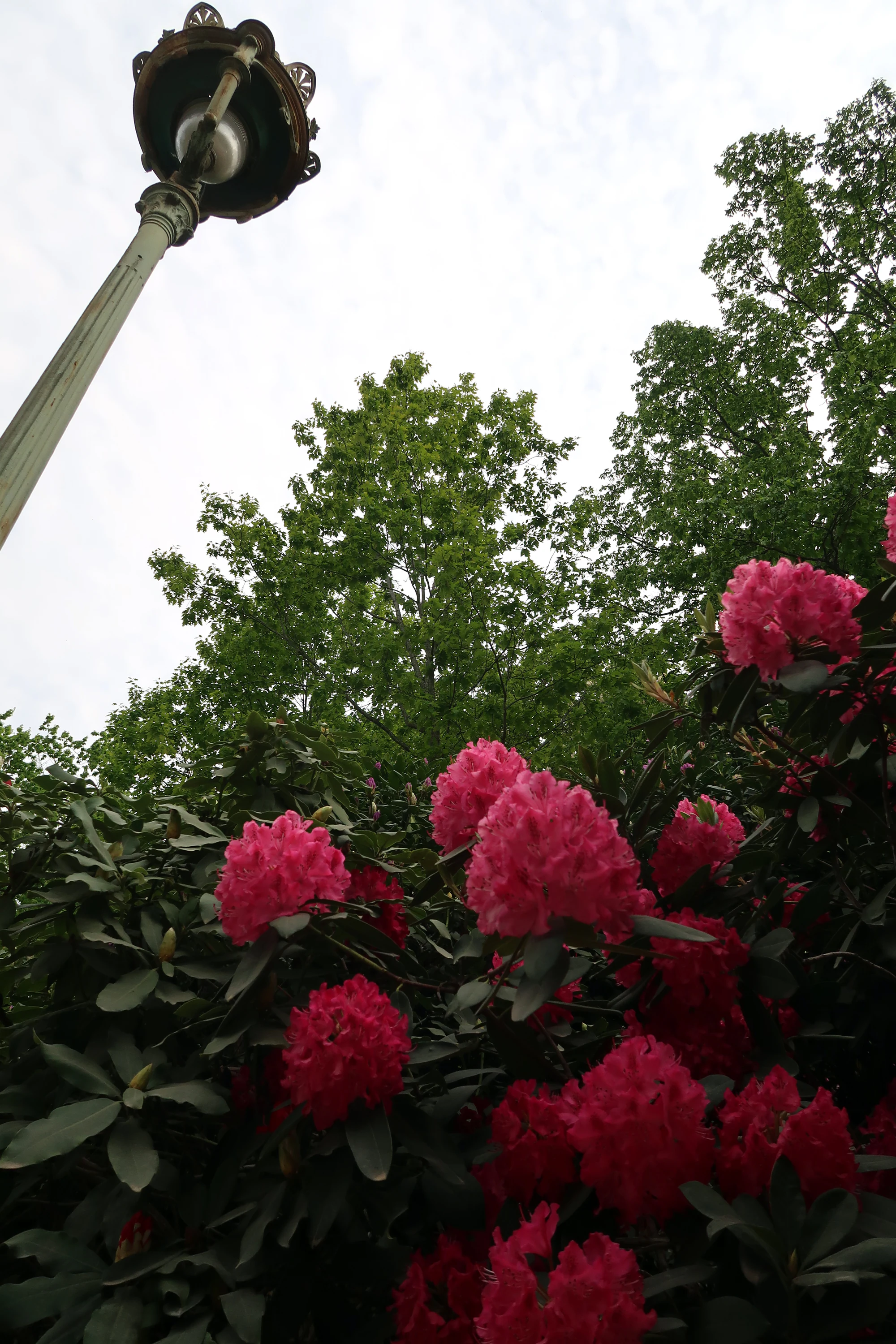
Pink flower clusters fill the lower part of an upward view, with leafy trees, an ornate lamp and pale sky above.

Spring flowers and a park lamp in Parc du Thabor, photographed on 28 April 2022.

Photograph: “Rennes - Parc du Thabor” by Fred Romero, CC BY 4.0. Original photograph unchanged. · Creative Commons

Getting there and practical advice

Opening hours and admission

Ordinary entry is free. The published daily hours are 07:30–18:30 from October through February; 07:30–20:00 in March and April; 07:30–20:30 from May through August; and 07:30–20:00 in September. Weather closures can override these hours. Check the current park listing before setting out.

Toilets, play and refreshments

The official visitor listing confirms public toilets, a children’s play area and a refreshment point near the rue de la Palestine entrance. Opening times for individual services may differ from the gates. If you need an accessible toilet, confirm its precise location and current availability before relying on it.

Metro and bus

For a straightforward city-centre approach, take metro line a or b to Sainte-Anne and walk via rue Saint-Melaine. The official guidance gives about ten minutes on foot. C5 normally serves the Thabor stop; check STAR’s journey planner and disruption information for your date.

Dated disruption: 18 October 2026

STAR’s published C5 alert lists Thabor as unserved in both directions during the Marathon Vert on Sunday 18 October, approximately 07:15–18:00. For that day, check the live network information before travelling and consider the metro approach instead.

Arriving by car or bicycle

Destination Rennes lists Kléber car park and parking at Place Saint-Melaine. Check local signs and payment conditions: paid street parking is due to expand in the Thabor district from 16 November 2026. If cycling, leave the bicycle at an appropriate parking place or push it inside the park.

Place Saint-Melaine and rue de la Palestine

These are the entrances recommended by the official visitor listing for people with reduced mobility. Use one as a clear meeting and return point. The recommendation concerns access to the park; it does not provide measured gradients or a complete wheelchair route through every collection.

Rue de Paris and the other gates

Rue de Paris is reached only by a large staircase. Other listed entrances include allée Jeanne Guillon, boulevard de la Duchesse Anne and square Lucien Rose, but the practical listing does not establish an equivalent step-free route from each. Choose the specifically recommended gates when that distinction matters.

Sources and useful links

Wildlife you might spot

4

Each card links to a full Explore page with photos, traits, and fun facts.

Snap map for this place

Start with the big picture, then zoom in to explore individual wildlife observations around this place.

Loading map…

Good to know before you go

Take a photograph of a plant label as well as its flower if you want to identify it later.

Use the permitted lawns for a break; check signs before stepping onto grass.

Keep dogs on a lead and walk bicycles or scooters through the park.

Treat the botanical labels as information, never permission to taste or pick plants.

Leave space around gardeners, newly planted beds and protected tree roots.

Carry water and a light rain layer so a café opening or passing shower does not dictate your visit.

Frequently asked questions

Yes. Destination Rennes lists the park as free. Tickets or booking conditions for an organised tour, performance or other special event are separate from ordinary entry.
Place Saint-Melaine or rue de la Palestine is the official recommendation. Avoid rue de Paris if you need to avoid steps. Check your intended internal destination separately if gradients, path surfaces or accessible toilets are important.
Choose a lawn that signs allow visitors to use. The city distinguishes accessible lawns from the protected formal section and large central lawn; an open gate does not mean every grassed area is available.
No. June is the usual peak described by the city, while weather, pruning and the particular variety affect what you will see. Keep the botanical collection and trees in your plan as well.

Recent snaps at this place

Recent snaps will appear here as new observations are added.

View all ›

Take the discovery with you

Exploring Parc du Thabor?

Identify the wildlife you spot, learn as you go, and keep a collection of the adventure.

  1. 1Spot it
  2. 2Snap it
  3. 3Keep the discovery