

'āHinahina
argyroxiphium sandwicense
The 'āHinahina, also known as the Mauna Kea or Haleakalā silversword, is an extraordinary, iconic plant endemic to the high-altitude volcanic slopes of Hawaii. This stunning member of the sunflower family grows as a dense, globe-like rosette of glittering silver leaves for decades. At the end of its life, it undergoes a spectacular transformation, sending up a massive flowering stalk up to two meters tall draped in hundreds of maroon-colored blossoms. This dramatic event occurs only once, after which the plant disperses its seeds and dies, completing its monocarpic life cycle.
Habitat: Found in alpine cinder deserts and dry subalpine shrublands on high-elevation Hawaiian volcanoes.
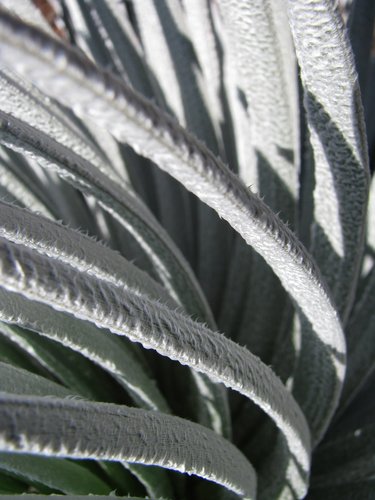
This species forms a striking, spherical rosette of rigid, sword-shaped leaves that are densely covered in woolly, silver-white hairs. The silvery sheen is highly reflective, giving the plant a metallic, almost glowing appearance against dark volcanic rock. When mature, it produces a single, towering central stalk adorned with 100 to 500 flower heads, each featuring purplish-red ray florets surrounding a yellow center.
Category
PlantsRarity
Common
Danger
1/5 · Very low
Snaps
Be the first to snap!
Its Hawaiian name, 'āHinahina, refers to its beautiful silver-gray color.
The plant's reflective leaves are so efficient that they can focus sunlight inward toward the plant's core to keep it warm in freezing alpine temperatures.
Though it can live for nearly a century, the plant flowers exactly once and dies immediately after setting its seeds.
The dense layer of silver hairs on its leaves reflects intense high-altitude ultraviolet radiation and reduces moisture loss.
A robust, shallow lateral root system combined with a strong taproot stabilizes the plant in loose, shifting volcanic cinder.
It concentrates decades of stored energy into a single, massive reproductive event to maximize pollination success before dying.
As a photosynthetic plant, it generates its own energy from sunlight, carbon dioxide, and water absorbed from the volcanic soil.
Hylaeus volcanicus
Pollinated by native Hawaiian yellow-faced bees, which assist in fertilizing the massive flower heads.
Tephritis cratericola
The larvae of this endemic fly feed on the seeds and flower heads of the silversword, reducing its reproductive yield.

Ovis aries
Introduced domestic sheep heavily browsed and decimated native populations of silverswords before exclusion fences were built.
No trait badges are assigned for this object yet.
No aliases listed yet.
Collections for this object will appear here as more themes are added.
Danger
1/5 · Very low
No special safety notes yet.
Start with the whole plant, then compare leaf arrangement, leaf edges, stems and any flowers or fruit. Opposite leaves grow in pairs; alternate leaves come one at a time along the stem. These details tell you far more together than a single green leaf does. Plant Identifier: upload a photo and compare the visible details.
30-200 cm
2-15 kg
20-90 years
As a photosynthetic plant, it generates its own energy from sunlight, carbon dioxide, and water absorbed from the volcanic soil.
Found in alpine cinder deserts and dry subalpine shrublands on high-elevation Hawaiian volcanoes.
Zoom in to split clusters and explore where this object has been snapped.
Recent snaps will appear here as new observations are added.

Hawaii, US
You might spot 'āhinahina, Kūpaoa, and Chukar.
View guide →

Hawaii, US
You might spot 'āhinahina, Jackson's Chameleon, and Sea Turtle.
View guide →

Hawaii, US
You might spot 'āhinahina, Jackson's Chameleon, and Hawaiʻi ʻamakihi.
View guide →

Hawaii, US
You might spot Māmane, Great Mullein, and Wand Mullein.
View guide →
Take the discovery with you
Snap it with Snappit to identify it, learn what makes it special, and add the discovery to your collection.