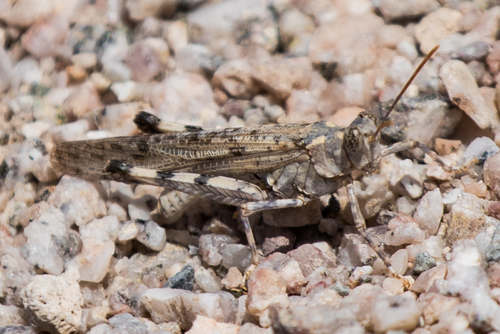


Alkali Grasshopper
anconia integra
The Alkali Grasshopper (Anconia integra) is a highly specialized insect beautifully adapted to some of North America's harshest desert environments. Thriving in barren alkali flats, salt basins, and desert sinks where few other creatures can survive, this resilient grasshopper is a testament to evolutionary adaptation. It plays an important role in its sparse desert food webs, consuming salt-tolerant vegetation and serving as a vital food source for desert birds and reptiles. With its specialized physiology, it easily manages high salinity and extreme temperatures, making it a true desert survivor whose quiet presence on sun-baked salt crusts highlights the surprising biodiversity of seemingly inhospitable landscapes.
Habitat: Typically found in arid alkali sinks, salt flats, and dry lake beds dominated by salt-tolerant halophytic vegetation.
This medium-sized grasshopper features a pale, mottled coloration that ranges from chalky white and light gray to greenish-yellow, perfectly mimicking the salt-crusted soils of its habitat. Its body is covered in fine dark speckles and blotches that break up its outline against dusty ground. It has large, prominent eyes suited for detecting predators in wide-open terrains, and its hind legs are strong and adapted for powerful leaping, though it also possesses fully developed wings for short, low-altitude flights.
Category
InsectsRarity
Common
Danger
1/5 · Very low
Snaps
2
Their pale white and gray coloration is an excellent example of substrate matching, where an animal's color perfectly matches the geological features of its home.
These grasshoppers live in environments so salty that the ground is often covered in a white crust, yet they thrive without access to fresh water.
To escape the intense desert ground heat, they climb up into the low branches of saltbushes or perform high-frequency leaps to catch cooler air currents.
Blends Corporate-level seamlessly with white alkaline crusts and dusty desert soils to remain virtually invisible to predators.
Utilizes behavioral adaptations like stilt-walking on its long legs to elevate its body above the scorching ground heat.
Specially adapted digestive system allows it to safely consume highly saline and alkaline desert plants without dehydration.
Feeds almost exclusively on halophytic (salt-loving) plants common to alkali basins.
Age differences: Nymphs and adults consume the same host plants, though nymphs target tender young shoots.
Allenrolfsea occidentalis
Feeds on the leaves and stems of this salt-tolerant desert plant.
Uta stansburiana
Preys on the grasshopper on the desert floor during the day.

Antrozous pallidus
Preys on grasshoppers and other desert insects at dusk.
No trait badges are assigned for this object yet.
No aliases listed yet.
Collections for this object will appear here as more themes are added.
Danger
1/5 · Very low
No special safety notes yet.
The easiest way to identify Alkali Grasshopper is to use the Snappit nature identifier app.
2-4 cm
4-7 cm
0.001-0.003 kg
up to 1 years
12 km/h
Feeds almost exclusively on halophytic (salt-loving) plants common to alkali basins.
Typically found in arid alkali sinks, salt flats, and dry lake beds dominated by salt-tolerant halophytic vegetation.
Zoom in to split clusters and explore where this object has been snapped.
Take the discovery with you
Snap it with Snappit to identify it, learn what makes it special, and add the discovery to your collection.













.jpg&width=800)




