





Allegheny Mountain Dusky Salamander
Desmognathus ochrophaeus
The Allegheny Mountain Dusky Salamander is a small, dark salamander that loves to live in cool, moist places. It has a smooth body and is often found near streams and under rocks in the forest.
Habitat: Forests
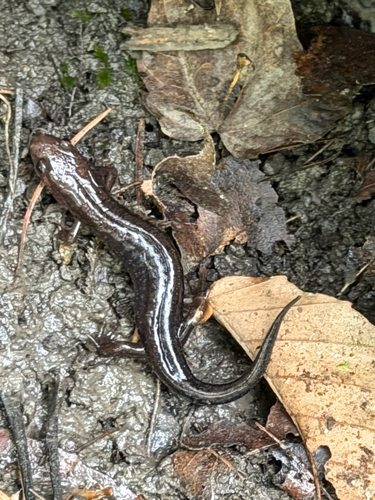
The Allegheny Mountain Dusky Salamander is a small, slender amphibian with a dark brown to black body. It often has a reddish, yellow, or orange stripe down its back, sometimes with chevron-like markings. A dark line runs from its eye to its jaw, and its belly is mottled gray.
Category
AmphibiansRarity
Common
Danger
1/5 · Very low
Snaps
8
It can regrow its tail if a predator grabs it.
It can use its strong tail as a prop to climb steep rocks!
Mom salamanders guard their eggs for weeks until they hatch!
This salamander doesn't have any lungs to breathe!
Allegheny Mountain Dusky Salamander can breathe underwater and on land by absorbing oxygen through its moist skin and mouth lining.
Allegheny Mountain Dusky Salamander can drop its tail to distract predators, allowing it to escape unharmed.
Allegheny Mountain Dusky Salamander can catch fast insects by flicking out its long, sticky tongue with amazing speed.
Allegheny Mountain Dusky Salamander has varied skin patterns that help it blend perfectly into rocky and leafy forest floors.
It munches on small insects and other tiny creatures found in the damp forest floor.
Phalangium opilio
hunts for these tiny arachnids in the damp forest leaf litter.
Thamnophis sirtalis
eaten by this common garter snake in its habitat.
.jpg&width=800)
Gyrinophilus porphyriticus
eaten by this larger, aquatic salamander species.
Sorex cinereus
eaten by this small, fast-moving mammal.
Solitary animals live alone for most of their lives, only interacting with others for mating or parental care.
This trait identifies organisms whose diet primarily consists of insects and other small invertebrates.
Thermoregulating organisms maintain a stable internal body temperature despite fluctuations in the external environment.
This habitat trait identifies species found in mountainous regions, characterized by high elevation, steep slopes, and varying climate zones.

Describes organisms that break down dead organic material, recycling nutrients back into the ecosystem.

Forest habitats are terrestrial environments dominated by dense tree cover, supporting a high diversity of plant and animal life.

Nocturnal animals are primarily active during the nighttime hours, typically resting or sleeping during the day.

Endangered status indicates a species is at a very high risk of extinction in the wild in the near future.
No aliases listed yet.
Danger
1/5 · Very low
If you see a salamander, watch it from a distance and don't touch it, as they can be delicate.
The easiest way to identify Allegheny Mountain Dusky Salamander is to use the Snappit nature identifier app.
7-12 cm
0.002-0.01 kg
5-10 years
0.5 km/h
It munches on small insects and other tiny creatures found in the damp forest floor.
Forests
Foraging
Zoom in to split clusters and explore where this object has been snapped.
May 23, 2026
Chestnut Ridge ParkPhoto attribution
no rights reserved
License: CC0 1.0 ↗
Image may be shown cropped inside the card frame.

New York, US
You might spot Allegheny Mountain Dusky Salamander.
View guide →
.jpg)
Pennsylvania, US
You might spot Admiral Butterfly and Forest Tent Caterpillar Moth.
View guide →
Ohio, US
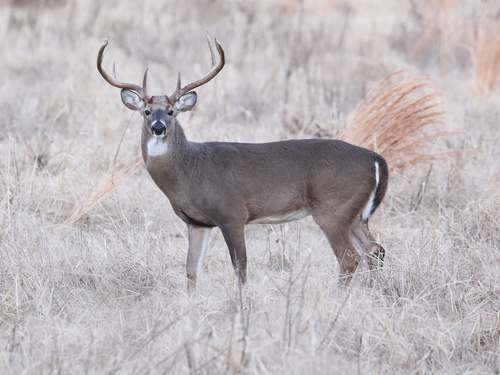
You might spot White-Tailed Deer, Mayapple, and American Beech.
View guide →

Pennsylvania, US
You might spot Steeplebush, Elk, and Eastern Newt.
View guide →

West Virginia, US
You might spot Eastern Red-Backed Salamander and Wehrle's Salamander.
View guide →

Pennsylvania, US
You might spot Elk, Ring-Necked Snake, and Timber Rattlesnake.
View guide →
Take the discovery with you
Snap it with Snappit to identify it, learn what makes it special, and add the discovery to your collection.







.JPG&width=800)


.jpg&width=800)

