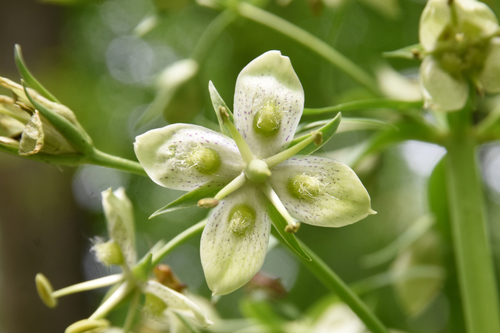


American Columbo
frasera caroliniensis
The American Columbo (Frasera caroliniensis) is one of the most spectacular and mysterious wildflowers of the eastern North American woodlands. Belonging to the gentian family, this monocarpic perennial spends the vast majority of its life as a quiet, ground-hugging rosette of large, velvety leaves, accumulating energy in its massive taproot for up to thirty years. Then, in a final, dramatic act of reproductive triumph, it sends up a towering, architectural flowering stalk that can reach over two meters in height, adorned with hundreds of intricate, pale-green blossoms. After setting seed, the entire plant dies, completing its long and patient life cycle. This synchronized blooming phenomenon, where local populations flower in unison after years of dormancy, is a breathtaking woodland event. The towering stalks stand like green sentinels in the forest understory, buzzing with diverse pollinators attracted to their unique nectar glands. For nature enthusiasts, finding a blooming colony is a rare and unforgettable highlight of the spring season.
Habitat: Typically found in dry, rocky, open deciduous woodlands, limestone glades, barrens, and steep clay slopes.
In its vegetative state, the American Columbo forms a large, striking basal rosette of smooth, lance-shaped, bluish-green leaves that can grow up to 40 centimeters long. When it transitions to bloom, it produces a stout, fleshy, upright stem reaching 100 to 250 centimeters tall. The stem leaves are arranged in whorled groups of four or five, gradually decreasing in size as they ascend. The massive flowering panicle is pyramidal, displaying dozens of star-shaped, four-petaled flowers. Each petal is a pale, yellowish-green speckled with purple dots, and features a distinctive, large, circular, fringed pit near the base that serves as a nectar gland.
Category
PlantsRarity
Common
Danger
1/5 · Very low
Snaps
Be the first to snap!
A single giant flowering stalk can produce thousands of seeds, but the plant requires perfect environmental conditions to trigger its once-in-a-lifetime bloom.
Because it can live for decades as a simple rosette, a patch of these plants may look exactly the same for twenty years before suddenly transforming into a forest of giants.
Despite its common name 'American Columbo', it is a member of the Gentian family and is not closely related to the true Colombo root plant of Africa.
Spends up to 30 years as a vegetative rosette, storing energy in a thick taproot before blooming once and dying.
Synchronizes blooming events across local populations, overwhelming seed predators with a sudden glut of seeds.
Features large, exposed glands on its petals that secrete copious nectar to attract a diverse array of pollinating insects.
As a photosynthetic plant, it generates its own energy from sunlight, water, and carbon dioxide while drawing essential minerals from the soil.
Bombus pensylvanicus
Provides abundant nectar to and is pollinated by the American Bumblebee.

Odocoileus virginianus
Leaves and young flowering stalks are sometimes grazed upon by White-tailed Deer.

Chauliognathus pensylvanicus
Small beetles like the Goldenrod Soldier Beetle feed on the nectar and assist in pollination.
No trait badges are assigned for this object yet.
No aliases listed yet.
Collections for this object will appear here as more themes are added.
Danger
1/5 · Very low
No special safety notes yet.
The easiest way to identify American Columbo is to use the Snappit nature identifier app.
100-250 cm
7-30 years
As a photosynthetic plant, it generates its own energy from sunlight, water, and carbon dioxide while drawing essential minerals from the soil.
Typically found in dry, rocky, open deciduous woodlands, limestone glades, barrens, and steep clay slopes.
Zoom in to split clusters and explore where this object has been snapped.
Recent snaps will appear here as new observations are added.
Take the discovery with you
Snap it with Snappit to identify it, learn what makes it special, and add the discovery to your collection.








.jpg&width=800)



_001.jpg&width=800)




