





Goldenrod Soldier Beetle
Chauliognathus pensylvanicus
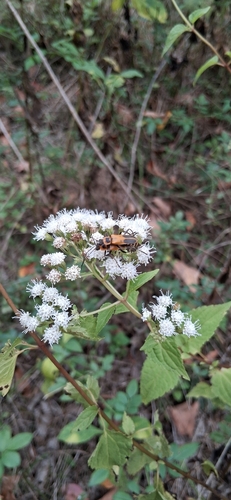
The Goldenrod Soldier Beetle is a bright orange and black insect that loves to munch on flowers. They are often found in gardens and fields, making them fun to spot while exploring nature!
Habitat: Grasslands
The Goldenrod Soldier Beetle has a soft, elongated body with a yellowish-orange head and pronotum, often featuring a black spot. Its flexible wing covers are typically yellowish-brown to reddish-brown, each with a distinctive dark spot near the tip, differing from many hard-shelled beetles.
Category
InsectsRarity
Common
Danger
1/5 · Very low
Snaps
11
Adults love to gather on goldenrod flowers, making them super easy to spot!
Baby soldier beetles (larvae) live in the soil and eat tiny slugs and insect eggs.
They're called "soldier beetles" because their wing covers resemble uniforms, not armor!
Unlike many beetles, their wing covers are soft and flexible, not hard and rigid.
Goldenrod Soldier Beetle can prey on soft-bodied insects like aphids, helping plants by controlling pest populations.
Goldenrod Soldier Beetle helps flowers reproduce by moving pollen between them as it feeds on nectar and pollen.
Goldenrod Soldier Beetle has a unique chemical defense that makes it taste bad to predators, helping it avoid being eaten.
Adults sip nectar and munch pollen from flowers, while their babies hunt tiny garden pests!
Age differences: Larvae are carnivorous, feeding on insect eggs, small slugs, and other soft-bodied invertebrates in the soil.
Solidago canadensis
Gathers nectar and pollen from its bright yellow flowers.

Aphis nerii
Larvae and adults prey on soft-bodied aphids, controlling pests.
_Misumena_vatia_male.jpg&width=800)
Misumena vatia
Can be ambushed by camouflaged spiders hiding on flowers.
Marked with parallel bands or lines of color.
Solitary animals live alone for most of their lives, only interacting with others for mating or parental care.
Colorful describes organisms or objects displaying a wide range of bright and distinct colors.
Grassland habitats are terrestrial biomes dominated by grasses and herbaceous plants, supporting a variety of grazing animals.

This trait identifies organisms whose diet primarily consists of insects and other small invertebrates.

Describes plants that are particularly attractive and beneficial to a wide range of pollinating organisms.

Diurnal animals are primarily active during daylight hours, typically resting or sleeping at night.

Describes a species whose presence and role have a disproportionately large effect on its environment.

Describes organisms that transfer pollen, enabling the fertilization and reproduction of plants.
No aliases listed yet.
Danger
1/5 · Very low
These beetles are safe to observe but don't touch them too much to keep them happy.
The easiest way to identify Goldenrod Soldier Beetle is to use the Snappit nature identifier app.
20-28 mm
10-14 mm
7-21 days
Adults sip nectar and munch pollen from flowers, while their babies hunt tiny garden pests!
Grasslands
Foraging
6
Zoom in to split clusters and explore where this object has been snapped.
Sep 26, 2025
Newbern Historic DistrictPhoto attribution
no rights reserved
License: CC0 1.0 ↗
Image may be shown cropped inside the card frame.

Illinois, US
You might spot Carolina Mantis and Goldenrod Soldier Beetle.
View guide →

Iowa, US
You might spot Common Eastern Bumble Bee and North American Luna Moth.
View guide →

Wisconsin, US
You might spot Common Eastern Bumble Bee, Monarch, and Bee.
View guide →

Wisconsin, US
You might spot Common Eastern Bumble Bee, Bee, and Monarch.
View guide →

Illinois, US
You might spot Common Milkweed and Common Eastern Bumble Bee.
View guide →

Maryland, US
You might spot Great Blue Heron, Bald Eagle, and Eastern Box Turtle.
View guide →
Take the discovery with you
Snap it with Snappit to identify it, learn what makes it special, and add the discovery to your collection.







.jpg&width=800)


